NanoMedicines Research Group, Department of Biochemistry and Molecular Biology, Life Sciences Institute, University of British Columbia, 2350 Health Sciences Mall, Vancouver, BC V6T 1Z3, Canada.
NanoMedicines Research Group, Department of Biochemistry and Molecular Biology, Life Sciences Institute, University of British Columbia, 2350 Health Sciences Mall, Vancouver, BC V6T 1Z3, Canada.
Mol Ther. 2022 Sep 7;30(9):3034-3051. doi: 10.1016/j.ymthe.2022.06.012. Epub 2022 Jun 22.
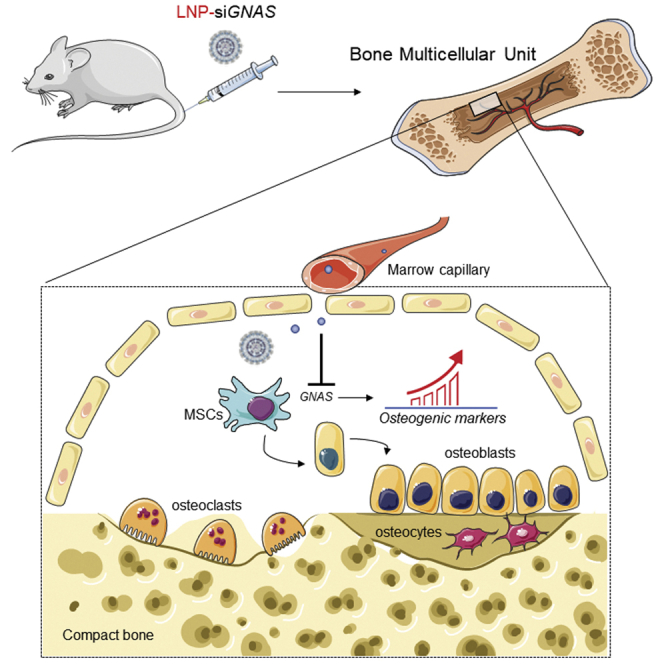
Approved drugs for the treatment of osteoporosis can prevent further bone loss but do not stimulate bone formation. Approaches that improve bone density in metabolic diseases are needed. Therapies that take advantage of the ability of mesenchymal stem cells (MSCs) to differentiate into various osteogenic lineages to treat bone disorders are of particular interest. Here we examine the ability of small interfering RNA (siRNA) to enhance osteoblast differentiation and bone formation by silencing the negative suppressor gene GNAS in bone MSCs. Using clinically validated lipid nanoparticle (LNP) siRNA delivery systems, we show that silencing the suppressor gene GNAS in vitro in MSCs leads to molecular and phenotypic changes similar to those seen in osteoblasts. Further, we demonstrate that these LNP-siRNAs can transfect a large proportion of mice MSCs in the compact bone following intravenous injection. Transfection of MSCs in various animal models led to silencing of GNAS and enhanced differentiation of MSCs into osteoblasts. These data demonstrate the potential for LNP delivery of siRNA to enhance the differentiation of MSCs into osteoblasts, and suggests that they are a promising approach for the treatment of osteoporosis and other bone diseases.
经批准用于治疗骨质疏松症的药物可以防止进一步的骨质流失,但不能刺激骨形成。需要寻找改善代谢性疾病骨密度的方法。利用间充质干细胞(MSCs)分化为各种成骨谱系的能力来治疗骨疾病的疗法特别令人感兴趣。在这里,我们研究了小干扰 RNA(siRNA)通过沉默骨 MSC 中的负抑制基因 GNAS 来增强成骨细胞分化和骨形成的能力。使用经过临床验证的脂质纳米颗粒(LNP)siRNA 递送系统,我们表明在 MSC 中体外沉默抑制基因 GNAS 会导致与成骨细胞中观察到的分子和表型变化相似。此外,我们证明这些 LNP-siRNA 可以在静脉注射后转染大量小鼠骨髓间充质干细胞。在各种动物模型中对 MSCs 的转染导致 GNAS 的沉默和 MSCs 向成骨细胞的分化增强。这些数据表明,LNP 递送 siRNA 有潜力增强 MSCs 向成骨细胞的分化,并表明它们是治疗骨质疏松症和其他骨疾病的有前途的方法。