State Key Laboratory of Veterinary Biotechnology, Harbin Veterinary Research Institute, Chinese Academy of Agricultural Sciences, Harbin, China.
Front Cell Infect Microbiol. 2022 Jun 6;12:928050. doi: 10.3389/fcimb.2022.928050. eCollection 2022.
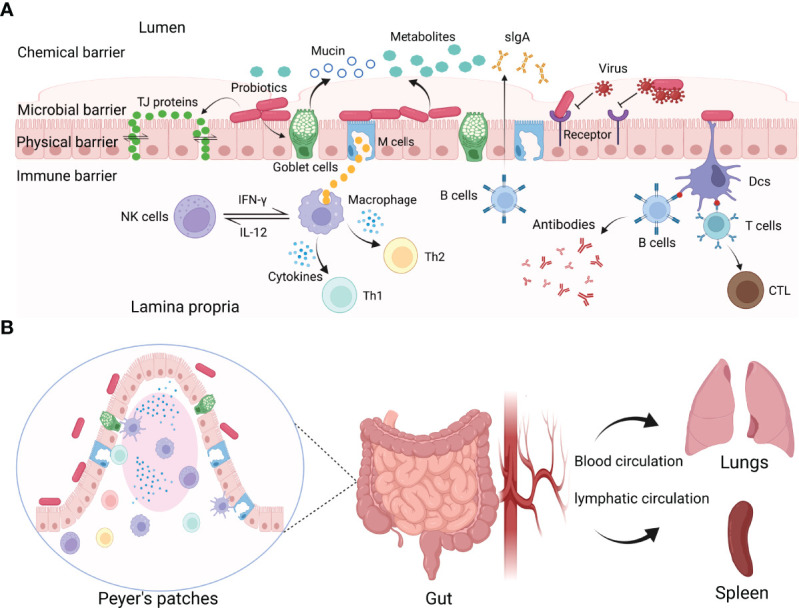
Probiotics exert a variety of beneficial effects, including maintaining homeostasis and the balance of intestinal microorganisms, activating the immune system, and regulating immune responses. Due to the beneficial effects of probiotics, a wide range of probiotics have been developed as probiotic agents for animal and human health. Viral diseases cause serious economic losses to the livestock every year and remain a great challenge for animals. Moreover, strategies for the prevention and control of viral diseases are limited. Viruses enter the host through the skin and mucosal surface, in which are colonized by hundreds of millions of microorganisms. The antiviral effects of probiotics have been proved, including modulation of chemical, microbial, physical, and immune barriers through various probiotics, probiotic metabolites, and host signaling pathways. It is of great significance yet far from enough to elucidate the antiviral mechanisms of probiotics. The major interest of this review is to discuss the antiviral effects and underlying mechanisms of probiotics and to provide targets for the development of novel antivirals.
益生菌发挥着多种有益作用,包括维持体内平衡和肠道微生物的平衡、激活免疫系统以及调节免疫反应。由于益生菌的有益作用,已经开发出了广泛的益生菌作为动物和人类健康的益生菌制剂。病毒性疾病每年都会给畜牧业造成严重的经济损失,仍然是动物健康的一大挑战。此外,预防和控制病毒性疾病的策略有限。病毒通过皮肤和黏膜表面进入宿主,在那里被数亿微生物定植。已经证明了益生菌具有抗病毒作用,包括通过各种益生菌、益生菌代谢物和宿主信号通路来调节化学、微生物、物理和免疫屏障。阐明益生菌的抗病毒机制具有重要意义,但还远远不够。本综述的主要目的是讨论益生菌的抗病毒作用及其潜在机制,并为新型抗病毒药物的开发提供靶点。