Kaloustian Marc Krikor, Hachem Claire El, Zogheib Carla, Nehme Walid, Hardan Louis, Rached Pamela, Kharouf Naji, Haikel Youssef, Mancino Davide
Department of Endodontics, Faculty of Dentistry, Saint Joseph University, Beirut 1107 2180, Lebanon.
Department of Pediatric Dentistry, Faculty of Dentistry, Saint Joseph University, Beirut 1107 2180, Lebanon.
Bioengineering (Basel). 2022 Jun 19;9(6):260. doi: 10.3390/bioengineering9060260.
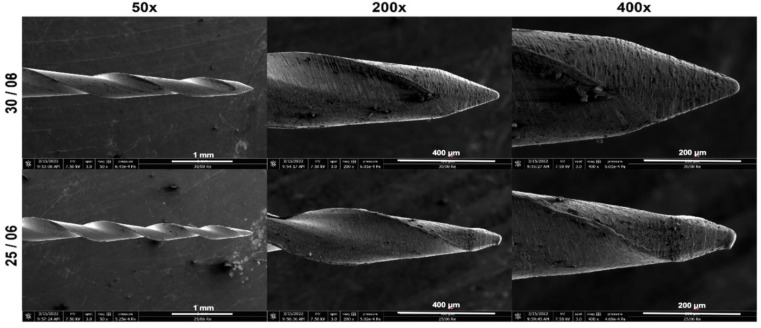
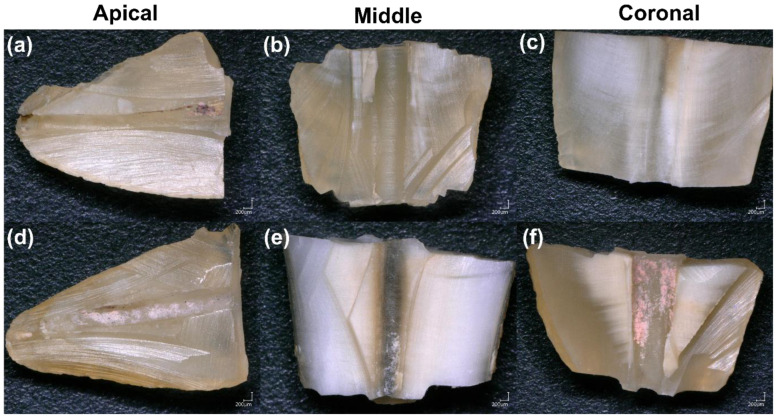
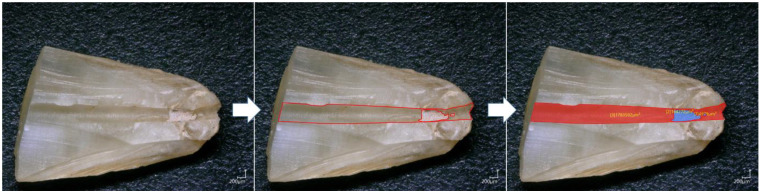
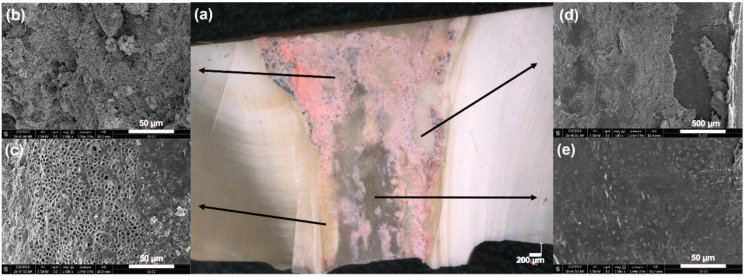
This study aimed to evaluate the effectiveness of the Endostar REvision system (Poldent, Warsaw, Poland) in the removal of filling materials from oval root canals using sonic irrigation as an additional cleaning method. Thirty human-extracted mandibular premolars with oval canals were prepared using the ProTaper Universal system (Dentsply Maillefer, Ballaigues, Switzerland) up to instrument F1 (20/.07), and then filled by the continuous wave vertical compaction technique using pulp canal sealer EWT (Sybron Dental Specialties, Orange, CA, USA). The teeth were randomly divided into two groups (n = 15) according to the instrumentation system and the additional cleaning method, as follows: REvision (30/.08, 25/.06) with EQ-S sonic activation (Meta Biomed, Chungcheongbuk-do, Korea), REvision (30/.08, 25/.06) without additional activation. All specimens were sectioned longitudinally at 3 and 7 mm from the apex, and analyzed using digital microscopy (KEYENCE, Osaka, Japan) to measure the total area of the residual obturation materials, followed by SEM analysis. The data on the percentage of remaining filling material were analyzed by Kruskal−Wallis one-way Analysis of Variance on ranks. None of the retreatment protocols completely removed the filling material from the root canals (p > 0.05); the retreatment technique using sonic activation showed statistically less residual filling materials than the retreatment technique using irrigants without activation at the coronal third (p < 0.05), whilst no significant difference was found between both tested groups at the apical and middle thirds (p > 0.05). The REvision system showed promising results in the removal of filling materials from oval canals.
本研究旨在评估Endostar REvision系统(波兰华沙的Poldent公司)在使用声波冲洗作为辅助清洁方法时,从椭圆形根管中去除充填材料的效果。选取30颗带有椭圆形根管的人下颌前磨牙,使用ProTaper Universal系统(瑞士Ballaigues的登士柏迈福公司)预备至F1器械(20/.07),然后采用连续波垂直加压技术,使用牙髓根管封闭剂EWT(美国加利福尼亚州奥兰治的Sybron Dental Specialties公司)进行充填。根据器械预备系统和辅助清洁方法,将牙齿随机分为两组(n = 15),如下:使用EQ-S声波激活器(韩国忠清北道的Meta Biomed公司)的REvision系统(30/.08,25/.06);未进行额外激活的REvision系统(30/.08,25/.06)。所有标本均从根尖开始在3 mm和7 mm处纵向切片,使用数码显微镜(日本大阪的基恩士公司)进行分析,以测量残留充填材料的总面积,随后进行扫描电镜分析。采用Kruskal-Wallis单向秩和方差分析对剩余充填材料百分比的数据进行分析。所有再治疗方案均未完全从根管中去除充填材料(p > 0.05);使用声波激活的再治疗技术在冠方三分之一处显示出统计学上比未激活冲洗液的再治疗技术残留充填材料更少(p < 0.05),而在根尖和中间三分之一处,两组之间未发现显著差异(p > 0.05)。REvision系统在从椭圆形根管中去除充填材料方面显示出有前景的结果。