Fyllas Nikolaos M, Koufaki Theano, Sazeides Christodoulos I, Spyroglou Gavriil, Theodorou Konstantinos
Biodiversity Conservation Laboratory, Department of Environment, University of the Aegean, 81100 Mytilene, Greece.
Forest Research Institute, Hellenic Agricultural Organisation "Demeter", 57006 Thessaloniki, Greece.
Plants (Basel). 2022 Jun 20;11(12):1616. doi: 10.3390/plants11121616.
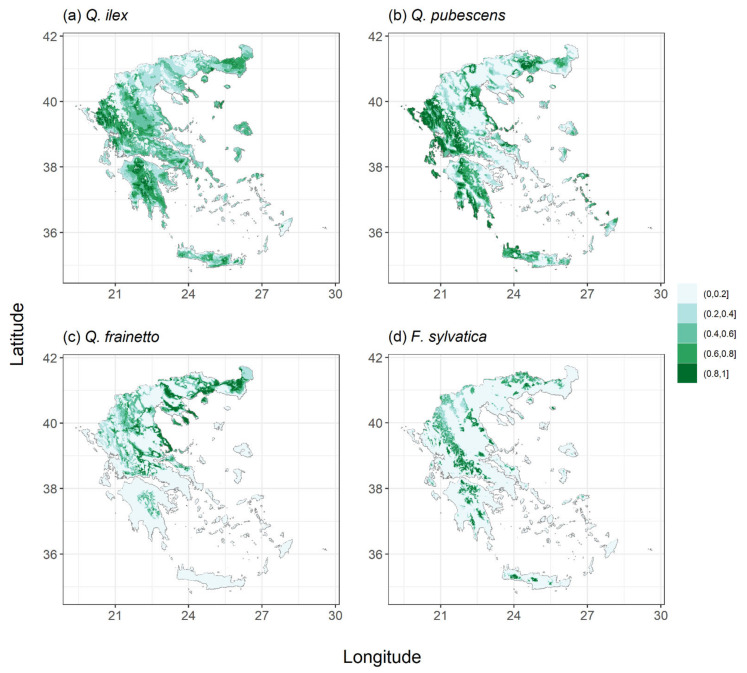
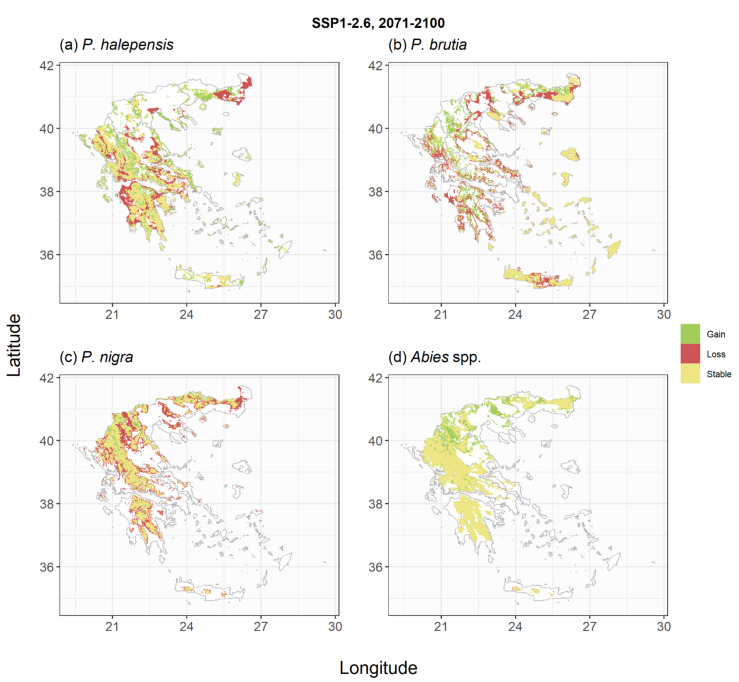
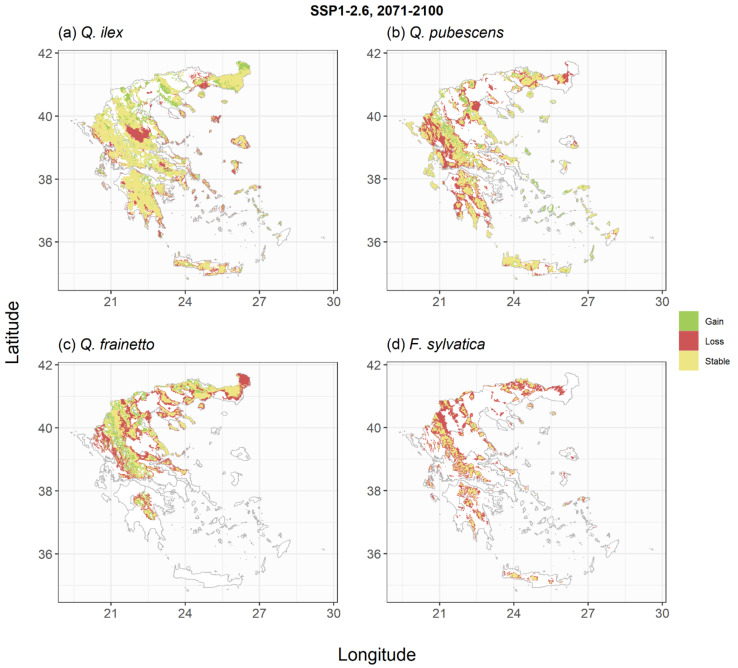
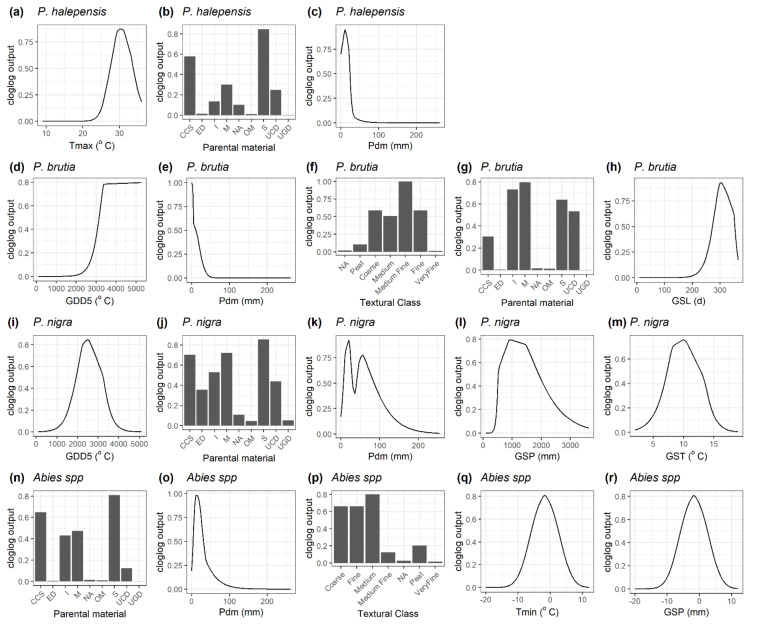
Climate change is affecting species distribution and ecosystem form and function. Forests provide a range of ecosystem services, and understanding their vulnerability to climate change is important for designing effective adaptation strategies. Species Distribution Modelling (SDM) has been extensively used to derive habitat suitability maps under current conditions and project species distribution shifts under climate change. In this study, we model the current and future habitat suitability of the dominant tree species in Greece (, , , , , , , and ), based on species-specific presence data from the EU-Forest database, enhanced with data from Greece that is currently under-represented in terms of tree species occurrence points. By including these additional presence data, areas with relatively drier conditions for some of the study species were included in the SDM development, yielding a potentially lower vulnerability under climate change conditions. SDMs were developed for each taxon using climate and soil data at a resolution of ~1 km. Model performance was assessed under current conditions and was found to adequately simulate potential distributions. Subsequently, the models were used to project the potential distribution of each species under the SSP1-2.6 and SSP5-8.5 scenarios for the 2041-2070 and 2071-2100 time periods. Under climate change scenarios, a reduction in habitat-suitable areas was predicted for most study species, with higher elevation taxa experiencing more pronounced potential habitat shrinkages. An exception was the endemic and its sister species , which, although currently found at mid and high elevations, seem able to maintain their potential distribution under most climate change scenarios. Our findings suggest that climate change could significantly affect the distribution and dynamics of forest ecosystems in Greece, with important ecological, economic and social implications, and thus adequate mitigation measures should be implemented.
气候变化正在影响物种分布以及生态系统的形态和功能。森林提供一系列生态系统服务,了解其对气候变化的脆弱性对于设计有效的适应策略至关重要。物种分布模型(SDM)已被广泛用于绘制当前条件下的栖息地适宜性地图,并预测气候变化下物种分布的变化。在本研究中,我们基于欧盟森林数据库中特定物种的存在数据,并结合希腊目前在树种出现点方面代表性不足的数据,对希腊的优势树种(、、、、、、、和)的当前和未来栖息地适宜性进行建模。通过纳入这些额外的存在数据,一些研究物种相对干燥条件的区域被纳入SDM开发中,从而在气候变化条件下可能降低脆弱性。使用分辨率约为1公里的气候和土壤数据为每个分类单元开发SDM。在当前条件下评估模型性能,发现其能充分模拟潜在分布。随后,利用这些模型预测2041 - 2070年和2071 - 2100年期间在SSP1 - 2.6和SSP5 - 8.5情景下每个物种的潜在分布。在气候变化情景下,预计大多数研究物种的适宜栖息地面积会减少,海拔较高的分类单元潜在栖息地收缩更为明显。一个例外是特有种及其姊妹种,尽管它们目前分布在中高海拔地区,但在大多数气候变化情景下似乎能够维持其潜在分布。我们的研究结果表明,气候变化可能会显著影响希腊森林生态系统的分布和动态,具有重要的生态、经济和社会影响,因此应实施适当的缓解措施。