Central Research Laboratories, Sysmex Corporation, Kobe, Japan.
Business Incubation Division, Sysmex Corporation, Kobe, Japan.
Alzheimers Res Ther. 2022 Jun 23;14(1):86. doi: 10.1186/s13195-022-01029-0.
Clinicians, researchers, and patients alike would greatly benefit from more accessible and inexpensive biomarkers for neural β-amyloid (Aβ). We aimed to assess the performance of fully automated plasma Aβ immunoassays, which correlate significantly with immunoprecipitation mass spectrometry assays, in predicting brain Aβ status as determined by visual read assessment of amyloid positron emission tomography (PET).
The plasma Aβ42/Aβ40 ratio was measured using a fully automated immunoassay platform (HISCL series) in two clinical studies (discovery and validation studies). The discovery and validation sample sets were retrospectively and randomly selected from participants with early Alzheimer's disease (AD) identified during screening for the elenbecestat Phase 3 program.
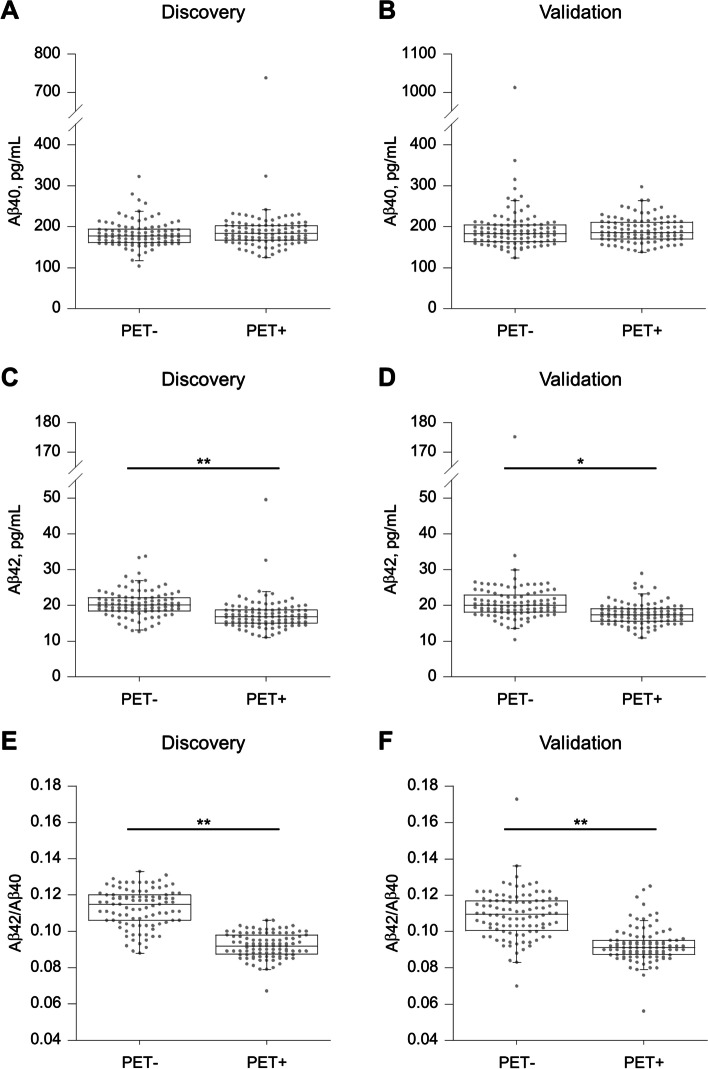
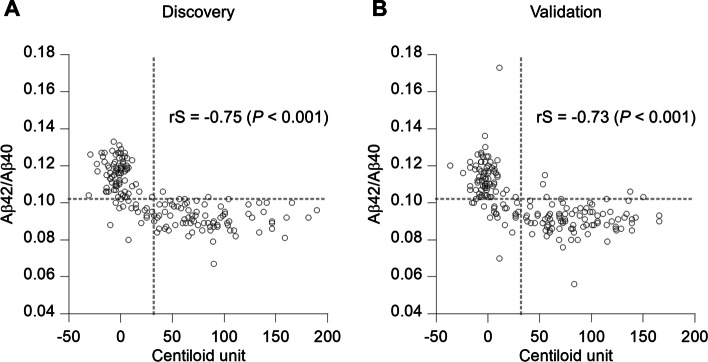
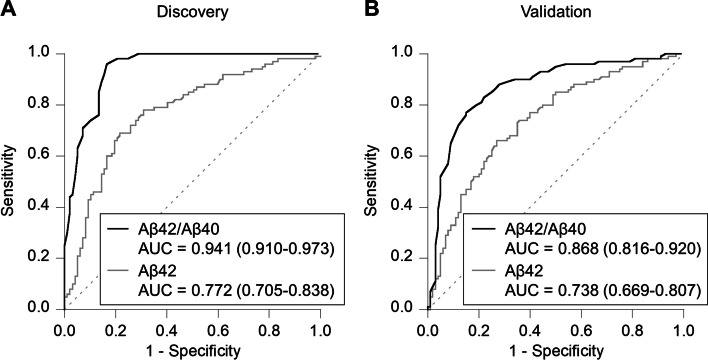
We included 197 participants in the discovery study (mean [SD] age 71.1 [8.5] years; 112 females) and 200 in the validation study (age 70.8 [7.9] years; 99 females). The plasma Aβ42/Aβ40 ratio predicted amyloid PET visual read status with areas under the receiver operating characteristic curves of 0.941 (95% confidence interval [CI] 0.910-0.973) and 0.868 (95% CI 0.816-0.920) in the discovery and validation studies, respectively. In the discovery study, a cutoff value of 0.102 was determined based on maximizing the Youden Index, and the sensitivity and specificity were calculated to be 96.0% (95% CI 90.1-98.9%) and 83.5% (95% CI 74.6-90.3%), respectively. Using the same cutoff value, the sensitivity and specificity in the validation study were calculated to be 88.0% (95% CI 80.0-93.6%) and 72.0% (95% CI 62.1-80.5%), respectively.
The plasma Aβ42/Aβ40 ratio measured using the HISCL series achieved high accuracy in predicting amyloid PET status. Since our blood-based immunoassay system is less invasive and more accessible than amyloid PET and cerebrospinal fluid testing, it may contribute to the diagnosis of AD in routine clinical practice.
临床医生、研究人员和患者都将从更易于获得和更经济的神经β-淀粉样蛋白(Aβ)生物标志物中获益匪浅。我们旨在评估与免疫沉淀质谱分析显著相关的全自动血浆 Aβ 免疫分析在预测脑 Aβ 状态方面的性能,这种免疫分析是通过对淀粉样蛋白正电子发射断层扫描(PET)进行视觉读值评估来确定的。
在两项临床研究(发现研究和验证研究)中,使用全自动免疫分析平台(HISCL 系列)测量血浆 Aβ42/Aβ40 比值。发现和验证样本集是从筛选出的参加elenbecestat 三期计划的早期阿尔茨海默病(AD)参与者中回顾性和随机选择的。
我们纳入了 197 名发现研究参与者(平均[标准差]年龄 71.1[8.5]岁;112 名女性)和 200 名验证研究参与者(年龄 70.8[7.9]岁;99 名女性)。血浆 Aβ42/Aβ40 比值对淀粉样蛋白 PET 视觉读值状态的预测,其在发现研究和验证研究中的受试者工作特征曲线下面积分别为 0.941(95%置信区间[CI]0.910-0.973)和 0.868(95% CI 0.816-0.920)。在发现研究中,基于最大化 Youden 指数,确定了 0.102 的截断值,计算出的敏感性和特异性分别为 96.0%(95% CI 90.1-98.9%)和 83.5%(95% CI 74.6-90.3%)。使用相同的截断值,验证研究中的敏感性和特异性分别计算为 88.0%(95% CI 80.0-93.6%)和 72.0%(95% CI 62.1-80.5%)。
使用 HISCL 系列测量的血浆 Aβ42/Aβ40 比值在预测淀粉样蛋白 PET 状态方面具有很高的准确性。由于我们的血液免疫分析系统比淀粉样蛋白 PET 和脑脊液检测更具侵入性和更易获得,因此它可能有助于在常规临床实践中诊断 AD。