Kong Amanda Shen-Yee, Lai Kok Song, Hee Cheng-Wan, Loh Jiun Yan, Lim Swee Hua Erin, Sathiya Maran
School of Pharmacy, Monash University Malaysia, Jalan Lagoon Selatan, Bandar Sunway, Subang Jaya 47500, Malaysia.
Health Sciences Division, Abu Dhabi Women's College, Higher Colleges of Technology, Abu Dhabi 41012, United Arab Emirates.
Antioxidants (Basel). 2022 Jun 15;11(6):1175. doi: 10.3390/antiox11061175.
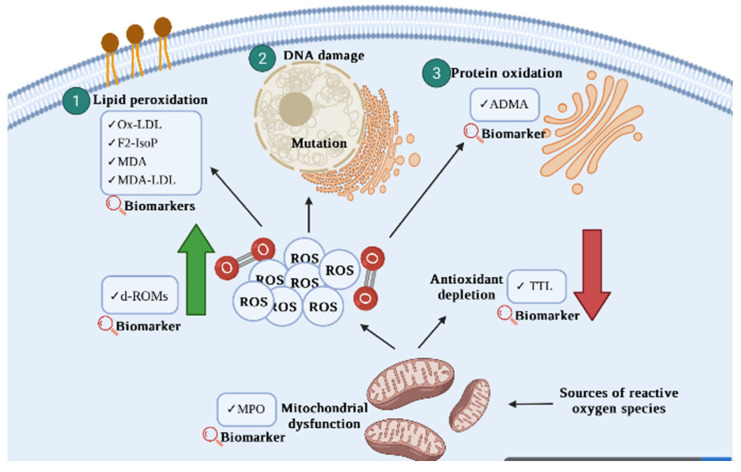
Cardiovascular disease (CVD) remains the leading cause of death globally, with unhealthy lifestyles today greatly increasing the risk. Over the decades, scientific investigation has been carried out on reactive oxygen species (ROS) and their resultant oxidative stress based on their changes made on biological targets such as lipids, proteins, and DNA. Since the existing clinical studies with antioxidants failed to provide relevant findings on CVD prediction, the focus has shifted towards recognition of oxidised targets as biomarkers to predict prognosis and response to accurate treatment. The identification of redox markers could help clinicians in providing risk stratification for CVD events beyond the traditional prognostic and diagnostic targets. This review will focus on how oxidant-related parameters can be applied as biomarkers for CVD based on recent clinical evidence.
心血管疾病(CVD)仍然是全球主要的死亡原因,如今不健康的生活方式大大增加了患病风险。几十年来,基于活性氧(ROS)及其产生的氧化应激对脂质、蛋白质和DNA等生物靶点的影响,人们开展了相关科学研究。由于现有的抗氧化剂临床研究未能提供有关心血管疾病预测的相关结果,因此重点已转向将氧化靶点识别为生物标志物,以预测预后和对精确治疗的反应。氧化还原标志物的识别有助于临床医生在传统预后和诊断靶点之外,为心血管疾病事件提供风险分层。本综述将基于近期临床证据,重点探讨与氧化剂相关的参数如何用作心血管疾病的生物标志物。