Ni Lijia, Zhang Zhixian, Shen Rui, Liu Xiaoqiang, Li Xuexue, Chen Baiji, Wu Xiquan, Li Hongyu, Xie Xiaoying, Huang Songyin
Department of Clinical Laboratory, Sun Yat-sen Memorial Hospital, Sun Yat-sen University, Guangzhou 510120, China.
Guangdong Provincial Key Laboratory of Malignant Tumor Epigenetics and Gene Regulation, Sun Yat-sen Memorial Hospital, Sun Yat-sen University, Guangzhou 510120, China.
Antibiotics (Basel). 2022 May 30;11(6):736. doi: 10.3390/antibiotics11060736.
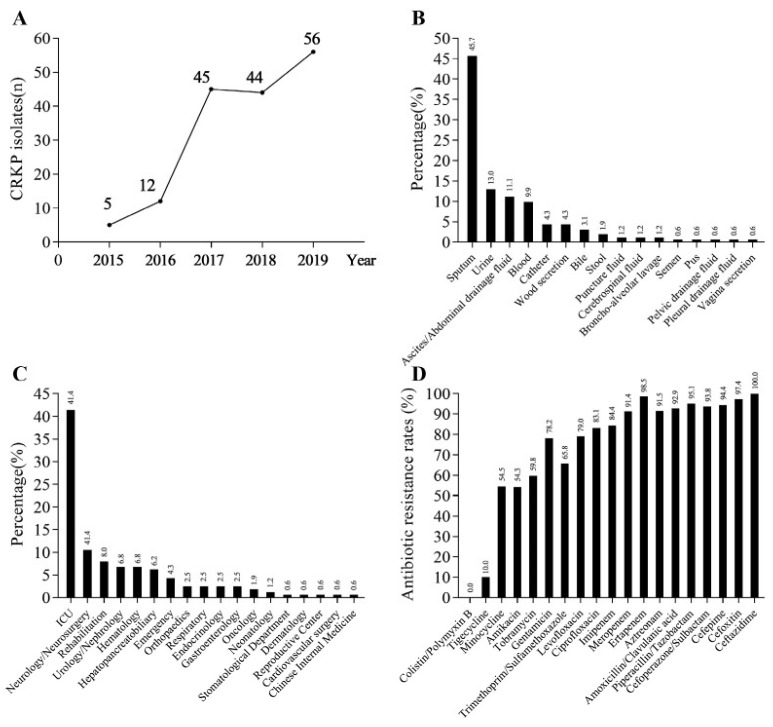
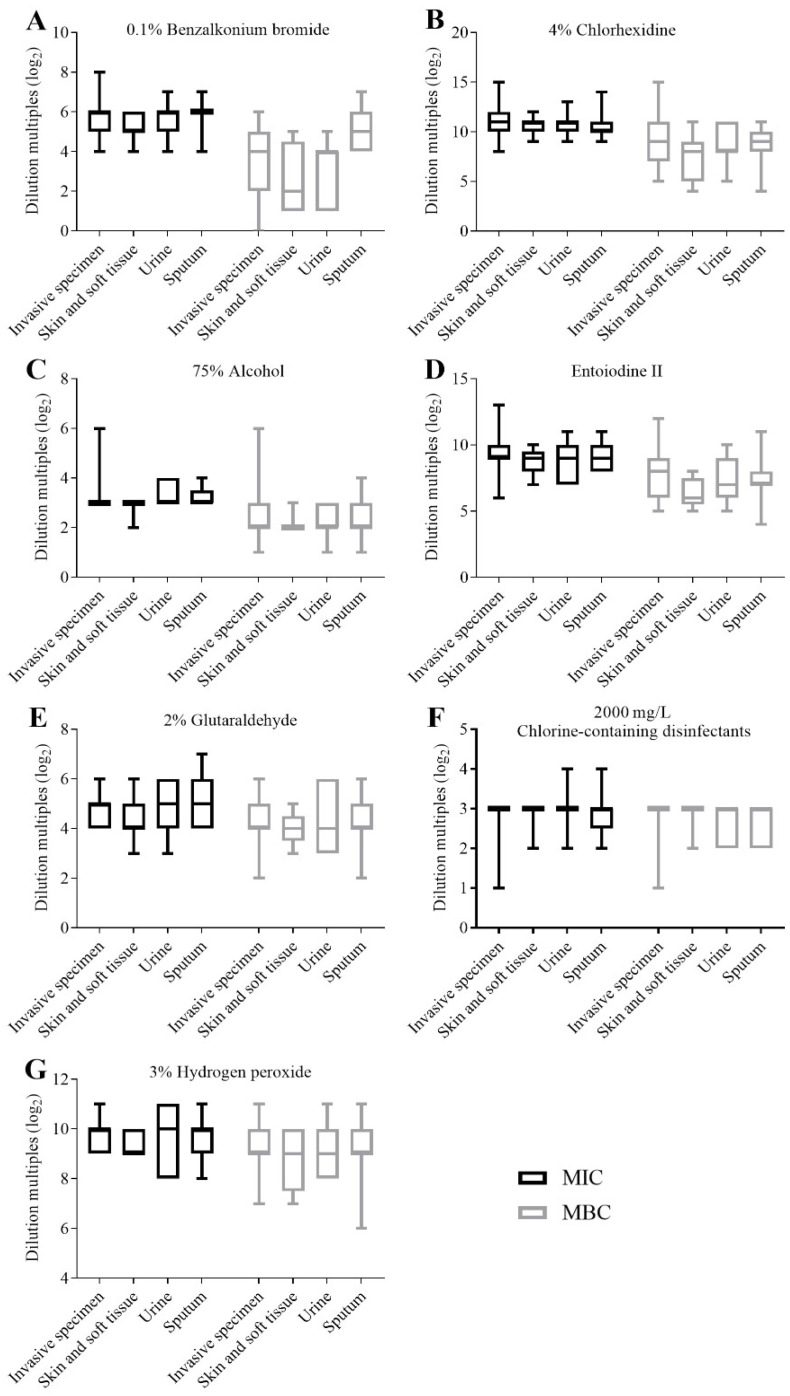
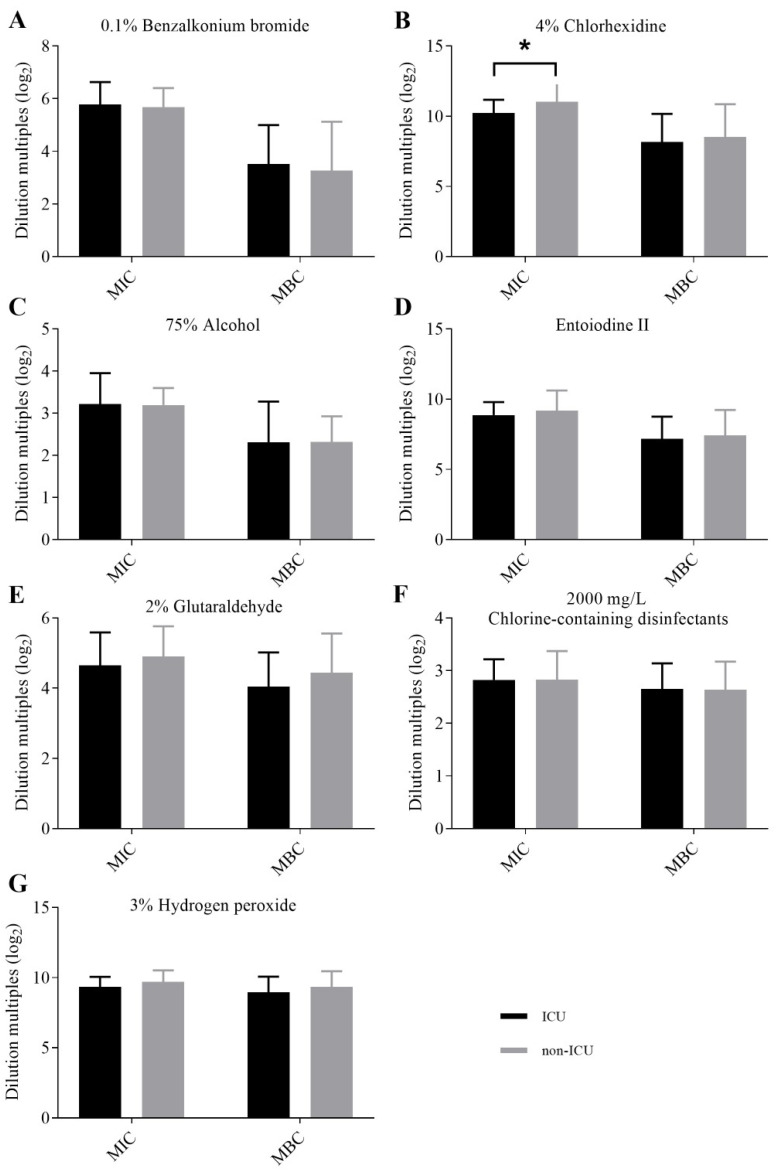
Disinfectant resistance is evolving into a serious problem due to the long-term and extensive use of disinfectants, which brings great challenges to hospital infection control. As a notorious multidrug-resistant bacterium, carbapenem-resistant Klebsiella pneumoniae (CRKP) is one of the most common and difficult pathogens of nosocomial infection. The minimum inhibitory concentration (MIC) and minimum bactericidal concentration (MBC) tests of seven kinds of disinfectants (0.1% benzalkonium bromide, 4% aqueous chlorhexidine, 75% alcohol, entoiodine II, 2% glutaraldehyde, 2000 mg/L chlorine-containing disinfectants, and 3% hydrogen peroxide) were detected by the broth dilution method. Three efflux pump genes (oqxA, oqxB, and qacE∆1-sul1) were detected by PCR. The mean MIC value of aqueous chlorhexidine from the intensive care unit (ICU) (0.0034%) was significantly higher than that from non-ICUs (0.0019%) (p < 0.05). The positive rates of three efflux pump genes oqxA, oqxB and qacE∆1-sul1 were 60.9% (39/64), 17.2% (11/64) and 71.9% (46/64) in the detected CRKP isolates, respectively. This study discovered that CRKP strains demonstrated extensive resistance to clinical disinfectants and suggest that it is necessary to perform corresponding increases in the concentration of aqueous chlorhexidine and chlorine-containing disinfectants on the basis of current standards in the healthcare industry.
由于消毒剂的长期广泛使用,消毒剂耐药性正演变成一个严重问题,这给医院感染控制带来了巨大挑战。作为一种臭名昭著的多重耐药菌,耐碳青霉烯类肺炎克雷伯菌(CRKP)是医院感染最常见且最难对付的病原体之一。采用肉汤稀释法检测了七种消毒剂(0.1%苯扎溴铵、4%氯己定水溶液、75%酒精、碘伏II、2%戊二醛、2000 mg/L含氯消毒剂和3%过氧化氢)的最低抑菌浓度(MIC)和最低杀菌浓度(MBC)。通过PCR检测三个外排泵基因(oqxA、oqxB和qacE∆1-sul1)。重症监护病房(ICU)氯己定水溶液的平均MIC值(0.0034%)显著高于非ICU(0.0019%)(p<0.05)。在检测的CRKP分离株中,三个外排泵基因oqxA、oqxB和qacE∆1-sul1的阳性率分别为60.9%(39/64)、17.2%(11/64)和71.9%(46/64)。本研究发现CRKP菌株对临床消毒剂表现出广泛耐药性,并建议在医疗行业现行标准的基础上,有必要相应提高氯己定水溶液和含氯消毒剂的浓度。