Unidad de Investigación en Reproducción Humana, Instituto Nacional de Perinatología-Facultad de Química, Universidad Nacional Autónoma de México, Ciudad de México C.P. 0451, Mexico.
Cells. 2022 Jun 18;11(12):1964. doi: 10.3390/cells11121964.
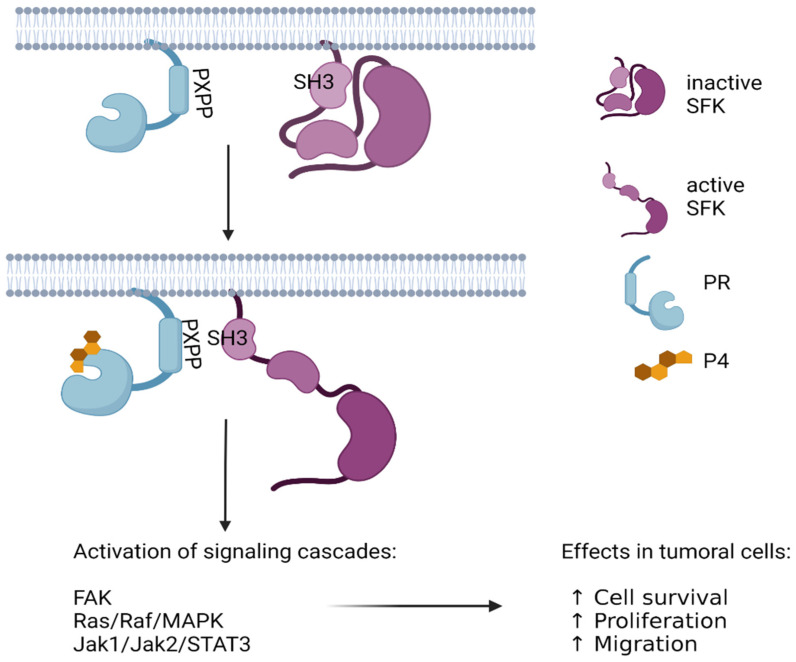
The nuclear progesterone receptor (PR) is mainly known for its role as a ligand-regulated transcription factor. However, in the last ten years, this receptor's extranuclear or rapid actions have gained importance in the context of physiological and pathophysiological conditions such as cancer. The PR's polyproline (PXPP) motif allows protein-protein interaction through SH3 domains of several cytoplasmatic proteins, including the Src family kinases (SFKs). Among members of this family, cSrc is the most well-characterized protein in the scenario of rapid actions of the PR in cancer. Studies in breast cancer have provided the most detailed information on the signaling and effects triggered by the cSrc-PR interaction. Nevertheless, the study of this phenomenon and its consequences has been underestimated in other types of malignancies, especially those not associated with the reproductive system, such as glioblastomas (GBs). This review will provide a detailed analysis of the impact of the PR-cSrc interplay in the progression of some non-reproductive cancers, particularly, in GBs.
核孕激素受体(PR)主要作为配体调节转录因子发挥作用。然而,在过去十年中,这种受体的核外或快速作用在癌症等生理和病理生理条件下变得越来越重要。PR 的多脯氨酸(PXPP)基序允许通过包括Src 家族激酶(SFKs)在内的几种细胞质蛋白的 SH3 结构域进行蛋白质-蛋白质相互作用。在该家族成员中,cSrc 是 PR 在癌症中快速作用的情况下研究最充分的蛋白质。在乳腺癌中的研究为 cSrc-PR 相互作用触发的信号转导和效应提供了最详细的信息。然而,在其他类型的恶性肿瘤中,特别是与生殖系统无关的恶性肿瘤(如神经胶质瘤(GBs))中,对这种现象及其后果的研究被低估了。本综述将详细分析 PR-cSrc 相互作用对某些非生殖系统癌症(特别是神经胶质瘤)进展的影响。