Interdisciplinary BioMedical Group on Artificial Intelligence IBMAI, School of Emergency Medicine, Department MeSVA, University of L'Aquila, 67100 L'Aquila, Italy.
Int J Environ Res Public Health. 2022 Jun 9;19(12):7103. doi: 10.3390/ijerph19127103.
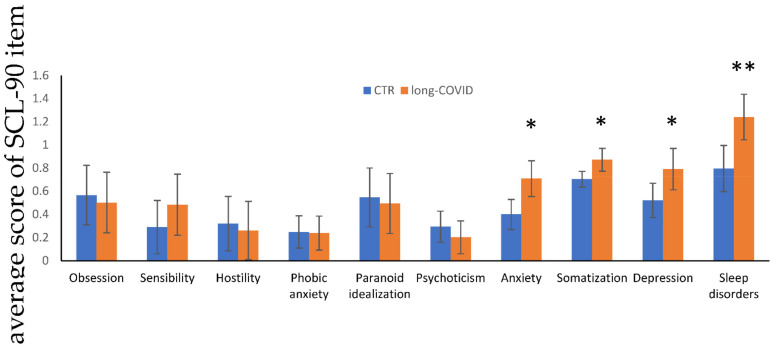
The aim of our study is to evaluate the correlation between the psychological status of patients recovered from SARS-CoV-2 (Severe Acute Respiratory Syndrome Coronavirus 2) infection (long-COVID patients) and their inflammatory status. Three months after hospital discharge, ninety-three patients were recruited and categorized into two distinct populations: control and long-COVID (COrona VIrus Disease) group. Patients belonging to the control group presented with an entering diagnosis of cardiovascular, metabolic, or respiratory disease and a negative history of SARS-CoV-2 infection, whereas the long-COVID population presented with a severe SARS-CoV-2 infection treated in the sub-intensive Care Unit. Psychological evaluation was performed through the administration of the Symptom Checklist-90 (SCL90) and LDH (Lactate dehydrogenase), ferritin, CRPhs (C-high sensitivity Reactive Protein), NLR (Neutrophil-to-lymphocyte ratio), PLR (Platelet-to-lymphocyte ratio), and SII (systemic immune-inflammation index) were investigated. We highlighted that beyond the first three months after contagion, patients recovered from SARS-CoV-2 infection are characterized by the persistence of a systemic inflammatory state and are at high risk for developing somatization, depression, anxiety, and sleep disturbances. Interestingly, ferritin value was strongly correlated with sleep disorders (p < 0.05). Our study emphasizes how COVID-19 strategies for risk stratification, prognosis, and therapy management of patients should be implemented with a psychological follow-up.
我们的研究目的是评估 SARS-CoV-2(严重急性呼吸综合征冠状病毒 2)感染后康复患者(长新冠患者)的心理状态与其炎症状态之间的相关性。在出院后三个月,招募了 93 名患者,并将其分为两个不同的群体:对照组和长新冠(COrona VIrus Disease)组。对照组患者的入院诊断为心血管、代谢或呼吸系统疾病,且无 SARS-CoV-2 感染史,而长新冠组患者则患有严重的 SARS-CoV-2 感染,在亚重症监护病房接受治疗。通过症状清单-90(SCL90)和乳酸脱氢酶(LDH)、铁蛋白、C 反应蛋白(CRPhs)、中性粒细胞与淋巴细胞比值(NLR)、血小板与淋巴细胞比值(PLR)和系统性免疫炎症指数(SII)来进行心理评估。我们发现,在感染后的头三个月之后,从 SARS-CoV-2 感染中康复的患者仍然存在系统性炎症状态,并且存在躯体化、抑郁、焦虑和睡眠障碍的高风险。有趣的是,铁蛋白值与睡眠障碍强烈相关(p < 0.05)。我们的研究强调了 COVID-19 患者的风险分层、预后和治疗管理策略应如何实施心理随访。