Massafra Raffaella, Comes Maria Colomba, Bove Samantha, Didonna Vittorio, Gatta Gianluca, Giotta Francesco, Fanizzi Annarita, La Forgia Daniele, Latorre Agnese, Pastena Maria Irene, Pomarico Domenico, Rinaldi Lucia, Tamborra Pasquale, Zito Alfredo, Lorusso Vito, Paradiso Angelo Virgilio
Struttura Semplice Dipartimentale di Fisica Sanitaria, I.R.C.C.S. Istituto Tumori "Giovanni Paolo II", Viale Orazio Flacco 65, 70124 Bari, Italy.
Dipartimento di Medicina di Precisione Università della Campania "Luigi Vanvitelli", 80131 Naples, Italy.
J Pers Med. 2022 Jun 10;12(6):953. doi: 10.3390/jpm12060953.
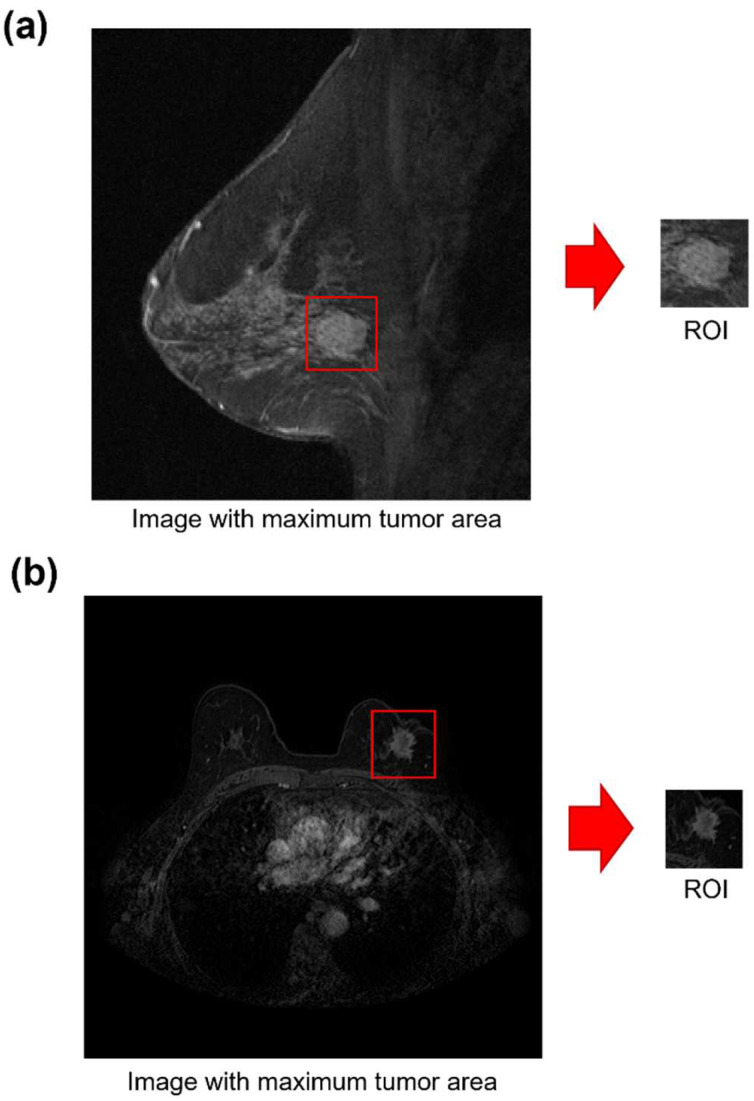
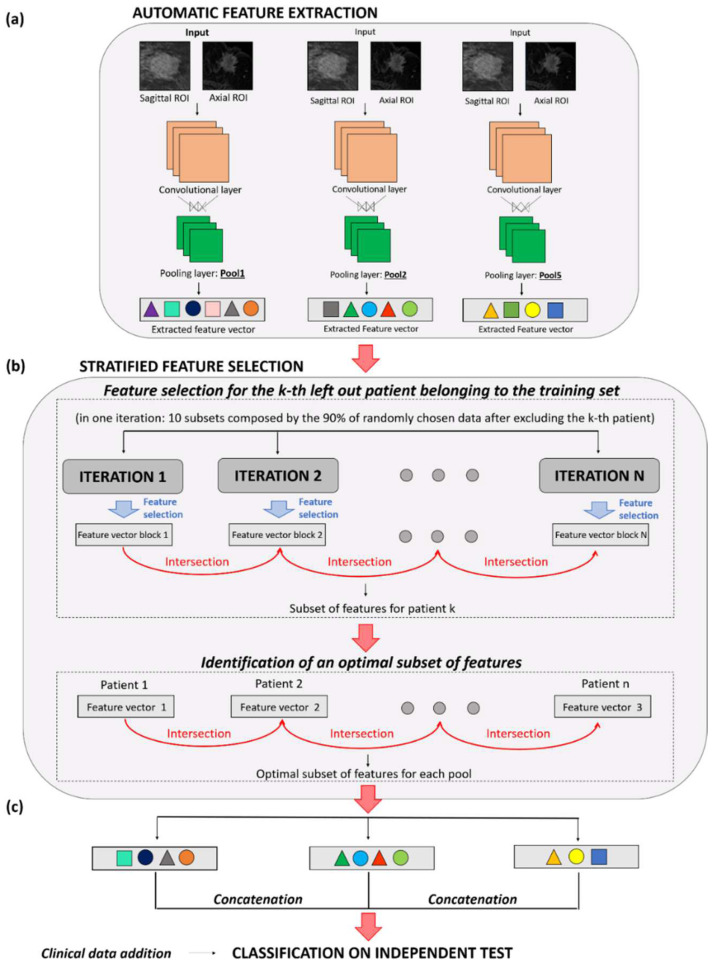
To date, some artificial intelligence (AI) methods have exploited Dynamic Contrast-Enhanced Magnetic Resonance Imaging (DCE-MRI) to identify finer tumor properties as potential earlier indicators of pathological Complete Response (pCR) in breast cancer patients undergoing neoadjuvant chemotherapy (NAC). However, they work either for sagittal or axial MRI protocols. More flexible AI tools, to be used easily in clinical practice across various institutions in accordance with its own imaging acquisition protocol, are required. Here, we addressed this topic by developing an AI method based on deep learning in giving an early prediction of pCR at various DCE-MRI protocols (axial and sagittal). Sagittal DCE-MRIs refer to 151 patients (42 pCR; 109 non-pCR) from the public I-SPY1 TRIAL database (DB); axial DCE-MRIs are related to 74 patients (22 pCR; 52 non-pCR) from a private DB provided by Istituto Tumori "Giovanni Paolo II" in Bari (Italy). By merging the features extracted from baseline MRIs with some pre-treatment clinical variables, accuracies of 84.4% and 77.3% and AUC values of 80.3% and 78.0% were achieved on the independent tests related to the public DB and the private DB, respectively. Overall, the presented method has shown to be robust regardless of the specific MRI protocol.
迄今为止,一些人工智能(AI)方法已利用动态对比增强磁共振成像(DCE-MRI)来识别更精细的肿瘤特征,作为接受新辅助化疗(NAC)的乳腺癌患者病理完全缓解(pCR)的潜在早期指标。然而,它们要么适用于矢状面MRI协议,要么适用于横断面MRI协议。需要更灵活的AI工具,以便根据其自身的成像采集协议在各个机构的临床实践中轻松使用。在此,我们通过开发一种基于深度学习的AI方法来解决这个问题,该方法能够在各种DCE-MRI协议(矢状面和横断面)下对pCR进行早期预测。矢状面DCE-MRI数据来自公共的I-SPY1 TRIAL数据库(DB)中的151名患者(42例pCR;109例非pCR);横断面DCE-MRI数据来自意大利巴里的“乔瓦尼·保罗二世”肿瘤研究所提供的一个私人数据库中的74名患者(22例pCR;52例非pCR)。通过将从基线MRI中提取的特征与一些治疗前临床变量相结合,在与公共数据库和私人数据库相关的独立测试中,分别实现了84.4%和77.3%的准确率以及80.3%和78.0%的AUC值。总体而言,无论采用何种特定的MRI协议方法都表现出了强大的性能。