Quintana María, de-León Leandro, Cubero Jaime, Siverio Felipe
Unidad de Protección Vegetal, Instituto Canario de Investigaciones Agrarias, 38270 San Cristóbal de La Laguna, Spain.
Departamento de Bioquímica, Microbiología, Biología Celular y Genética, Facultad de Farmacia, Universidad de La Laguna, 38200 San Cristóbal de La Laguna, Spain.
Microorganisms. 2022 May 26;10(6):1104. doi: 10.3390/microorganisms10061104.
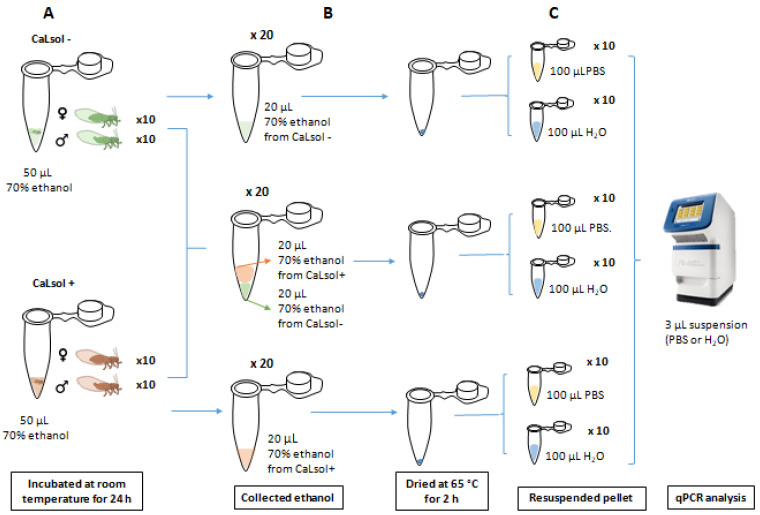
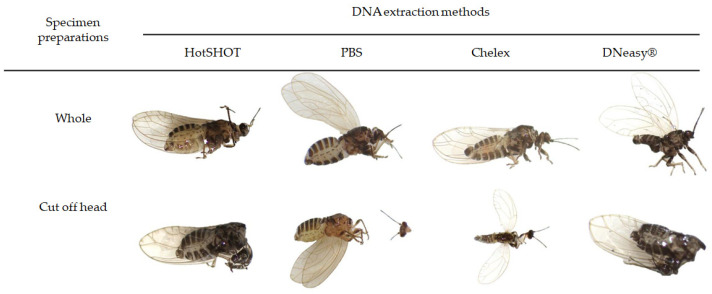
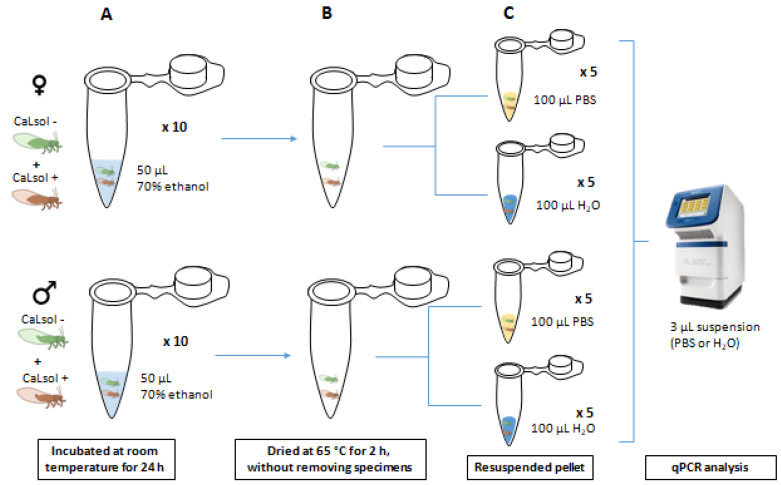
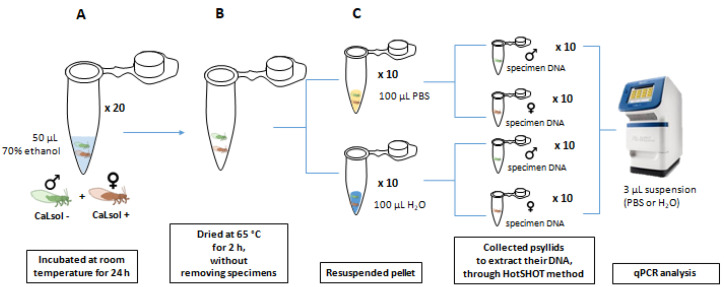
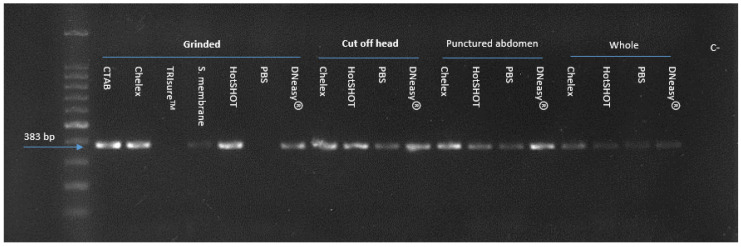
' Liberibacter solanacearum' (CaLsol) is an uncultured bacterium, transmitted by psyllids and associated with several diseases in and crops. CaLsol detection in psyllids often requires insect destruction, preventing a subsequent morphological identification. In this work, we have assessed the influence on the detection of CaLsol by PCR in (Hemiptera: Psyllidae), of four specimen preparations (entire body, ground, cut-off head, and punctured abdomen) and seven DNA extraction methods (PBS suspension, squashing on membrane, CTAB, Chelex, TRIsure, HotSHOT, and DNeasy). DNA yield and purity ratios, time consumption, cost, and residues generated were also evaluated. Optimum results were obtained through grinding, but it is suggested that destructive procedures are not essential in order to detect CaLsol. Although CaLsol was detected by qPCR with DNA obtained by the different procedures, HotSHOT was the most sensitive method. In terms of time consumption and cost, squashed on membrane, HotSHOT, and PBS were the fastest, while HotSHOT and PBS were the cheapest. In summary, HotSHOT was accurate, fast, simple, and sufficiently sensitive to detect this bacterium within the vector. Additionally, cross-contamination with CaLsol was assessed in the ethanol solutions where specimens were usually collected and preserved. CaLsol-free psyllids were CaLsol-positive after incubation with CaLsol-positive specimens. This work provides a valuable guide when choosing a method to detect CaLsol in vectors according to the purpose of the study.
番茄细菌性溃疡病菌(CaLsol)是一种无法人工培养的细菌,通过木虱传播,与茄科作物的多种病害有关。在木虱中检测CaLsol通常需要破坏昆虫,这使得后续无法进行形态学鉴定。在这项研究中,我们评估了四种样本制备方法(完整虫体、研磨、断头和穿刺腹部)和七种DNA提取方法(PBS悬浮液、膜上挤压、CTAB法、Chelex法、TRIsure法、HotSHOT法和DNeasy法)对通过PCR检测番茄木虱(半翅目:木虱科)中CaLsol的影响。还评估了DNA产量和纯度比、时间消耗、成本以及产生的残留物。通过研磨获得了最佳结果,但结果表明,检测CaLsol不一定需要采用破坏性程序。尽管通过qPCR能检测到不同程序获得的DNA中的CaLsol,但HotSHOT法是最灵敏的方法。在时间消耗和成本方面,膜上挤压法、HotSHOT法和PBS法最快,而HotSHOT法和PBS法最便宜。总之,HotSHOT法准确、快速、简单且灵敏度足以检测载体中的这种细菌。此外,在通常收集和保存木虱样本的乙醇溶液中评估了CaLsol的交叉污染情况。无菌木虱与CaLsol阳性样本孵育后呈CaLsol阳性。这项研究为根据研究目的选择检测载体中CaLsol的方法提供了有价值的指导。