Vilela Janice de M V, Moghassemi Saeid, Dadashzadeh Arezoo, Dolmans Marie-Madeleine, Azevedo Ricardo B, Amorim Christiani A
Pôle de Recherche en Gynécologie, Institut de Recherche Expérimentale et Clinique, Université Catholique de Louvain, 1200 Brussels, Belgium.
Gynecology and Andrology Department, Cliniques Universitaires Saint-Luc, 1200 Brussels, Belgium.
Nanomaterials (Basel). 2022 Jun 10;12(12):1999. doi: 10.3390/nano12121999.
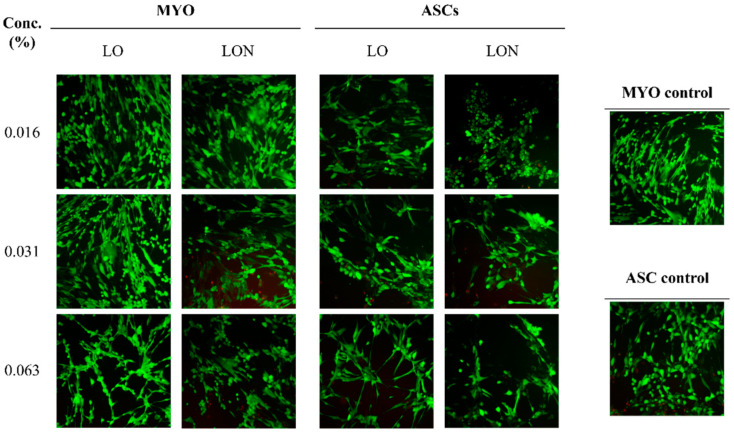
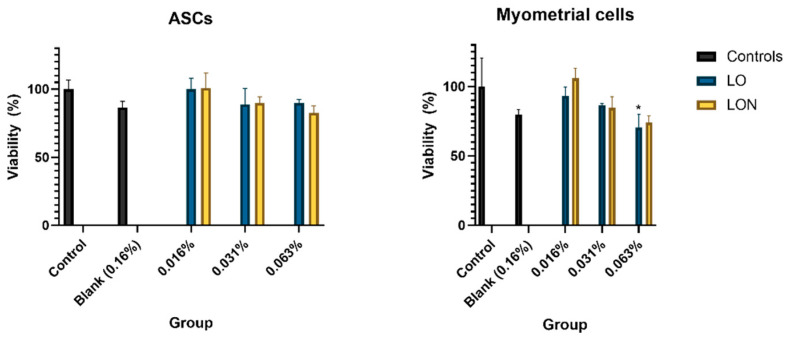
(1) Background: Essential oils have long been used as therapeutic agents. Lavender () oil (LO) is an antispasmodic, anticonvulsant, relaxant, painkilling, and antimicrobial essential oil investigated as a natural substance for biomedical therapies. Nanoparticles have shown significant promise in improving drug delivery and efficacy. Considering these benefits, the aim of this study was to evaluate the toxicity of LO and lavender oil niosomes (LONs) in stem cells and myofibroblast models cultured in vitro. (2) Methods: Adipose tissue-derived stem cells and myometrial cells were cultured with LO or LONs at different concentrations (0, 0.016%, 0.031%, and 0.063%) and toxicity was evaluated with PrestoBlue™ and live/dead assay using calcein and ethidium homodimer. (3) Results: Cell viability was similar to controls in all groups, except in 0.063% LO for myometrial cells, which showed lower viability than the control medium. (4) Conclusion: These results suggest that both LO and LONs are safe for cell culture and may be used for pharmaceutical and biomedical therapies in future applications in regenerative medicine.
(1) 背景:精油长期以来一直被用作治疗剂。薰衣草油(LO)是一种具有解痉、抗惊厥、松弛、止痛和抗菌作用的精油,被作为一种用于生物医学治疗的天然物质进行研究。纳米颗粒在改善药物递送和疗效方面显示出巨大的潜力。考虑到这些益处,本研究的目的是评估LO和薰衣草油脂质体(LONs)对体外培养的干细胞和成肌纤维细胞模型的毒性。(2) 方法:将脂肪组织来源的干细胞和子宫肌层细胞与不同浓度(0、0.016%、0.031%和0.063%)的LO或LONs一起培养,并使用PrestoBlue™以及钙黄绿素和乙锭同二聚体进行活/死检测来评估毒性。(3) 结果:除了子宫肌层细胞在0.063% LO组中活力低于对照培养基外,所有组的细胞活力与对照组相似。(4) 结论:这些结果表明,LO和LONs对于细胞培养都是安全的,并且在未来再生医学的应用中可能用于制药和生物医学治疗。