Wondim Mulugeta A, Czupryna Piotr, Pancewicz Sławomir, Kruszewska Ewelina, Groth Monika, Moniuszko-Malinowska Anna
Department of Infectious Diseases and Neuroinfections, Medical University of Bialystok, Żurawia 14 Block E, 15-540 Białystok, Poland.
Pathogens. 2022 Jun 18;11(6):704. doi: 10.3390/pathogens11060704.
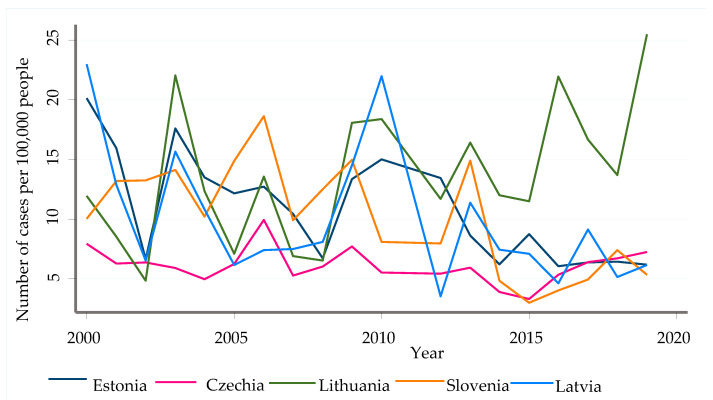
Tick-borne encephalitis is a neuroinfection widely distributed in the Euro-Asia region. Primarily, the virus is transmitted by the bite of infected ticks. From 2000-2019, the total number of confirmed cases in Europe reported to the European Centre for Disease Prevention and Control was 51,519. The number of cases decreased in 2014 and 2015; however, since 2015, a growing number of cases have been observed, with the involvement of countries in which TBE has not been previously reported. The determinant factors for the spread of TBE are host population size, weather conditions, movement of hosts, and local regulations on the socioeconomic dynamics of the local and travelling people around the foci areas. The mean incidence rate of tick-borne encephalitis from 2000-2019 in Europe was 3.27, while the age-adjusted mean incidence rate was 2.19 per 100,000 population size. This review used several articles and data sources from the European Centre for Diseases Prevention and Control.
蜱传脑炎是一种广泛分布于欧亚地区的神经感染性疾病。该病毒主要通过感染蜱虫的叮咬传播。2000年至2019年期间,向欧洲疾病预防控制中心报告的欧洲确诊病例总数为51519例。2014年和2015年病例数有所下降;然而,自2015年以来,观察到病例数不断增加,一些此前未报告过蜱传脑炎的国家也出现了病例。蜱传脑炎传播的决定性因素包括宿主种群规模、天气条件、宿主移动以及疫源地周边当地居民和旅行者社会经济动态的地方法规。2000年至2019年欧洲蜱传脑炎的平均发病率为3.27,而年龄调整后的平均发病率为每10万人口2.19例。本综述使用了欧洲疾病预防控制中心的多篇文章和数据来源。