Miyachi Takashi, Sugano Yuta, Tanaka Shizune, Hirayama Junko, Yamamoto Fumio, Nomura Kyoko
School of Medicine, Akita University, 1-1-1 Hondo, Akita 010-8543, Japan.
Department of Environment Health Science and Public Health, Akita University Graduate School of Medicine, 1-1-1 Hondo, Akita 010-8543, Japan.
Vaccines (Basel). 2022 Jun 2;10(6):893. doi: 10.3390/vaccines10060893.
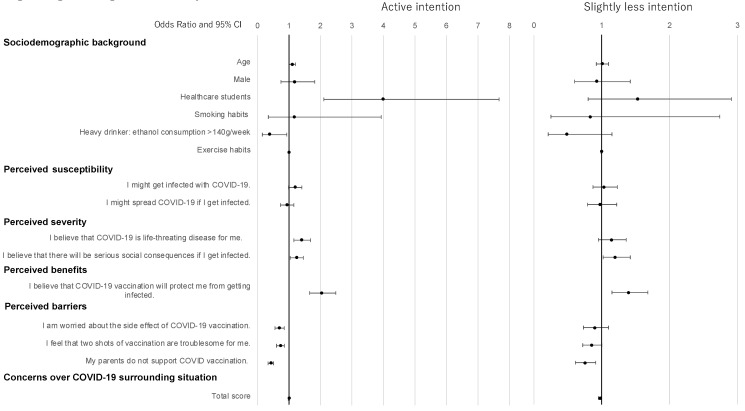
This study investigated the intention to get the coronavirus disease of 2019 (COVID-19) vaccine and its associated factors among Japanese university students. A cross-sectional survey was conducted from March to May 2021 via an e-learning platform at Akita University. Participants were 1776 graduate and undergraduate students who answered the survey on vaccine intention, the health belief model (HBM), sociodemographic characteristics, and concerns over COVID-19-related situations. Vaccine intention was stratified into active, slightly less, and no intention, and the associated factors were determined using the multinomial logistic regression model. Results showed that 56.7% of students had active intention, followed by slightly less intention (34.5%) and no intention (8.8%). After adjusting for covariates, healthcare course, perceived severity (life-threatening and serious social consequences), and perceived benefits from HBM were significantly associated with active intention, with adjusted odds ratios of 4.02 (95% confidence interval [CI], 2.11-7.67), 1.40 (95% CI, 1.16-1.69), 1.23 (95% CI, 1.04-1.46), and 2.03 (95% CI, 1.66-2.49), respectively; perceived barriers (side effect, troublesome, and parent disagreement) were adversely associated with active intention. The public health strategy to improve students' vaccine uptake requires providing accurate information on vaccine safety and efficacy while removing any barriers to vaccination.
本研究调查了日本大学生接种2019冠状病毒病(COVID-19)疫苗的意愿及其相关因素。2021年3月至5月,通过秋田大学的一个电子学习平台进行了一项横断面调查。参与者为1776名研究生和本科生,他们回答了关于疫苗接种意愿、健康信念模型(HBM)、社会人口学特征以及对COVID-19相关情况的担忧的调查。疫苗接种意愿被分为积极意愿、意愿稍低和无意愿,使用多项逻辑回归模型确定相关因素。结果显示,56.7%的学生有积极意愿,其次是意愿稍低(34.5%)和无意愿(8.8%)。在对协变量进行调整后,医疗保健课程、感知严重性(危及生命和严重的社会后果)以及来自健康信念模型的感知益处与积极意愿显著相关,调整后的优势比分别为4.02(95%置信区间[CI],2.11 - 7.67)、1.40(95% CI,1.16 - 1.69)、1.23(95% CI,1.04 - 1.46)和2.03(95% CI,1.66 - 2.49);感知障碍(副作用、麻烦和家长不同意)与积极意愿呈负相关。提高学生疫苗接种率的公共卫生策略需要提供关于疫苗安全性和有效性的准确信息,同时消除任何疫苗接种障碍。