Mullick Tahsin, Radovic Ana, Shaaban Sam, Doryab Afsaneh
Department of Engineering Systems and Environment, University of Virginia, Charlottesville, VA, United States.
Department of Pediatrics, University of Pittsburgh, Pittsburgh, PA, United States.
JMIR Form Res. 2022 Jun 24;6(6):e35807. doi: 10.2196/35807.
Depression levels in adolescents have trended upward over the past several years. According to a 2020 survey by the National Survey on Drug Use and Health, 4.1 million US adolescents have experienced at least one major depressive episode. This number constitutes approximately 16% of adolescents aged 12 to 17 years. However, only 32.3% of adolescents received some form of specialized or nonspecialized treatment. Identifying worsening symptoms earlier using mobile and wearable sensors may lead to earlier intervention. Most studies on predicting depression using sensor-based data are geared toward the adult population. Very few studies look into predicting depression in adolescents.
The aim of our work was to study passively sensed data from adolescents with depression and investigate the predictive capabilities of 2 machine learning approaches to predict depression scores and change in depression levels in adolescents. This work also provided an in-depth analysis of sensor features that serve as key indicators of change in depressive symptoms and the effect of variation of data samples on model accuracy levels.
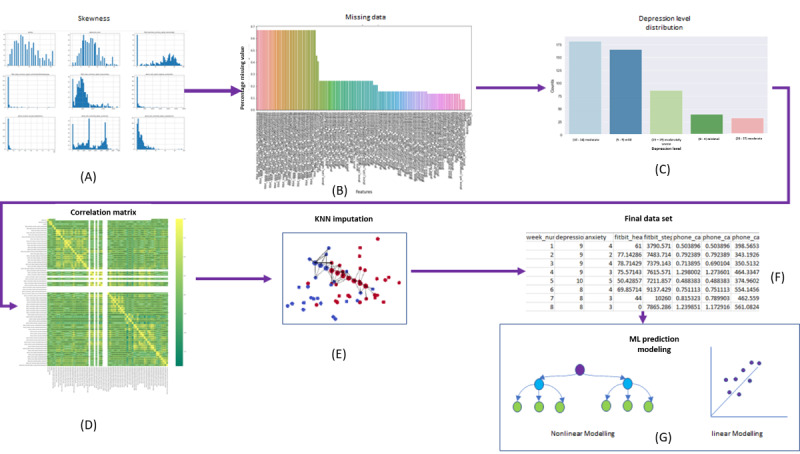
This study included 55 adolescents with symptoms of depression aged 12 to 17 years. Each participant was passively monitored through smartphone sensors and Fitbit wearable devices for 24 weeks. Passive sensors collected call, conversation, location, and heart rate information daily. Following data preprocessing, 67% (37/55) of the participants in the aggregated data set were analyzed. Weekly Patient Health Questionnaire-9 surveys answered by participants served as the ground truth. We applied regression-based approaches to predict the Patient Health Questionnaire-9 depression score and change in depression severity. These approaches were consolidated using universal and personalized modeling strategies. The universal strategies consisted of Leave One Participant Out and Leave Week X Out. The personalized strategy models were based on Accumulated Weeks and Leave One Week One User Instance Out. Linear and nonlinear machine learning algorithms were trained to model the data.
We observed that personalized approaches performed better on adolescent depression prediction compared with universal approaches. The best models were able to predict depression score and weekly change in depression level with root mean squared errors of 2.83 and 3.21, respectively, following the Accumulated Weeks personalized modeling strategy. Our feature importance investigation showed that the contribution of screen-, call-, and location-based features influenced optimal models and were predictive of adolescent depression.
This study provides insight into the feasibility of using passively sensed data for predicting adolescent depression. We demonstrated prediction capabilities in terms of depression score and change in depression level. The prediction results revealed that personalized models performed better on adolescents than universal approaches. Feature importance provided a better understanding of depression and sensor data. Our findings can help in the development of advanced adolescent depression predictions.

在过去几年中,青少年的抑郁水平呈上升趋势。根据2020年全国药物使用和健康调查,410万美国青少年经历过至少一次重度抑郁发作。这个数字约占12至17岁青少年的16%。然而,只有32.3%的青少年接受了某种形式的专业或非专业治疗。使用移动和可穿戴传感器更早地识别症状恶化情况可能会带来更早的干预。大多数利用基于传感器的数据预测抑郁症的研究都针对成年人群。很少有研究关注青少年抑郁症的预测。
我们工作的目的是研究来自患有抑郁症青少年的被动感知数据,并调查两种机器学习方法预测青少年抑郁症评分和抑郁水平变化的能力。这项工作还对作为抑郁症状变化关键指标的传感器特征以及数据样本变化对模型准确性水平的影响进行了深入分析。
本研究纳入了55名年龄在12至17岁之间有抑郁症状的青少年。通过智能手机传感器和Fitbit可穿戴设备对每位参与者进行24周的被动监测。被动传感器每天收集通话、对话、位置和心率信息。经过数据预处理后,对汇总数据集中67%(37/55)的参与者进行了分析。参与者每周填写的患者健康问卷-9调查结果作为基本事实。我们应用基于回归的方法来预测患者健康问卷-9抑郁评分和抑郁严重程度的变化。这些方法使用通用和个性化建模策略进行整合。通用策略包括留一参与者法和留第X周法。个性化策略模型基于累积周数法和留一周一用户实例法。训练线性和非线性机器学习算法对数据进行建模。
我们观察到,与通用方法相比,个性化方法在青少年抑郁症预测方面表现更好。按照累积周数个性化建模策略,最佳模型能够分别以2.83和3.21的均方根误差预测抑郁评分和每周抑郁水平变化。我们的特征重要性调查表明,基于屏幕、通话和位置的特征的贡献影响了最优模型,并且可以预测青少年抑郁症。
本研究深入探讨了使用被动感知数据预测青少年抑郁症的可行性。我们展示了在抑郁评分和抑郁水平变化方面的预测能力。预测结果表明,个性化模型在青少年中比通用方法表现更好。特征重要性有助于更好地理解抑郁症和传感器数据。我们的研究结果有助于开发先进的青少年抑郁症预测方法。