Department of Psychiatry, Dalhousie University, Halifax, NS, Canada.
Faculty of Computer Science, Dalhousie University, Halifax, NS, Canada.
JMIR Mhealth Uhealth. 2021 Oct 26;9(10):e20638. doi: 10.2196/20638.
Internalizing disorders are the most common psychiatric problems observed among youth in Canada. Sadly, youth with internalizing disorders often avoid seeking clinical help and rarely receive adequate treatment. Current methods of assessing internalizing disorders usually rely on subjective symptom ratings, but internalizing symptoms are frequently underreported, which creates a barrier to the accurate assessment of these symptoms in youth. Therefore, novel assessment tools that use objective data need to be developed to meet the highest standards of reliability, feasibility, scalability, and affordability. Mobile sensing technologies, which unobtrusively record aspects of youth behaviors in their daily lives with the potential to make inferences about their mental health states, offer a possible method of addressing this assessment barrier.
This study aims to explore whether passively collected smartphone sensor data can be used to predict internalizing symptoms among youth in Canada.
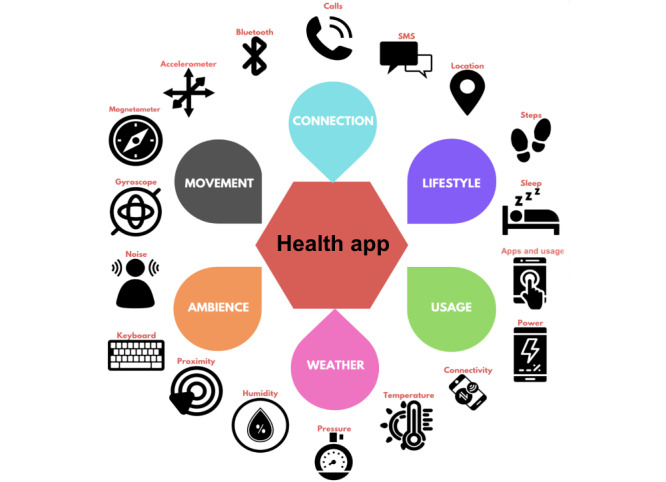
In this study, the youth participants (N=122) completed self-report assessments of symptoms of anxiety, depression, and attention-deficit hyperactivity disorder. Next, the participants installed an app, which passively collected data about their mobility, screen time, sleep, and social interactions over 2 weeks. Then, we tested whether these passive sensor data could be used to predict internalizing symptoms among these youth participants.
More severe depressive symptoms correlated with more time spent stationary (r=0.293; P=.003), less mobility (r=0.271; P=.006), higher light intensity during the night (r=0.227; P=.02), and fewer outgoing calls (r=-0.244; P=.03). In contrast, more severe anxiety symptoms correlated with less time spent stationary (r=-0.249; P=.01) and greater mobility (r=0.234; P=.02). In addition, youths with higher anxiety scores spent more time on the screen (r=0.203; P=.049). Finally, adding passively collected smartphone sensor data to the prediction models of internalizing symptoms significantly improved their fit.
Passively collected smartphone sensor data provide a useful way to monitor internalizing symptoms among youth. Although the results replicated findings from adult populations, to ensure clinical utility, they still need to be replicated in larger samples of youth. The work also highlights intervention opportunities via mobile technology to reduce the burden of internalizing symptoms early on.
在加拿大,青少年中最常见的精神问题是内化障碍。可悲的是,患有内化障碍的青少年通常避免寻求临床帮助,很少接受足够的治疗。目前评估内化障碍的方法通常依赖于主观症状评分,但内化症状经常被漏报,这给准确评估青少年的这些症状造成了障碍。因此,需要开发使用客观数据的新评估工具,以满足可靠性、可行性、可扩展性和可负担性的最高标准。移动感应技术可以在不干扰日常生活的情况下记录青少年行为的各个方面,并有潜力推断他们的心理健康状态,为解决这一评估障碍提供了一种可能的方法。
本研究旨在探讨被动采集的智能手机传感器数据是否可用于预测加拿大青少年的内化症状。
在这项研究中,青少年参与者(N=122)完成了焦虑、抑郁和注意缺陷多动障碍症状的自我报告评估。接下来,参与者安装了一个应用程序,该应用程序在两周内被动地收集有关他们的移动性、屏幕时间、睡眠和社交互动的数据。然后,我们测试了这些被动传感器数据是否可用于预测这些青少年参与者的内化症状。
更严重的抑郁症状与更久的静止时间(r=0.293;P=.003)、更少的移动性(r=0.271;P=.006)、夜间更高的光强度(r=0.227;P=.02)和更少的呼出电话(r=-0.244;P=.03)相关。相比之下,更严重的焦虑症状与更短的静止时间(r=-0.249;P=.01)和更大的移动性(r=0.234;P=.02)相关。此外,焦虑得分较高的青少年花在屏幕上的时间更多(r=0.203;P=.049)。最后,将被动采集的智能手机传感器数据添加到内化症状的预测模型中显著提高了模型的拟合度。
被动采集的智能手机传感器数据为监测青少年内化症状提供了一种有用的方法。尽管结果复制了成人人群的发现,但为了确保临床实用性,仍需要在更大的青少年样本中进行复制。这项工作还通过移动技术强调了干预机会,以尽早减轻内化症状的负担。