Laboratory of Immune Regulation, Department of Microbiology and Immunology, Graduate School of Medicine, Osaka University, Suita, Japan.
Department of Respiratory Medicine, Clinical Immunology, Graduate School of Medicine, Osaka University, Suita, Japan.
BMC Infect Dis. 2022 Jun 24;22(1):572. doi: 10.1186/s12879-022-07358-7.
The impact of SARS-CoV-2 infection on the gut fungal (mycobiota) and bacterial (microbiota) communities has been elucidated individually. This study analyzed both gut mycobiota and microbiota and their correlation in the COVID-19 patients with severe and mild conditions and follow-up to monitor their alterations after recovery.
We analyzed the gut mycobiota and microbiota by bacterial 16S and fungal ITS1 metagenomic sequencing of 40 severe patients, 38 mild patients, and 30 healthy individuals and reanalyzed those of 10 patients with severe COVID-19 approximately 6 months after discharge.
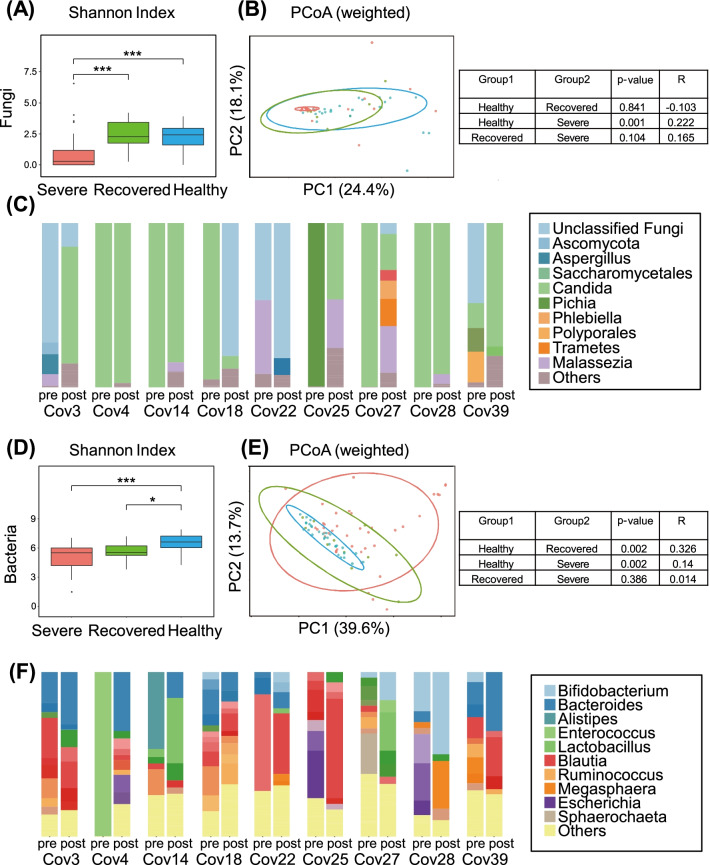
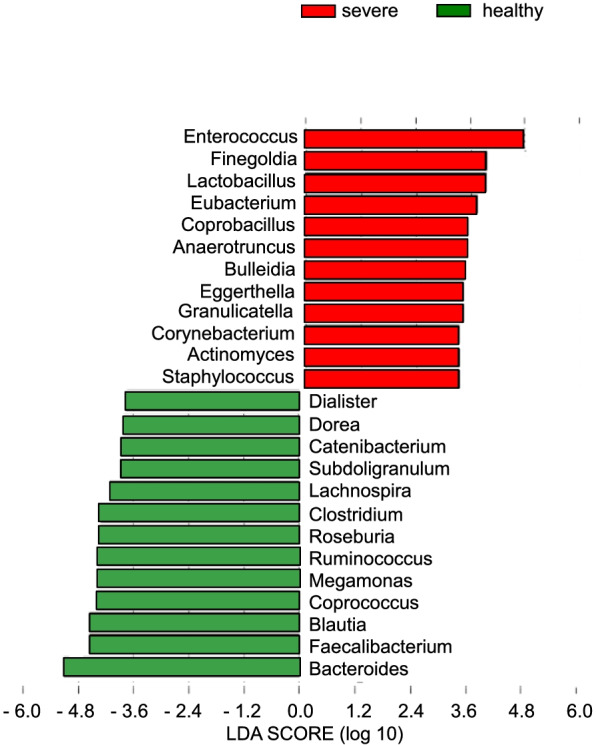
The mycobiota of the severe and mild groups showed lower diversity than the healthy group, and in some, characteristic patterns dominated by a single fungal species, Candida albicans, were detected. Lower microbial diversity in the severe group was observed, but no differences in its diversity or community structure were detected between the mild and healthy groups. The microbiota of the severe group was characterized by an increase in Enterococcus and Lactobacillus, and a decrease in Faecalibacterium and Bacteroides. The abundance of Candida was positively correlated with that of Enterococcus in patients with COVID-19. After the recovery of severe patients, alteration of the microbiota remained, but the mycobiota recovered its diversity comparable to that of mild and healthy groups.
In mild cases, the microbiota is stable during SARS-CoV-2 infection, but in severe cases, alterations persist for 6 months after recovery.
SARS-CoV-2 感染对肠道真菌(真菌群落)和细菌(微生物群落)的影响已分别阐明。本研究分析了 COVID-19 重症和轻症患者的肠道真菌群和细菌群及其相关性,并在康复后进行随访以监测其变化。
我们通过对 40 名重症患者、38 名轻症患者和 30 名健康个体的细菌 16S 和真菌 ITS1 宏基因组测序分析了肠道真菌群和细菌群,并对 10 名重症 COVID-19 患者在出院后大约 6 个月时的这些菌群进行了重新分析。
重症和轻症组的真菌群多样性低于健康组,在某些情况下,检测到以单一真菌物种(白色念珠菌)为主的特征模式。重症组的微生物多样性较低,但轻症和健康组之间的多样性或群落结构没有差异。重症组的微生物群以肠球菌和乳杆菌增加为特征,而粪杆菌和拟杆菌减少。COVID-19 患者中,白色念珠菌的丰度与肠球菌呈正相关。在重症患者康复后,其微生物群的改变仍然存在,但真菌群恢复了与轻症和健康组相当的多样性。
在轻症病例中,肠道微生物群在 SARS-CoV-2 感染期间保持稳定,但在重症病例中,这种改变在康复后 6 个月仍然存在。