Qaisar Mahnoor, Zahid Saba, Khera Rasheed Ahmad, El-Badry Yaser A, Saeed Muhammad Umar, Mehmood Rana Farhat, Iqbal Javed
Department of Chemistry, University of Agriculture, Faisalabad 38000, Pakistan.
Chemistry Department, Faculty of Science, Taif University, khurma, P.O. Box 11099, Taif 21944, Saudi Arabia.
ACS Omega. 2022 Jun 8;7(24):20528-20541. doi: 10.1021/acsomega.2c00001. eCollection 2022 Jun 21.
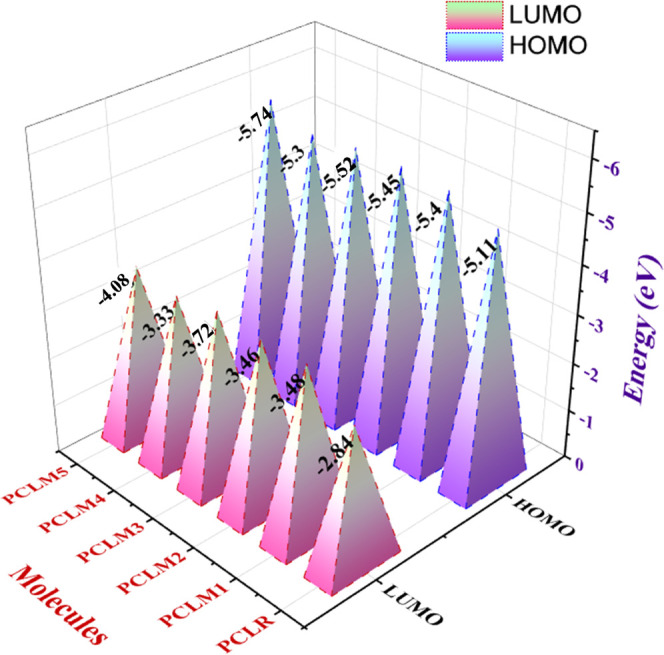
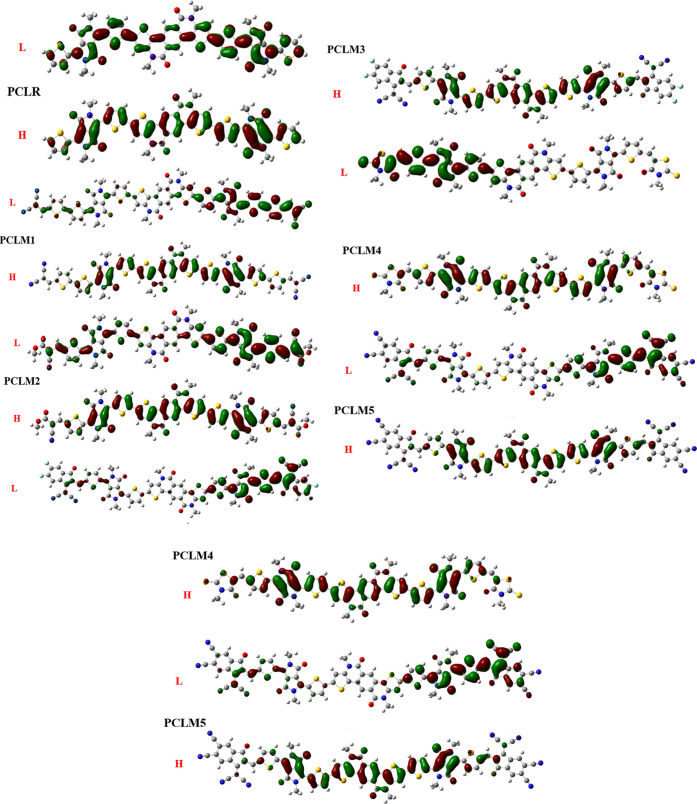
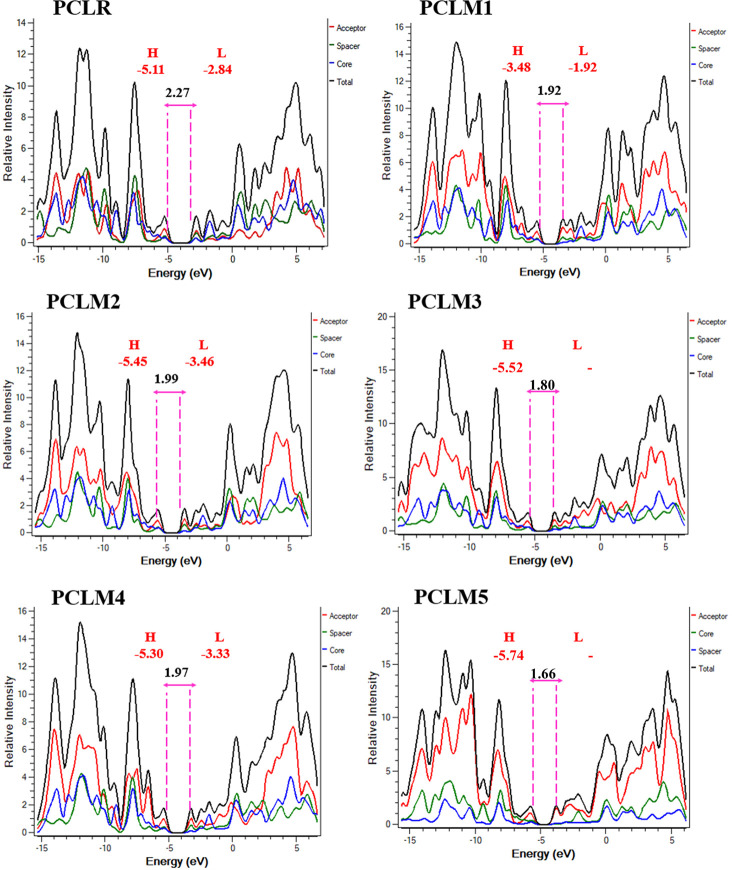
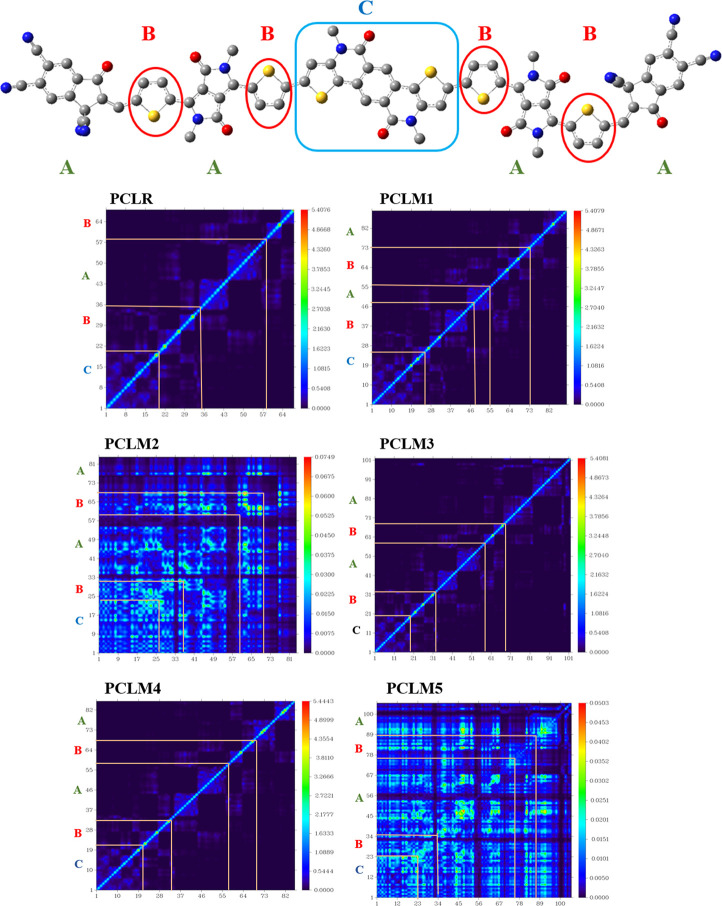
Small-molecule (SM)-based organic solar cells (OSCs) have dominated the photovoltaic industry on account of their efficient optical and electronic properties. This quantum mechanical study addresses a DFT study of pentacyclic aromatic bislactam (PCL)-based small molecules for extremely proficient OSCs. Five novel small molecules () retaining the A-π-A-π-D-π-A-π-A arrangement were fabricated from the reference . At the MPW1PW91/6-31G** level of theory, detailed profiling of these novel molecules was performed by accurately following DFT, along with the time-dependent density functional theory (TD-DFT) hypothetical simulations to analyze the UV-visible absorption (λ), light-harvesting efficiency (LHE), dipole moment (μ), fill factor (FF), open-circuit voltage ( ), power conversion efficiency (PCE), frontier molecular orbitals (FMOs), binding energy ( ), density of states (DOS), electrostatic potential (ESP), and transition density matrix (TDM) plots. Alteration of peripheral acceptors in all of the molecular structures drastically modified their charge-transfer properties, such as a strong light-harvesting capability in the range of 0.9993-0.9998, reduced exciton (from 0.34 to 0.39 eV), a reduced bandgap ( ) in the range of 1.66-1.99 eV, an elevated λ (775-959 nm) along with a higher μ in the solvent phase (1.934-7.865 D) when studied in comparison with , possessing an LHE of 0.9986, an of 0.40, an 2.27 eV, λ at 662 nm, and a μ of 0.628 D. The FMO analysis revealed the uniform dispersal of charge density entirely along the highest occupied (HOMO) and lowest unoccupied (LUMO) molecular orbitals in newly constructed moieties. Electron as well as hole mobility rates, , FF, and PCE of all novel molecules were higher as compared with those of , ultimately making them exceptional candidates for solar devices. Focusing on the outcomes, terminal acceptor modification was found to be a suitable method for the development of highly tuned OSCs in the future.
基于小分子(SM)的有机太阳能电池(OSC)因其高效的光学和电子特性在光伏产业中占据主导地位。这项量子力学研究涉及对基于五环芳族双内酰胺(PCL)的小分子用于极其高效的有机太阳能电池的密度泛函理论(DFT)研究。从参考物制备了五个保留A-π-A-π-D-π-A-π-A排列的新型小分子()。在MPW1PW91/6-31G**理论水平下,通过精确遵循DFT以及进行含时密度泛函理论(TD-DFT)假设模拟,对这些新型分子进行了详细剖析,以分析紫外-可见吸收(λ)、光捕获效率(LHE)、偶极矩(μ)、填充因子(FF)、开路电压()、功率转换效率(PCE)、前沿分子轨道(FMO)、结合能()、态密度(DOS)、静电势(ESP)和跃迁密度矩阵(TDM)图。所有分子结构中周边受体的改变极大地改变了它们的电荷转移特性,例如在0.9993 - 0.9998范围内具有很强的光捕获能力,激子降低(从0.