Rahma Osmalina Nur, Putra Alfian Pramudita, Rahmatillah Akif, Putri Yang Sa'ada Kamila Ariyansah, Fajriaty Nuzula Dwi, Ain Khusnul, Chai Rifai
Department of Physics, Faculty of Science and Technology, Universitas Airlangga, Surabaya, Indonesia.
Department of Physics, Biomedical Signals and Systems Research Group, Faculty of Science and Technology, Universitas Airlangga, Surabaya, Indonesia.
J Med Signals Sens. 2022 May 12;12(2):155-162. doi: 10.4103/jmss.JMSS_78_20. eCollection 2022 Apr-Jun.
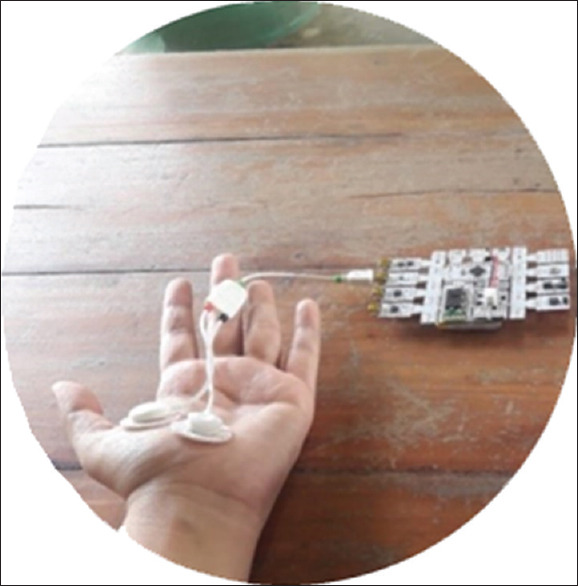
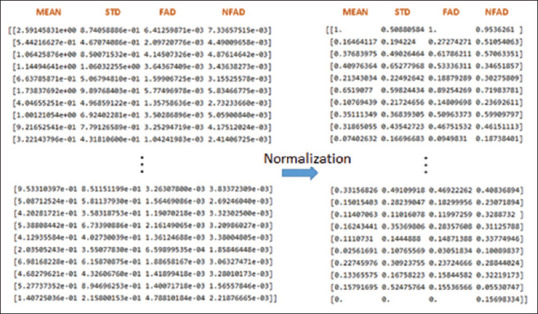
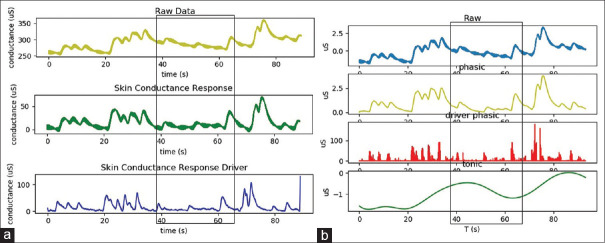
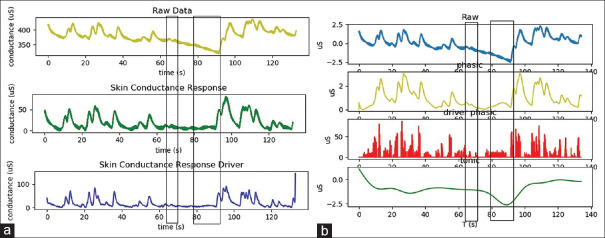
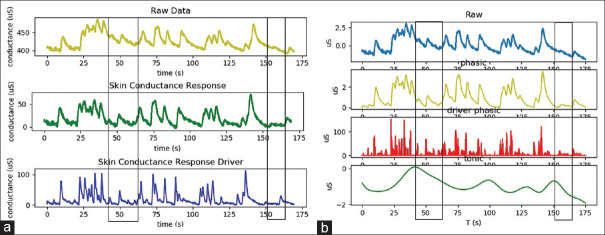
Stress can lead to harmful conditions in the body, such as anxiety disorders and depression. One of the promising noninvasive methods, which has been widely used in detecting stress and emotion, is electrodermal activity (EDA). EDA has a tonic and phasic component called skin conductance level and skin conductance response (SCR). However, the components of the EDA cannot be directly extracted and need to be deconvolved to obtain it. The EDA signals were collected from 18 healthy subjects that underwent three sessions - Stroop test with increasing stress levels. The EDA signals were then deconvoluted by using continuous deconvolution analysis (CDA) and convex optimization approach to electrodermal activity (cvxEDA). Four features from the result of the deconvolution process were collected, namely sample average, standard deviation, first absolute difference, and normalized first absolute difference. Those features were used as the input of the classification process using the extreme learning machine (ELM). The output of classification was the stress level; mild, moderate, and severe. The visual of the phasic component using cvxEDA is more precise or smoother than the CDA's result. However, both methods could separate SCR from the original skin conductivity raw and indicate the small peaks from the SCR. The classification process results showed that both CDA and cvxEDA methods with 50 hidden layers in ELM had a high accuracy in classifying the stress level, which was 95.56% and 94.45%, respectively. This study developed a stress level classification method using ELM and the statistical features of SCR. The result showed that EDA could classify the stress level with over 94% accuracy. This system could help people monitor their mental health during overworking, leading to anxiety and depression because of untreated stress.
压力会导致身体出现有害状况,如焦虑症和抑郁症。皮肤电活动(EDA)是一种很有前景的非侵入性方法,已被广泛用于检测压力和情绪。EDA有一个静息成分和一个相位成分,分别称为皮肤电导水平和皮肤电导反应(SCR)。然而,EDA的这些成分无法直接提取,需要进行去卷积才能获得。从18名健康受试者身上收集了EDA信号,这些受试者进行了三个阶段的斯特鲁普测试,压力水平逐渐增加。然后使用连续去卷积分析(CDA)和皮肤电活动凸优化方法(cvxEDA)对EDA信号进行去卷积。从去卷积过程的结果中提取了四个特征,即样本平均值、标准差、一阶绝对差和归一化一阶绝对差。这些特征被用作使用极限学习机(ELM)进行分类过程的输入。分类的输出是压力水平,分为轻度、中度和重度。使用cvxEDA的相位成分的可视化比CDA的结果更精确或更平滑。然而,两种方法都可以从原始皮肤电导率原始数据中分离出SCR,并显示出SCR的小峰值。分类过程结果表明,在ELM中具有50个隐藏层的CDA和cvxEDA方法在对压力水平进行分类时都具有很高的准确率,分别为95.56%和94.45%。本研究开发了一种使用ELM和SCR统计特征的压力水平分类方法。结果表明,EDA能够以超过94%的准确率对压力水平进行分类。该系统可以帮助人们在过度工作期间监测自己的心理健康,过度工作会因未处理的压力导致焦虑和抑郁。