Sackett Joshua D, Kamble Nitin, Leach Edmund, Schuelke Taruna, Wilbanks Elizabeth, Rowe Annette R
Department of Biological Sciences, University of Cincinnati, Cincinnati, OH, United States.
Department of Ecology, Evolution, and Marine Biology, University of California, Santa Barbara, Santa Barbara, CA, United States.
Front Microbiol. 2022 Jun 10;13:909824. doi: 10.3389/fmicb.2022.909824. eCollection 2022.
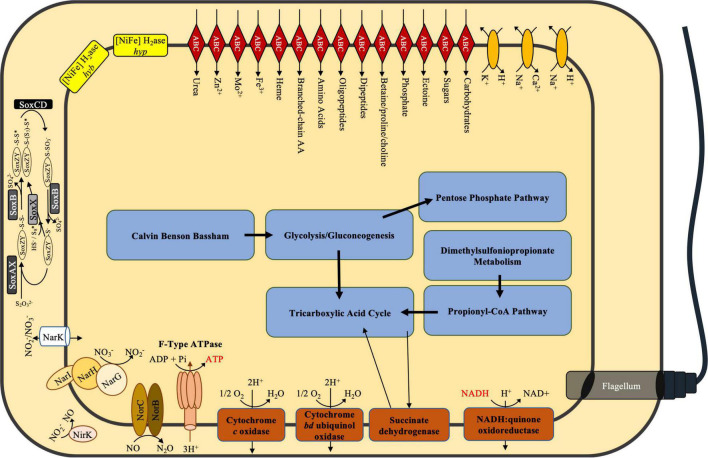
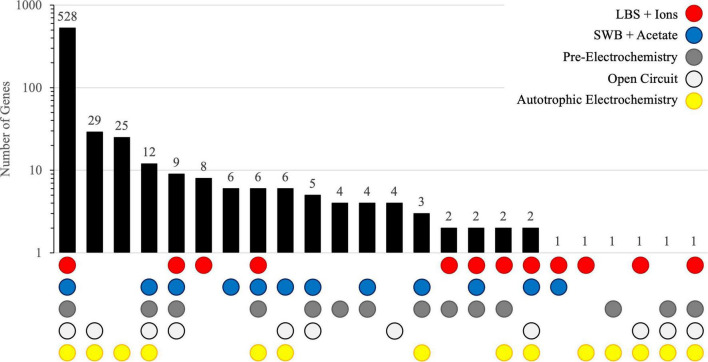
Extracellular electron transfer (EET) - the process by which microorganisms transfer electrons across their membrane(s) to/from solid-phase materials - has implications for a wide range of biogeochemically important processes in marine environments. Though EET is thought to play an important role in the oxidation of inorganic minerals by lithotrophic organisms, the mechanisms involved in the oxidation of solid particles are poorly understood. To explore the genetic basis of oxidative EET, we utilized genomic analyses and transposon insertion mutagenesis screens (Tn-seq) in the metabolically flexible, lithotrophic Alphaproteobacterium ElOx9. The finished genome of this strain is 4.3 MB, and consists of 4,139 predicted ORFs, 54 contain heme binding motifs, and 33 of those 54 are predicted to localize to the cell envelope or have unknown localizations. To begin to understand the genetic basis of oxidative EET in ElOx9, we constructed a transposon mutant library in semi-rich media which was comprised of >91,000 individual mutants encompassing >69,000 unique TA dinucleotide insertion sites. The library was subjected to heterotrophic growth on minimal media with acetate and autotrophic oxidative EET conditions on indium tin oxide coated glass electrodes poised at -278 mV vs. SHE or un-poised in an open circuit condition. We identified 528 genes classified as essential under these growth conditions. With respect to electrochemical conditions, 25 genes were essential under oxidative EET conditions, and 29 genes were essential in both the open circuit control and oxidative EET conditions. Though many of the genes identified under electrochemical conditions are predicted to be localized in the cytoplasm and lack heme binding motifs and/or homology to known EET proteins, we identified several hypothetical proteins and poorly characterized oxidoreductases that implicate a novel mechanism(s) for EET that warrants further study. Our results provide a starting point to explore the genetic basis of novel oxidative EET in this marine sediment microbe.
细胞外电子转移(EET)——微生物将电子跨膜转移至固相材料或从固相材料转移出电子的过程——对海洋环境中一系列具有重要生物地球化学意义的过程具有影响。尽管EET被认为在化能营养生物氧化无机矿物的过程中发挥重要作用,但对固体颗粒氧化所涉及的机制却知之甚少。为了探究氧化型EET的遗传基础,我们在代谢灵活的化能营养型α-变形菌ElOx9中利用了基因组分析和转座子插入诱变筛选(Tn-seq)。该菌株的完整基因组为4.3兆碱基,由4139个预测的开放阅读框组成,其中54个含有血红素结合基序,这54个中的33个预计定位于细胞膜或定位未知。为了开始了解ElOx9中氧化型EET的遗传基础,我们在半丰富培养基中构建了一个转座子突变体文库,该文库由超过91,000个个体突变体组成,涵盖超过69,000个独特的TA二核苷酸插入位点。该文库在含有乙酸盐的基本培养基上进行异养生长,并在相对于标准氢电极(SHE)电位为-278 mV的氧化铟锡涂层玻璃电极上进行自养氧化EET条件培养,或在开路条件下无电位培养。我们鉴定出528个在这些生长条件下被分类为必需的基因。关于电化学条件,25个基因在氧化EET条件下是必需的,29个基因在开路对照和氧化EET条件下都是必需的。尽管在电化学条件下鉴定出的许多基因预计定位于细胞质中,并且缺乏血红素结合基序和/或与已知EET蛋白的同源性,但我们鉴定出了几种假设蛋白和特征不明确的氧化还原酶,它们暗示了一种新的EET机制,值得进一步研究。我们的结果为探索这种海洋沉积物微生物中新型氧化型EET的遗传基础提供了一个起点。