Hance Jonte R, Hossenfelder Sabine
Quantum Engineering Technology Laboratories, Department of Electrical and Electronic Engineering, University of Bristol, Woodland Road, Bristol BS8 1US, UK.
Frankfurt Institute for Advanced Studies, Ruth-Moufang-Str. 1, D-60438 Frankfurt am Main, Germany.
Proc Math Phys Eng Sci. 2022 Jun;478(2262):20210705. doi: 10.1098/rspa.2021.0705. Epub 2022 Jun 22.
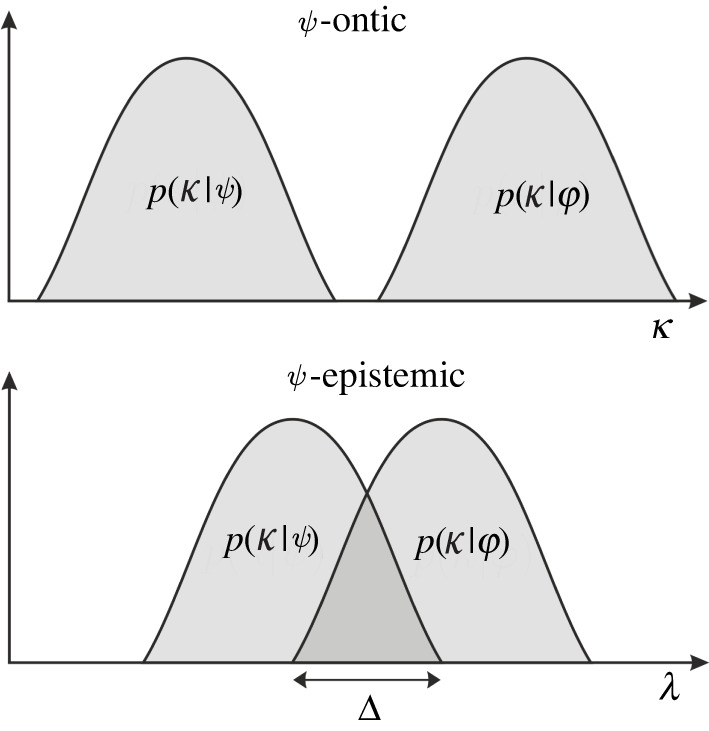
In quantum mechanics, the wave function predicts probabilities of possible measurement outcomes, but not which individual outcome is realized in each run of an experiment. This suggests that it describes an ensemble of states with different values of a hidden variable. Here, we analyse this idea with reference to currently known theorems and experiments. We argue that the ψ-ontic/epistemic distinction fails to properly identify ensemble interpretations and propose a more useful definition. We then show that all local ψ-ensemble interpretations which reproduce quantum mechanics violate statistical independence. Theories with this property are commonly referred to as superdeterministic or retrocausal. Finally, we explain how this interpretation helps make sense of some otherwise puzzling phenomena in quantum mechanics, such as the delayed choice experiment, the Elitzur-Vaidman bomb detector and the extended Wigner's friends scenario.
在量子力学中,波函数预测可能测量结果的概率,但无法预测在每次实验运行中实际出现的单个结果。这表明它描述了一个具有隐藏变量不同值的态的系综。在此,我们参照当前已知的定理和实验来分析这一观点。我们认为,ψ-实体/认知的区分未能正确识别系综诠释,并提出了一个更有用的定义。然后我们表明,所有重现量子力学的局域ψ-系综诠释都违反统计独立性。具有这种性质的理论通常被称为超决定论或逆因果论。最后,我们解释这种诠释如何有助于理解量子力学中一些原本令人困惑的现象,比如延迟选择实验、埃利茨尔-瓦伊德曼炸弹探测器以及扩展的维格纳朋友场景。