Department of Thoracic Surgery, Union Hospital, Tongji Medical College, Huazhong University of Science and Technology, Wuhan, China.
Cancer Center, Union Hospital, Tongji Medical College, Huazhong University of Science and Technology, Wuhan, China.
Pain Res Manag. 2022 Jun 15;2022:2201501. doi: 10.1155/2022/2201501. eCollection 2022.
Fear of pain (FOP) has been recognized as an influential moderator and determinant of the perception and disability of chronic pain. However, studies on FOP in postoperative acute pain are few and inconsistent.
To explore whether FOP is related to pain intensity after thoracic surgery and provide a reference for FOP study in postoperative pain.
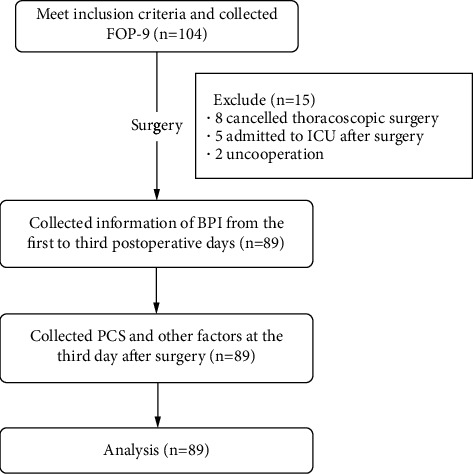
From February to March 2022, 89 patients completed Chinese Version of Fear of Pain-9 Items (FOP-9), Chinese version of the Brief Pain Inventory (BPI, including least, worst, and average pain) and Simplified Chinese version of the Pain Catastrophizing Scale (PCS). Correlation analyses and mediation analyses were used for exploring the relationship between factors.
Mediation analyses showed that the total effects of FOP-9 on BPI all were significant (least pain: effect = 0.085, =0.013, 95% CI = 0.019∼0.151; worst pain: effect = 0.116, =0.004, 95% CI = 0.037∼0.196; average pain: effect = 0.102, =0.005, 95% CI = 0.031∼0.174) indicating that FOP-9 was a predictor to BPI. The 95% bias-corrected bootstrap confidence interval of estimate of indirect effect between FOP-9 and least pain/average pain through PCS was -0.036∼0.024 and -0.003∼0.069 (all contain zero), which indicated that PCS is not a mediator between FOP-9 and least pain/average pain. However, the estimate of indirect effect between FOP-9 and worst pain through PCS were 0.048 (95% CI = 0.095∼0.088), and direct effect was not statistically significant (95% CI = -0.017∼0.153), indicating that PCS acted as a complete intermediary between FOP-9 and worst pain. FOP-9 and PCS showed significant positive prediction effect on worst pain.
Both trait FOP and state FOP were associated with higher postoperative pain reports after thoracic surgery. Trait FOP influences postoperative pain through the mediating effect of state FOP.
疼痛恐惧(Fear of Pain,FOP)已被认为是慢性疼痛感知和残疾的重要调节因素和决定因素。然而,术后急性疼痛中 FOP 的研究较少且结果不一致。
探讨 FOP 是否与胸科手术后的疼痛强度有关,为术后疼痛中的 FOP 研究提供参考。
2022 年 2 月至 3 月,89 例患者完成了恐惧疼痛 9 项量表(Fear of Pain-9 Items,FOP-9)、简明疼痛量表(Brief Pain Inventory,BPI,包括最小、最痛和平均疼痛)和简化中文版疼痛灾难化量表(Pain Catastrophizing Scale,PCS)中文版。采用相关分析和中介分析探讨各因素之间的关系。
中介分析显示,FOP-9 对 BPI 的总效应均有统计学意义(最小疼痛:效应值=0.085,=0.013,95%置信区间=0.019∼0.151;最痛:效应值=0.116,=0.004,95%置信区间=0.037∼0.196;平均疼痛:效应值=0.102,=0.005,95%置信区间=0.031∼0.174),表明 FOP-9 是 BPI 的预测因子。FOP-9 与最小疼痛/平均疼痛通过 PCS 的间接效应估计值的 95%偏置校正自举置信区间为-0.036∼0.024 和-0.003∼0.069(均包含零),表明 PCS 不是 FOP-9 与最小疼痛/平均疼痛之间的中介变量。然而,FOP-9 与 PCS 之间的间接效应估计值通过 PCS 为 0.048(95%置信区间=0.095∼0.088),直接效应无统计学意义(95%置信区间=0.017∼0.153),表明 PCS 是 FOP-9 与最痛之间的完全中介。FOP-9 和 PCS 对最痛有显著的正向预测作用。
特质性 FOP 和状态性 FOP 均与胸科手术后的术后疼痛报告呈正相关。特质性 FOP 通过状态性 FOP 的中介作用影响术后疼痛。