1 Department of Pain Medicine, the Second Affiliated Hospital and Yuying Children's Hospital of Wenzhou Medical University, Wenzhou, Zhejiang, China.
2 China-USA Neuroimaging Research Institute, the Second Affiliated Hospital and Yuying Children's Hospital, Wenzhou Medical University, Wenzhou, Zhejiang, China.
Mol Pain. 2018 Jan-Dec;14:1744806918755283. doi: 10.1177/1744806918755283. Epub 2018 Jan 21.
Objective Pain catastrophizing is linked to many aspects of pain perception and defines a unique dimension in predicting pain intensity and physical disability. Pain Catastrophizing Scale (PCS) is an effective, validated,self-report measure, commonly used in clinical trials. Here, we present a Simplified Chinese PCS (SC-PCS) version developed in Chinese patients suffering from chronic pain. Methods The SC-PCS was generated in five steps and tested on an initial patient cohort (N = 30). A convenience sample (N = 200) of in-hospital patients with non-malignant pain lasting for more than 12 weeks were recruited for the study, of which 81 completed 5 additional pain questionnaires. A subset (N = 24) of the patients completed an additional SC-PCS, 10 days after the initial query to assess test-retest validation. Results Intra-class correlations coefficient indicated high reproducibility and temporal consistency, (0.97), for the total score. Cronbach's alpha determined high internal consistency across the SC-PCS total score and its three subscales (0.87, 0.85, 0.62, and 0.65). The SC-PCS total score moderately or weakly (R = -0.2 to 0.49), but significantly, correlated with other measurements, such as pain Visual Analog Scale, Beck Depression Inventory, Pain Anxiety Symptoms Scales, Positive and Negative Affect Schedule, and education. We used exploratory factor analysis to examine the dimensionality of the SC-PCS, which indicated instability of the current three-factor model. However, a confirmatory factor analysis indicated that the three-factor model had the best goodness-fitting. Conclusions We demonstrate the successful translational adaptation from English to Simplified Chinese as well as the reliability and validity of SC-PCS. An important discovery was education level significantly correlated with SC-PCS, identifying a future consideration for other cross-cultural development of self-reported measures.
目的 疼痛灾难化与疼痛感知的许多方面有关,并定义了预测疼痛强度和身体残疾的独特维度。疼痛灾难化量表(PCS)是一种有效的、经过验证的、自我报告的测量工具,常用于临床试验。在这里,我们提出了一种中文版疼痛灾难化量表(SC-PCS),适用于患有慢性疼痛的中国患者。
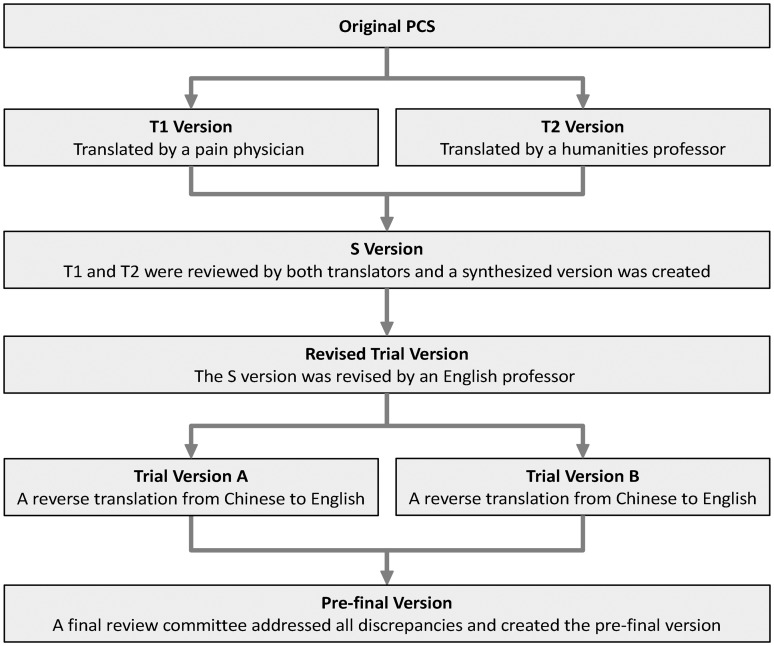
方法 SC-PCS 通过五个步骤生成,并在初始患者队列(N=30)中进行了测试。对患有持续超过 12 周的非恶性疼痛的住院患者进行了便利样本(N=200)的研究,其中 81 人完成了 5 项额外的疼痛问卷。患者的一部分(N=24)在初次查询后 10 天完成了额外的 SC-PCS,以评估测试-重测验证。
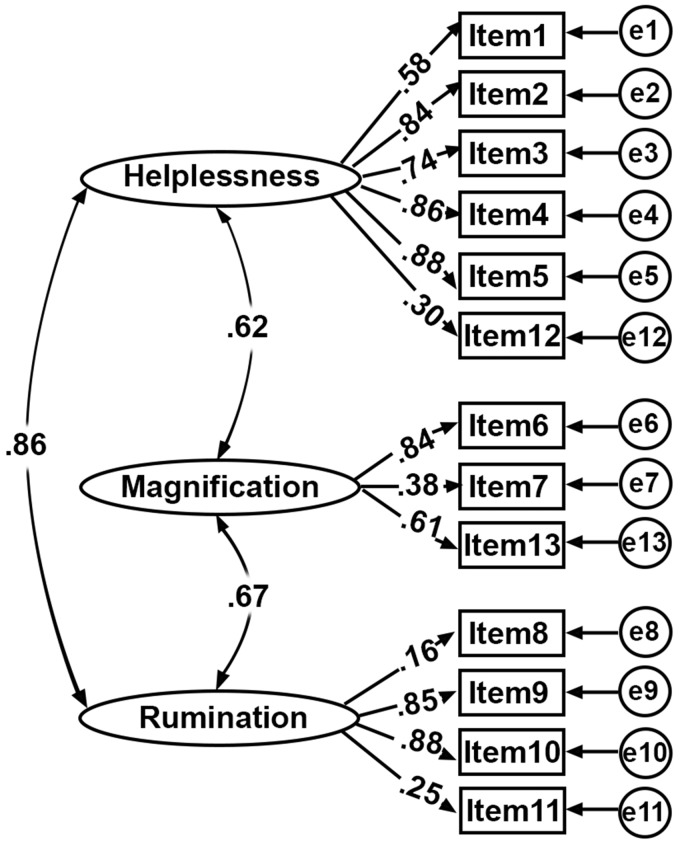
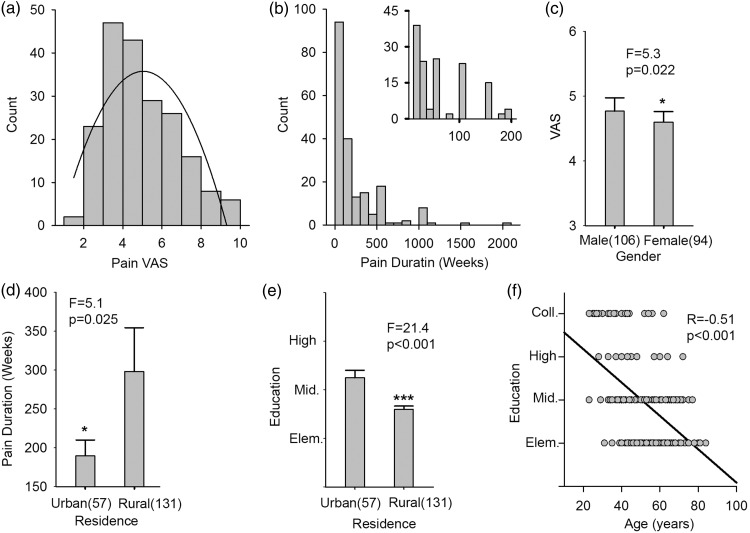
结果 组内相关系数表明,总分的重现性和时间一致性高(0.97)。SC-PCS 总分及其三个分量表(0.87、0.85、0.62 和 0.65)的克朗巴赫α值均表现出高内部一致性。SC-PCS 总分与其他测量指标,如疼痛视觉模拟量表、贝克抑郁量表、疼痛焦虑症状量表、正负情感量表和教育程度,呈中度或弱度(R=-0.2 至 0.49)但显著相关。我们使用探索性因子分析来检验 SC-PCS 的维度结构,结果表明当前的三因素模型不稳定。然而,验证性因子分析表明,三因素模型具有最佳的拟合优度。
结论 我们成功地将英语翻译成了简体中文,并证明了 SC-PCS 的可靠性和有效性。一个重要的发现是,教育程度与 SC-PCS 显著相关,这为其他跨文化自我报告测量的发展提供了未来的考虑因素。