Riphah Institute of Pharmaceutical Sciences, Riphah International University Lahore, Pakistan.
Department of Pharmacology, Faculty of Pharmaceutical Sciences, Government College University Faisalabad, Faisalabad, Pakistan.
Biomed Res Int. 2022 May 28;2022:2614599. doi: 10.1155/2022/2614599. eCollection 2022.
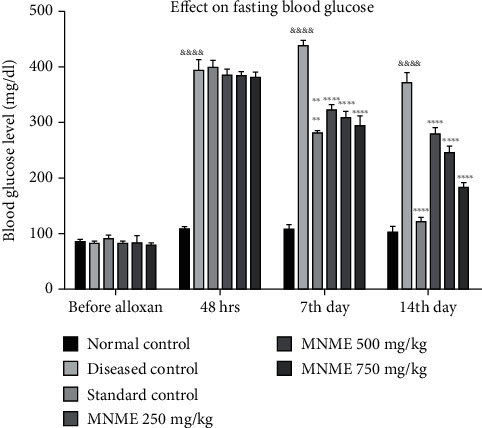
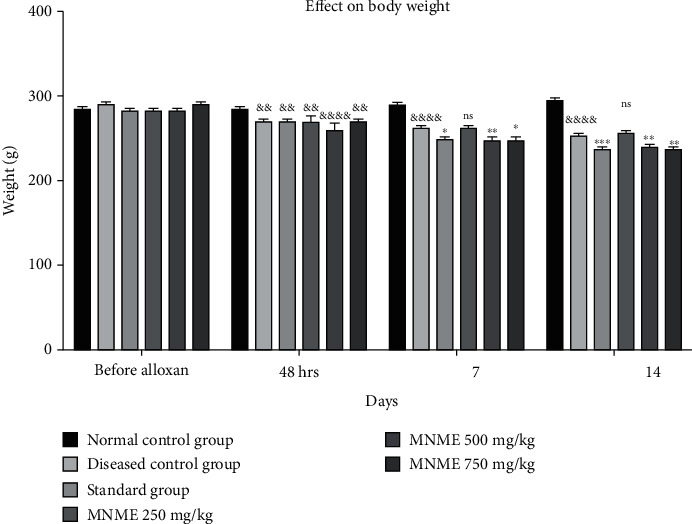
A high caloric food causes deposition of fats that may progress to obesity. Obesity is a risk factor for various metabolic and cardiovascular diseases, including but limited to diabetes mellitus. This study is aimed at determining the ameliorating effect of wallr aqueous-methanolic extract (MNME) on obesity and diabetes in Wistar rats. The MNME was chemically characterized by high-performance liquid chromatography (HPLC). The plant extract was evaluated by in vitro -amylase inhibition and DPPH scavenging activities. Obesity was induced by administering high sugar and fat diet (HSFD) to rats for six weeks, followed by intraperitoneal injection of alloxan monohydrate (150 mg/kg) to induce diabetes. Oral treatments with MNME 250, 500, and 750 mg/kg/day were given to diabetic obese rats for 14 days. The HPLC analysis showed the presence of phenolic acids and flavonoids. The plant extract showed significant antioxidant ( < 0.001) and alpha-amylase ( < 0.0001) inhibition activities. The administration of MNME displayed a considerable decrease in fasting blood glucose, body weight, liver function tests, urea, cholesterol, leptin, and insulin levels in diabetic obese rats as compared to the disease control group and maximum effect were observed at 750 mg/kg/day of MNME. The MNME significantly increased ( < 0.05 - 0.001) the levels of GSH, SOD, and CAT in the liver, kidney, and pancreas while notably ( < 0.05 - 0.001) reduced the malondialdehyde level in kidney and pancreas of diabetic obese rats in contrast to disease control rats. This experimental study concludes that the MNME had exhibited antiobesity and antidiabetic activities through reduction of oxidative stress, leptin, -amylase activity, and insulin resistance due to the presence of phenolic acid and flavonoid compounds.
高热量食物会导致脂肪沉积,进而导致肥胖。肥胖是多种代谢和心血管疾病的风险因素,包括但不限于糖尿病。本研究旨在确定马齿苋水-甲醇提取物(MNME)对 Wistar 大鼠肥胖和糖尿病的改善作用。MNME 通过高效液相色谱(HPLC)进行化学表征。通过体外淀粉酶抑制和 DPPH 清除活性评估植物提取物。通过给大鼠六周高糖高脂饮食(HSFD)诱导肥胖,然后腹腔注射一水合氧嘧啶(150mg/kg)诱导糖尿病。给糖尿病肥胖大鼠口服 MNME 250、500 和 750mg/kg/天 14 天。HPLC 分析表明存在酚酸和类黄酮。植物提取物显示出显著的抗氧化(<0.001)和α-淀粉酶(<0.0001)抑制活性。与疾病对照组相比,MNME 给药可显著降低糖尿病肥胖大鼠的空腹血糖、体重、肝功能试验、尿素、胆固醇、瘦素和胰岛素水平,最大效果在 MNME 750mg/kg/天。MNME 可显著增加(<0.05-0.001)糖尿病肥胖大鼠肝脏、肾脏和胰腺中 GSH、SOD 和 CAT 的水平,同时显著降低(<0.05-0.001)肾脏和胰腺中丙二醛的水平与疾病对照组大鼠相比。这项实验研究得出结论,MNME 通过减少氧化应激、瘦素、-淀粉酶活性和胰岛素抵抗,显示出抗肥胖和抗糖尿病活性,这归因于酚酸和类黄酮化合物的存在。