Department of Chemical and Structural Biology, Weizmann Institute of Science, Rehovot, Israel.
Protein Sci. 2022 Jul;31(7):e4361. doi: 10.1002/pro.4361.
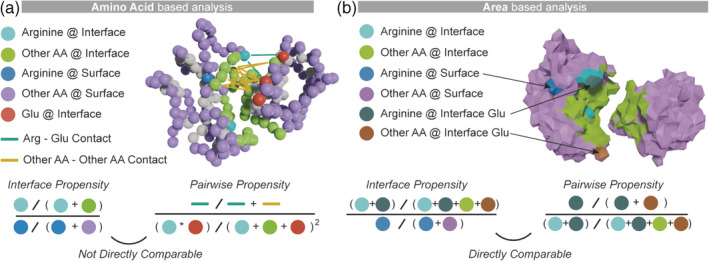
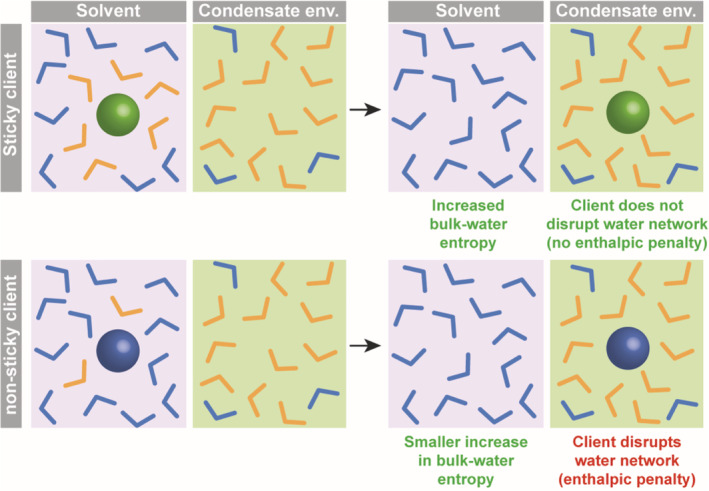
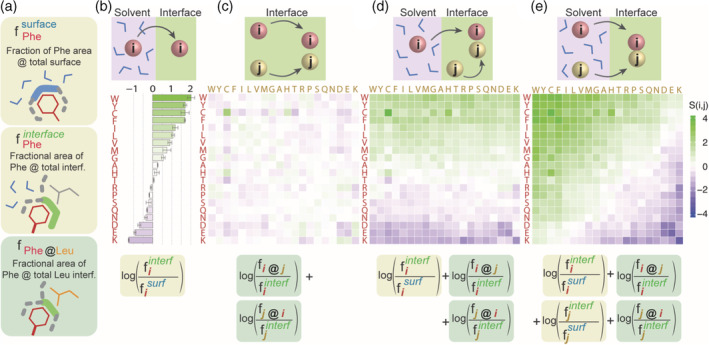
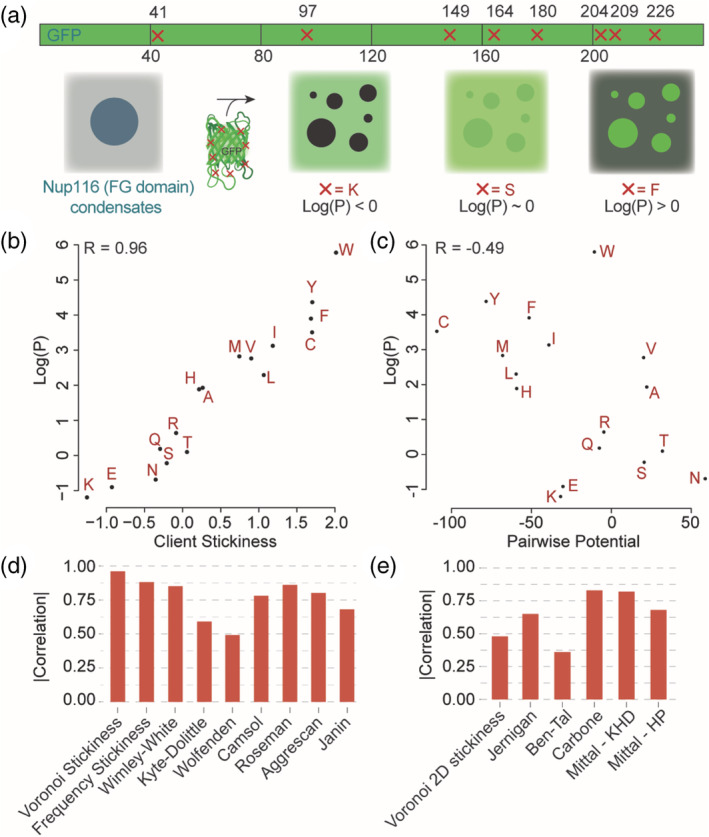
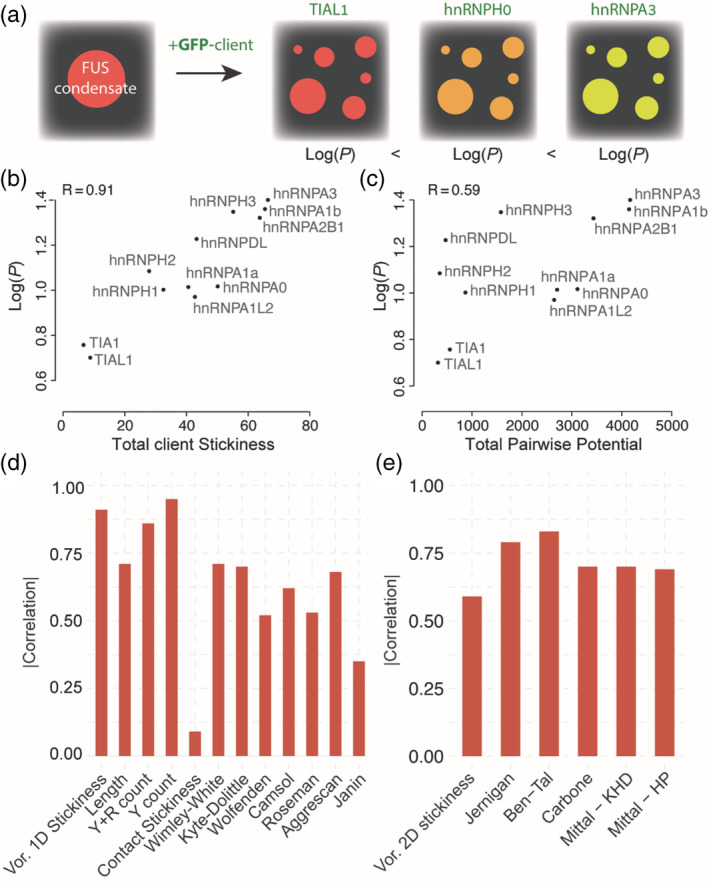
Membraneless organelles are cellular compartments that form by liquid-liquid phase separation of one or more components. Other molecules, such as proteins and nucleic acids, will distribute between the cytoplasm and the liquid compartment in accordance with the thermodynamic drive to lower the free energy of the system. The resulting distribution colocalizes molecular species to carry out a diversity of functions. Two factors could drive this partitioning: the difference in solvation between the dilute versus dense phase and intermolecular interactions between the client and scaffold proteins. Here, we develop a set of knowledge-based potentials that allow for the direct comparison between stickiness, which is dominated by desolvation energy, and pairwise residue contact propensity terms. We use these scales to examine experimental data from two systems: protein cargo dissolving within phase-separated droplets made from FG repeat proteins of the nuclear pore complex and client proteins dissolving within phase-separated FUS droplets. These analyses reveal a close agreement between the stickiness of the client proteins and the experimentally determined values of the partition coefficients (R > 0.9), while pairwise residue contact propensities between client and scaffold show weaker correlations. Hence, the stickiness of client proteins is sufficient to explain their differential partitioning within these two phase-separated systems without taking into account the composition of the condensate. This result implies that selective trafficking of client proteins to distinct membraneless organelles requires recognition elements beyond the client sequence composition. STATEMENT: Empirical potentials for amino acid stickiness and pairwise residue contact propensities are derived. These scales are unique in that they enable direct comparison of desolvation versus contact terms. We find that partitioning of a client protein to a condensate is best explained by amino acid stickiness.
无膜细胞器是通过一种或多种成分的液-液相分离形成的细胞区室。其他分子,如蛋白质和核酸,将根据降低系统自由能的热力学驱动力在细胞质和液相之间分配。由此产生的分布使分子物种共定位以执行多种功能。有两个因素可能导致这种分区:稀相和密相比之间的溶剂化差异以及客户和支架蛋白之间的分子间相互作用。在这里,我们开发了一组基于知识的势能,允许直接比较粘性(主要由去溶剂化能决定)和成对残基接触倾向项。我们使用这些尺度来检查来自两个系统的实验数据:蛋白质货物溶解在由核孔复合物的 FG 重复蛋白制成的相分离液滴中,以及客户蛋白溶解在相分离的 FUS 液滴中。这些分析表明,客户蛋白的粘性与其实验确定的分配系数(R>0.9)非常吻合,而客户和支架之间的成对残基接触倾向则显示出较弱的相关性。因此,客户蛋白的粘性足以解释它们在这两个相分离系统中的差异分区,而无需考虑凝聚物的组成。这一结果意味着客户蛋白选择性地运输到不同的无膜细胞器需要超越客户序列组成的识别元件。