Hildingsson Sofia, Gebre-Medhin Maria, Zschaeck Sebastian, Adrian Gabriel
Division of Oncology and Pathology, Clinical Sciences, Lund University, Lund, Sweden.
Department of Hematology, Oncology and Radiation Physics, Skåne University Hospital, Lund University, Lund, Sweden.
Clin Transl Radiat Oncol. 2022 Jun 15;36:40-46. doi: 10.1016/j.ctro.2022.06.004. eCollection 2022 Sep.
Hypoxia and large tumor volumes are negative prognostic factors for patients with head and neck squamous cell carcinoma (HNSCC) treated with radiation therapy (RT). PET-scanning with specific hypoxia-tracers (hypoxia-PET) can be used to non-invasively assess hypoxic tumor volume. Primary tumor volume is readily available for patients undergoing RT. However, the relationship between hypoxic volume and primary tumor volume is yet an open question. The current study investigates the hypotheses that larger tumors contain both a larger hypoxic volume and a higher hypoxic fraction.
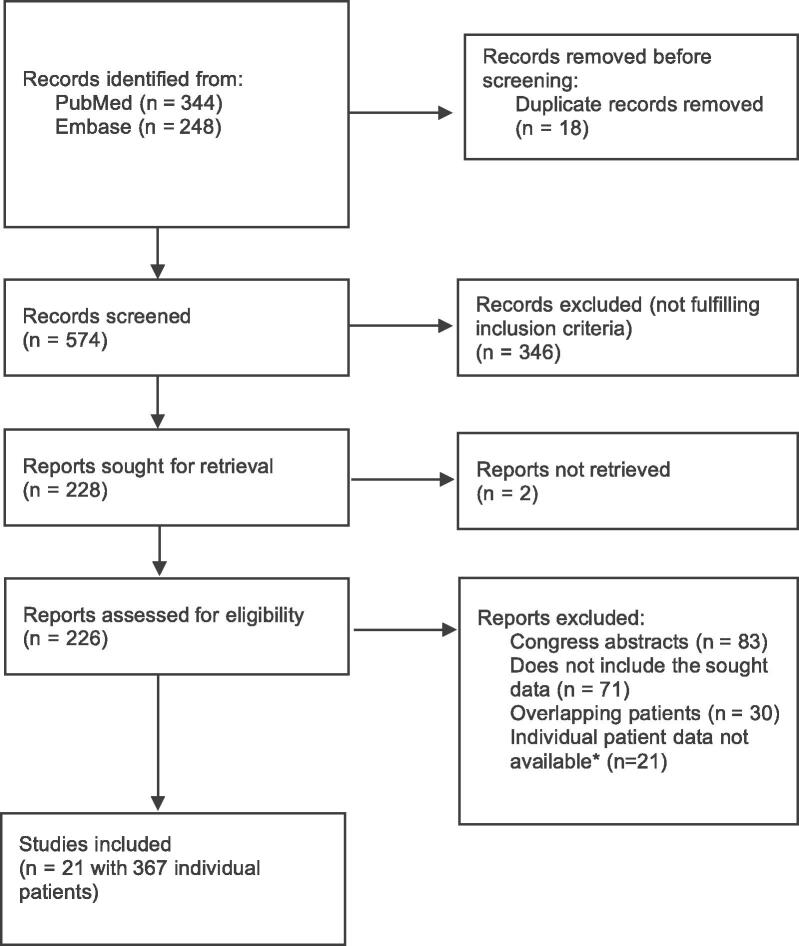
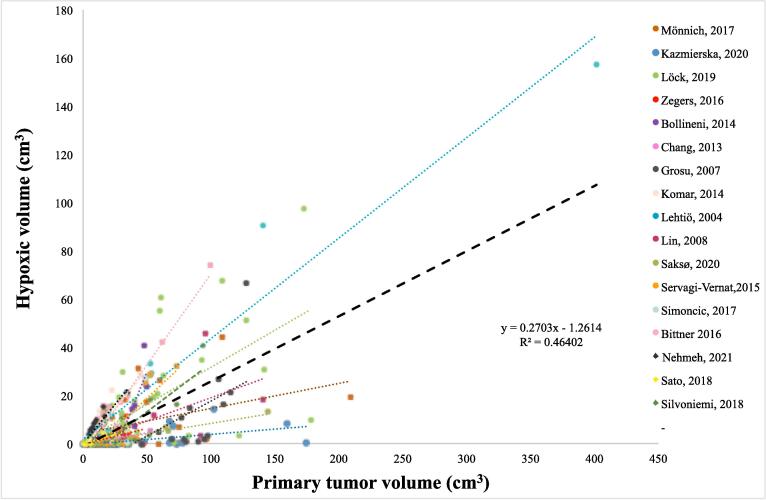
PubMed and Embase were systematically searched to identify articles fulfilling the predefined criteria. Individual tumor data (primary tumor volume and hypoxic volume/fraction) was extracted. Relationship between hypoxic volume and primary tumor volume was investigated by linear regression. The correlation between hypoxic fraction and log(primary tumor volume) was determined for each cohort and in a pooled analysis individual regression slopes and coefficients of determination (R) were weighted according to cohort size.
21 relevant articles were identified and individual data from 367 patients was extracted, out of which 323 patients from 17 studies had quantifiable volumes of interest. A correlation between primary tumor volume and PET-determined hypoxic volume was found ( Larger tumors had a significantly higher fraction of hypoxia compared with smaller tumors (.01). The weighted analysis of all studies revealed that for each doubling of the tumor volume, the hypoxic fraction increased by four percentage points.
This study shows correlations between primary tumor volume and hypoxic volume as well as primary tumor volume and the hypoxic fraction in patients with HNSCC. The findings suggest that not only do large tumors contain more cancer cells, they also have a higher proportion of potentially radioresistant hypoxic cells. This knowledge can be important when individualizing RT.
缺氧和大肿瘤体积是接受放射治疗(RT)的头颈部鳞状细胞癌(HNSCC)患者的不良预后因素。使用特定缺氧示踪剂的PET扫描(缺氧PET)可用于无创评估缺氧肿瘤体积。接受RT的患者的原发肿瘤体积很容易获得。然而,缺氧体积与原发肿瘤体积之间的关系仍是一个悬而未决的问题。当前研究调查了以下假设:更大的肿瘤既包含更大的缺氧体积,也包含更高的缺氧分数。
系统检索PubMed和Embase以识别符合预定义标准的文章。提取个体肿瘤数据(原发肿瘤体积和缺氧体积/分数)。通过线性回归研究缺氧体积与原发肿瘤体积之间的关系。确定每个队列中缺氧分数与log(原发肿瘤体积)之间的相关性,并在汇总分析中根据队列大小对个体回归斜率和决定系数(R)进行加权。
识别出21篇相关文章,并提取了367例患者的个体数据,其中来自17项研究的323例患者有可量化的感兴趣体积。发现原发肿瘤体积与PET确定的缺氧体积之间存在相关性(与较小肿瘤相比,较大肿瘤的缺氧分数显著更高(.01)。所有研究的加权分析显示,肿瘤体积每增加一倍,缺氧分数增加4个百分点。
本研究显示了HNSCC患者原发肿瘤体积与缺氧体积以及原发肿瘤体积与缺氧分数之间的相关性。研究结果表明,大肿瘤不仅包含更多癌细胞,还具有更高比例的潜在放射抗性缺氧细胞。在放疗个体化时,这一知识可能很重要。