Yuan Chaonan, Wang Xiao, Pecoraro Lorenzo
School of Pharmaceutical Science and Technology, Tianjin University, Tianjin, China.
Front Microbiol. 2022 Jun 14;13:928921. doi: 10.3389/fmicb.2022.928921. eCollection 2022.
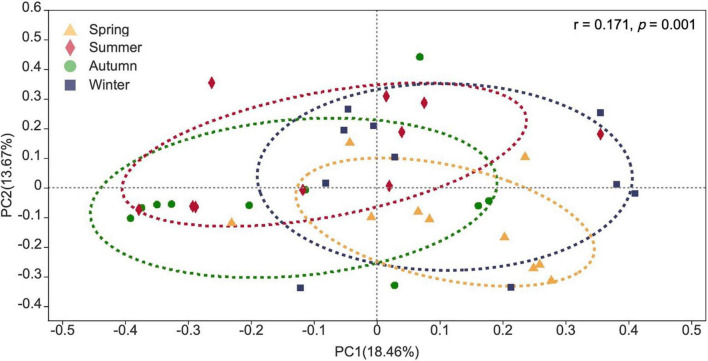
Airborne fungi have significant influence on air quality and may pose adverse effects on human health due to their allergenic and pathogenic effect. We carried out a 1-year survey on the airborne fungal diversity and concentration of indoor and outdoor environments, within the Tianjin University campus. Airborne fungi were sampled using an HAS-100B air sampler. Isolated fungal strains were identified based on morphological and molecular analysis. A total of 641 fungal strains belonging to 173 species and 74 genera were identified in this study. The dominant fungal genera were (29.49%), (25.9%), and (6.24%), while the most frequently occurring species were (15.44%), (11.86%), and (5.77%). The mean fungal concentration at different sites ranged from 0 to 420 CFU/m, which is lower than the permissive standard level. There was a seasonal variation in the airborne fungal community, while temperature and relative humidity were positively correlated with the fungal concentration and diversity at almost all the sites. Higher fungal diversity was recorded in peak period of human traffic at the two canteens, whereas the two dormitories showed higher fungal diversity in off-peak period. Our study provides the first report on the diversity and concentration of airborne fungal species within different Tianjin University campus environments and clarifies the role played by environmental factors on the analyzed fungal community. Our results may represent valuable information for air quality monitoring and microbial pollution control in densely populated human living environments.
空气传播的真菌对空气质量有重大影响,由于其致敏和致病作用,可能对人类健康造成不利影响。我们对天津大学校园内室内和室外环境中的空气传播真菌多样性和浓度进行了为期一年的调查。使用HAS - 100B空气采样器采集空气传播真菌。基于形态学和分子分析对分离出的真菌菌株进行鉴定。本研究共鉴定出641株真菌菌株,分属于74属173种。优势真菌属为(29.49%)、(25.9%)和(6.24%),而最常见的物种为(15.44%)、(11.86%)和(5.77%)。不同地点的真菌平均浓度在0至420 CFU/m之间,低于许可标准水平。空气传播真菌群落存在季节变化,而温度和相对湿度与几乎所有地点的真菌浓度和多样性呈正相关。两个食堂在人员流动高峰期记录到较高的真菌多样性,而两个宿舍在非高峰期显示出较高的真菌多样性。我们的研究首次报告了天津大学校园不同环境中空气传播真菌物种的多样性和浓度,并阐明了环境因素对所分析真菌群落的作用。我们的结果可能为人口密集的人类居住环境中的空气质量监测和微生物污染控制提供有价值的信息。