Department of Environmental and Global Health, Center for Environmental and Human Toxicology, Emerging Pathogens Institute, University of Florida, Gainesville, Florida, 32611, USA.
Division of Infectious Diseases & Global Medicine, University of Florida, Gainesville, Florida, 32611, USA.
Respir Res. 2022 Jul 2;23(1):177. doi: 10.1186/s12931-022-02091-w.
Respiratory infections such as influenza account for significant global mortality each year. Generating lipid profiles is a novel and emerging research approach that may provide new insights regarding the development and progression of priority respiratory infections. We hypothesized that select clusters of lipids in human sputum would be associated with specific viral infections (Influenza (H1N1, H3N2) or Rhinovirus).
Lipid identification and semi-quantitation was determined with liquid chromatography and high-resolution mass spectrometry in induced sputum from individuals with confirmed respiratory infections (influenza (H1N1, H3N2) or rhinovirus). Clusters of lipid species and associations between lipid profiles and the type of respiratory viral agent was determined using Bayesian profile regression and multinomial logistic regression.
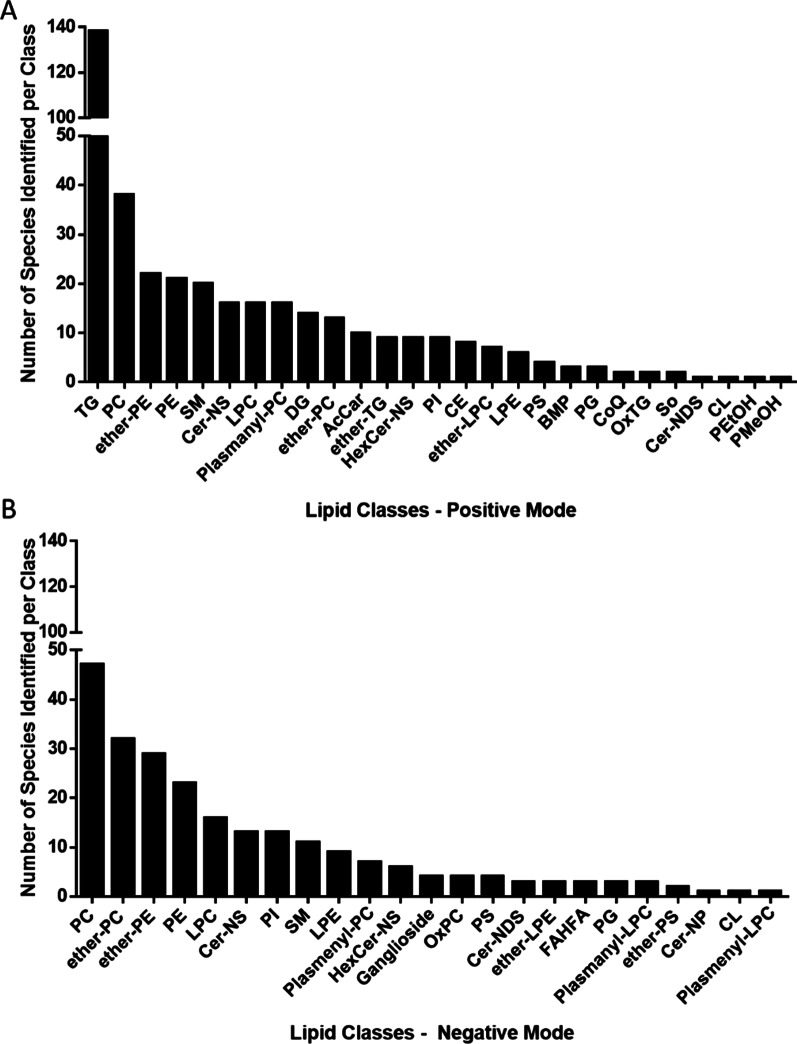
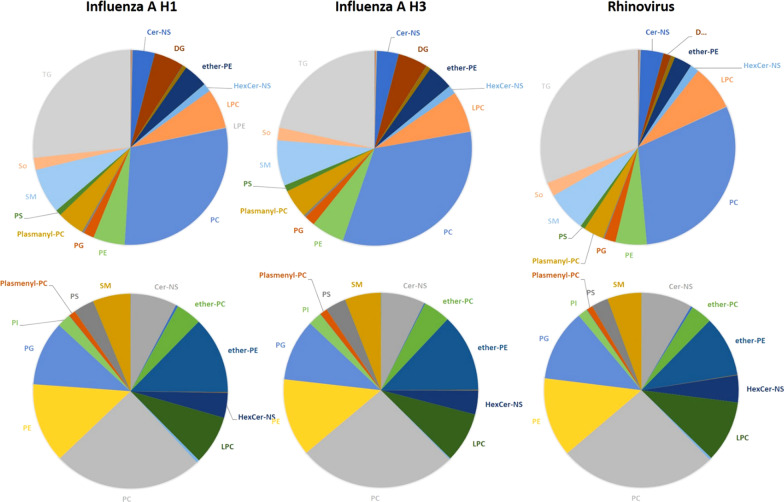
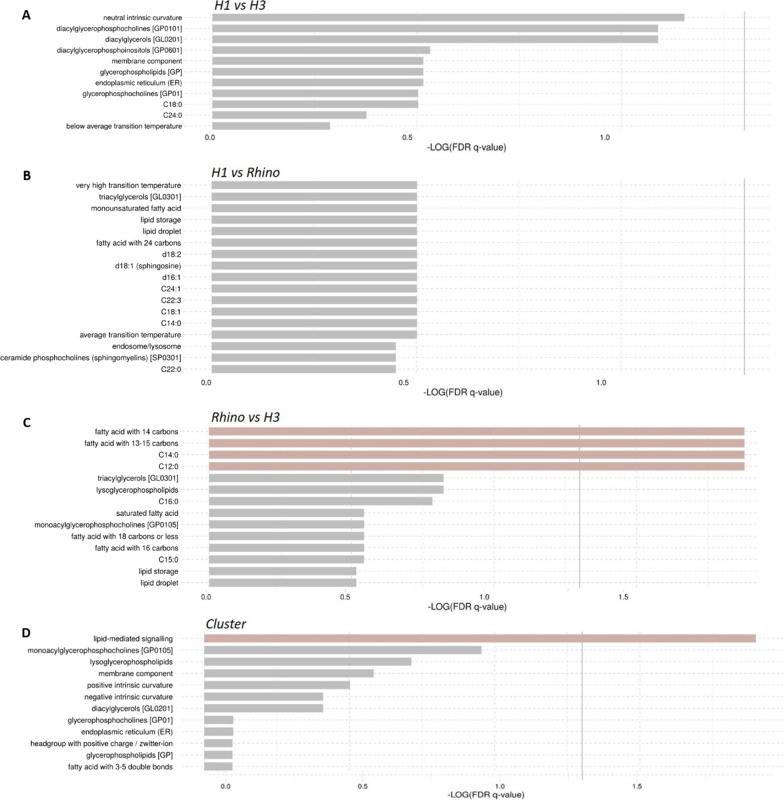
More than 600 lipid compounds were identified across the sputum samples with the most abundant lipid classes identified as triglycerides (TG), phosphatidylethanolamines (PE), phosphatidylcholines (PC), Sphingomyelins (SM), ether-PC, and ether-PE. A total of 12 lipid species were significantly different when stratified by infection type and included acylcarnitine (AcCar) (10:1, 16:1, 18:2), diacylglycerols (DG) (16:0_18:0, 18:0_18:0), Lysophosphatidylcholine (LPC) (12:0, 20:5), PE (18:0_18:0), and TG (14:1_16:0_18:2, 15:0_17:0_19:0, 16:0_17:0_18:0, 19:0_19:0_19:0). Cluster analysis yielded three clusters of lipid profiles that were driven by just 10 lipid species (TGs and DGs). Cluster 1 had the highest levels of each lipid species and the highest prevalence of influenza A H3 infection (56%, n = 5) whereas cluster 3 had lower levels of each lipid species and the highest prevalence of rhinovirus (60%; n = 6). Using cluster 3 as the reference group, the crude odds of influenza A H3 infection compared to rhinovirus in cluster 1 was significantly (p = 0.047) higher (OR = 15.00 [95% CI: 1.03, 218.29]). After adjustment for confounders (smoking status and pulmonary comorbidities), the odds ratio (OR) became only marginally significant (p = 0.099), but the magnitude of the effect estimate was similar (OR = 16.00 [0.59, 433.03]).
In this study, human sputum lipid profiles were shown to be associated with distinct types of viral infection. Better understanding the relationship between respiratory infections of global importance and lipids contributes to advancing knowledge of pathogenesis of infections including identifying populations with increased susceptibility and developing effective therapeutics and biomarkers of health status.
流感等呼吸道感染每年都会导致大量全球死亡。生成脂质谱是一种新颖且正在发展的研究方法,它可能为优先呼吸道感染的发展和进展提供新的见解。我们假设人类痰液中的某些脂质簇与特定的病毒感染(流感(H1N1、H3N2)或鼻病毒)有关。
使用液相色谱和高分辨率质谱法在确诊呼吸道感染(流感(H1N1、H3N2)或鼻病毒)患者的诱导痰中确定脂质的鉴定和半定量。使用贝叶斯轮廓回归和多项逻辑回归确定脂质种类簇和脂质谱与呼吸道病毒剂类型之间的关联。
在痰液样本中鉴定出超过 600 种脂质化合物,最丰富的脂质类别为甘油三酯(TG)、磷脂酰乙醇胺(PE)、磷脂酰胆碱(PC)、神经鞘磷脂(SM)、醚-PC 和醚-PE。按感染类型分层时,共有 12 种脂质种类差异显著,包括酰基辅酶 A(AcCar)(10:1、16:1、18:2)、二酰甘油(DG)(16:0_18:0、18:0_18:0)、溶血磷脂酰胆碱(LPC)(12:0、20:5)、PE(18:0_18:0)和 TG(14:1_16:0_18:2、15:0_17:0_19:0、16:0_17:0_18:0、19:0_19:0_19:0)。聚类分析产生了三个由仅 10 种脂质(TG 和 DG)驱动的脂质谱簇。簇 1 具有每种脂质的最高水平,且甲型流感 H3 感染的患病率最高(56%,n=5),而簇 3 则具有每种脂质的较低水平,且鼻病毒的患病率最高(60%;n=6)。使用簇 3 作为参考组,与鼻病毒相比,甲型流感 H3 感染在簇 1 中的粗比值比(OR)明显更高(p=0.047)(OR=15.00 [95%CI:1.03,218.29])。在调整混杂因素(吸烟状况和肺部合并症)后,比值比(OR)仅略有统计学意义(p=0.099),但效应估计值的幅度相似(OR=16.00 [0.59, 433.03])。
在这项研究中,人类痰液中的脂质谱与不同类型的病毒感染有关。更好地了解全球重要呼吸道感染和脂质之间的关系有助于深入了解感染的发病机制,包括确定易感染人群以及开发有效的治疗方法和健康状况的生物标志物。