
通过单细胞RNA测序深入了解2,3,7,8-四氯二苯并对二恶英诱导的斑马鱼精子发生破坏。
Insight into 2,3,7,8-tetrachlorodibenzo-p-dioxin-induced disruption of zebrafish spermatogenesis via single cell RNA-seq.
作者信息
Haimbaugh Alex, Akemann Camille, Meyer Danielle, Gurdziel Katherine, Baker Tracie R
机构信息
Department of Pharmacology, School of Medicine, Wayne State University, Detroit, MI 48207, USA.
Applied Genome Technology Center, School of Medicine, Wayne State University, Detroit, MI 48207, USA.
出版信息
PNAS Nexus. 2022 Jun 22;1(3):pgac060. doi: 10.1093/pnasnexus/pgac060. eCollection 2022 Jul.
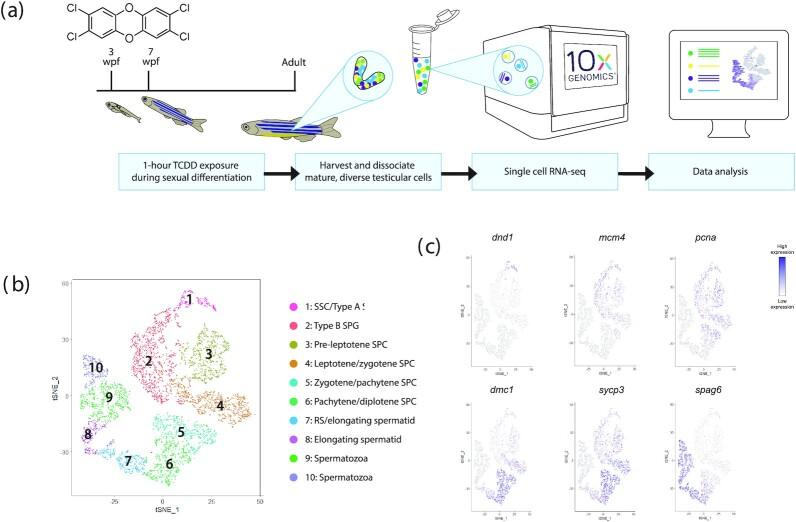
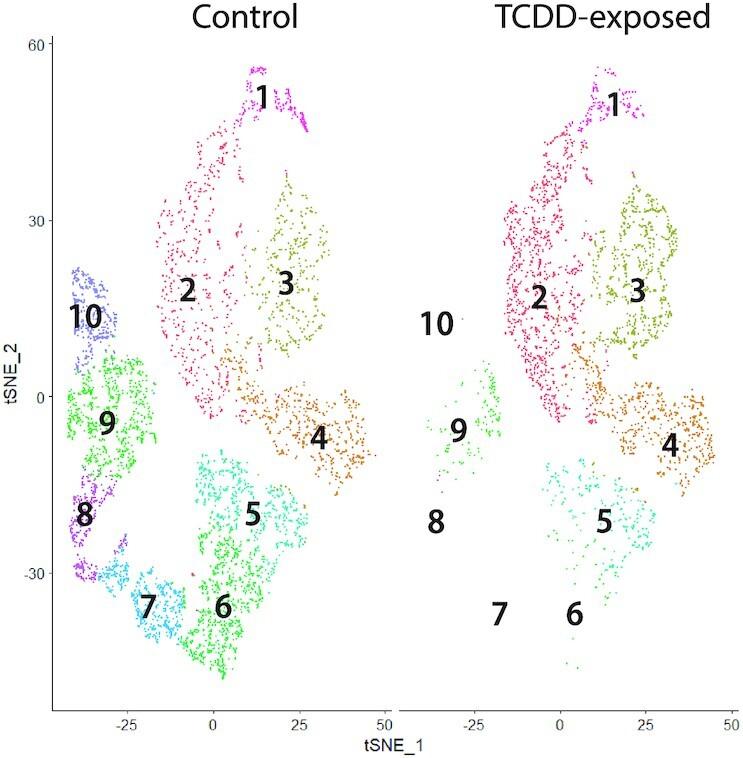
2,3,7,8-Tetrachlorodibenzo-p-dioxin (TCDD) is a potent and environmentally persistent endocrine disrupting chemical. Our previous work demonstrated the latent reproductive maladies of early-life TCDD exposure in zebrafish. Zebrafish acutely exposed to low, environmentally relevant levels of TCDD (50 pg/mL) during two windows of sexual differentiation in development (1 hour of exposure at 3 and 7 weeks postfertilization) were later infertile, showed a reduction in sperm, and exhibited gene expression consistent with an altered microenvironment, even months after exposure. Due to the highly heterogeneous cell- type and -stage landscape of the testes, we hypothesized various cell types contribute markedly different profiles toward the pathology of TCDD exposure. To investigate the contributions of the diverse cell types in the adult zebrafish testes to TCDD-induced pathology, we utilized single-cell RNA-seq and the 10x Genomics platform. The method successfully captured every stage of testicular germ cell development. Testes of adult fish exposed during sexual differentiation to TCDD contained sharply decreased populations of late spermatocytes, spermatids, and spermatozoa. Spermatogonia and early spermatocyte populations were, in contrast, enriched following exposure. Pathway analysis of differentially expressed genes supported previous findings that TCDD exposure resulted in male infertility, and suggested this outcome is due to apoptosis of spermatids and spermatozoa, even years after exposure cessation. Increased germ cell apoptosis was confirmed histologically. These results provide support for an environmental exposure explanation of idiopathic male infertility.
2,3,7,8-四氯二苯并对二恶英(TCDD)是一种强效且在环境中持久存在的内分泌干扰化学物质。我们之前的研究表明,斑马鱼在生命早期接触TCDD会引发潜在的生殖疾病。在发育过程中的两个性别分化窗口期(受精后3周和7周各暴露1小时),斑马鱼急性暴露于低水平、与环境相关的TCDD(50 pg/mL)中,之后出现不育,精子数量减少,并且即使在暴露数月后,其基因表达也显示出微环境改变。由于睾丸的细胞类型和阶段高度异质性,我们推测不同细胞类型对TCDD暴露病理学的影响显著不同。为了研究成年斑马鱼睾丸中不同细胞类型对TCDD诱导病理学的作用,我们利用了单细胞RNA测序和10x基因组学平台。该方法成功捕获了睾丸生殖细胞发育的各个阶段。在性别分化期间暴露于TCDD的成年鱼的睾丸中,晚期精母细胞、精子细胞和精子的数量急剧减少。相比之下,精原细胞和早期精母细胞群体在暴露后有所富集。对差异表达基因的通路分析支持了之前的研究结果,即TCDD暴露会导致雄性不育,并表明这种结果是由于精子细胞和精子的凋亡,即使在停止暴露数年之后也是如此。组织学检查证实了生殖细胞凋亡增加。这些结果为特发性男性不育的环境暴露解释提供了支持。



 Zotero 插件