Laboratory of Ecohydrology, École Polytechnique Fédérale de Lausanne, Lausanne, Switzerland.
Dipartimento di Scienze Ambientali, Informatica e Statistica, Università Ca' Foscari Venezia, Venezia-Mestre, Italy.
PLoS Comput Biol. 2022 Jul 8;18(7):e1010237. doi: 10.1371/journal.pcbi.1010237. eCollection 2022 Jul.
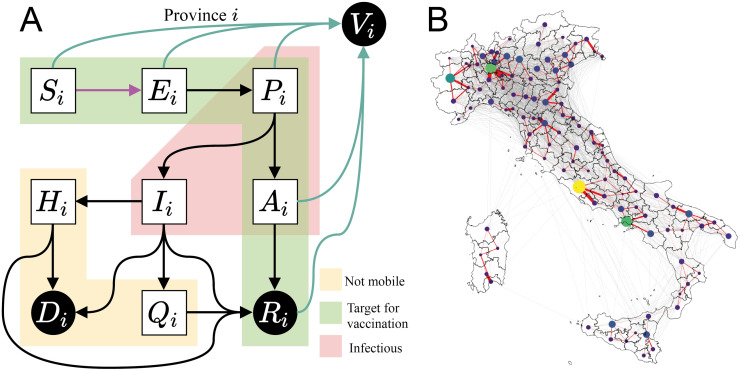
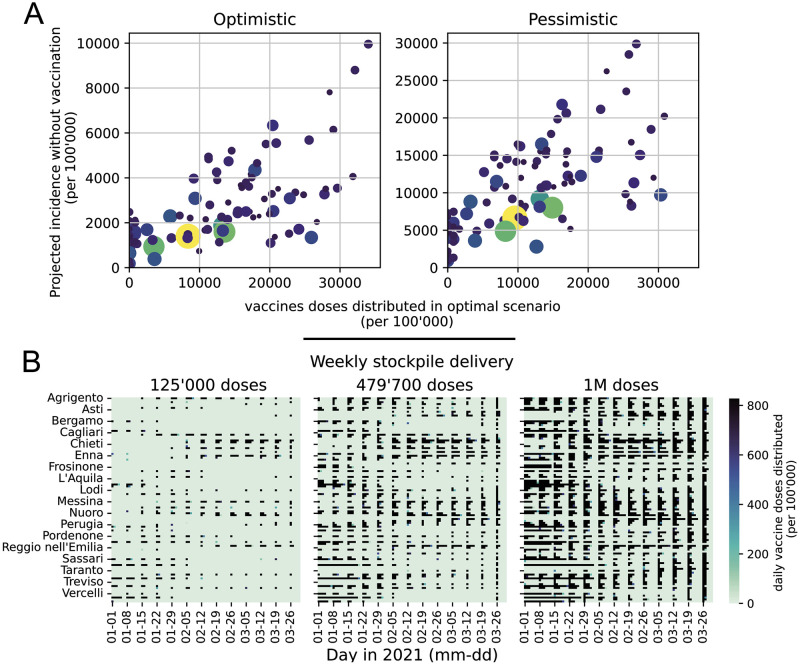
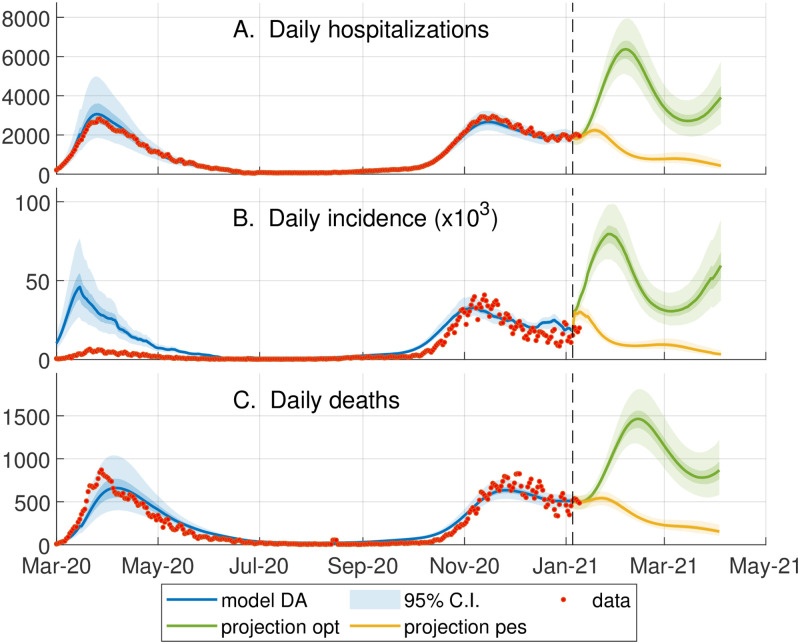
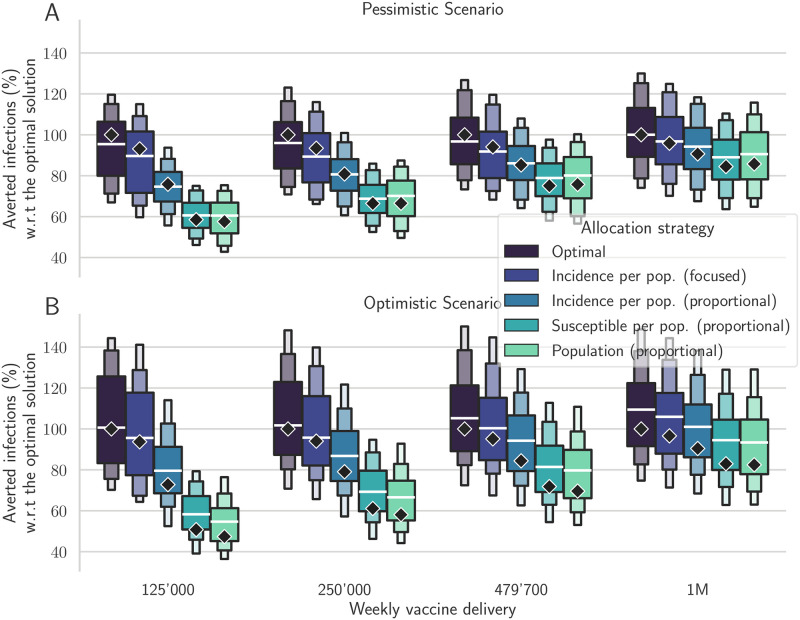
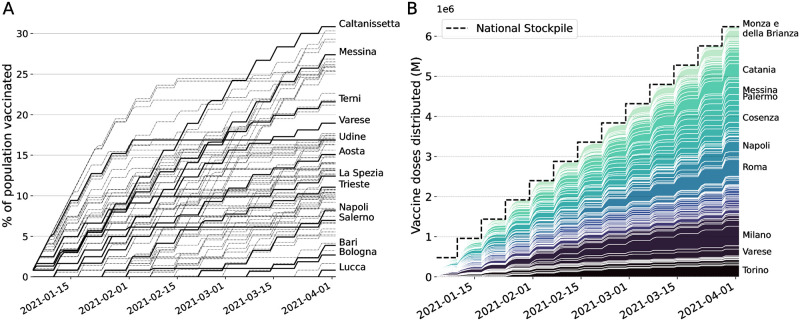
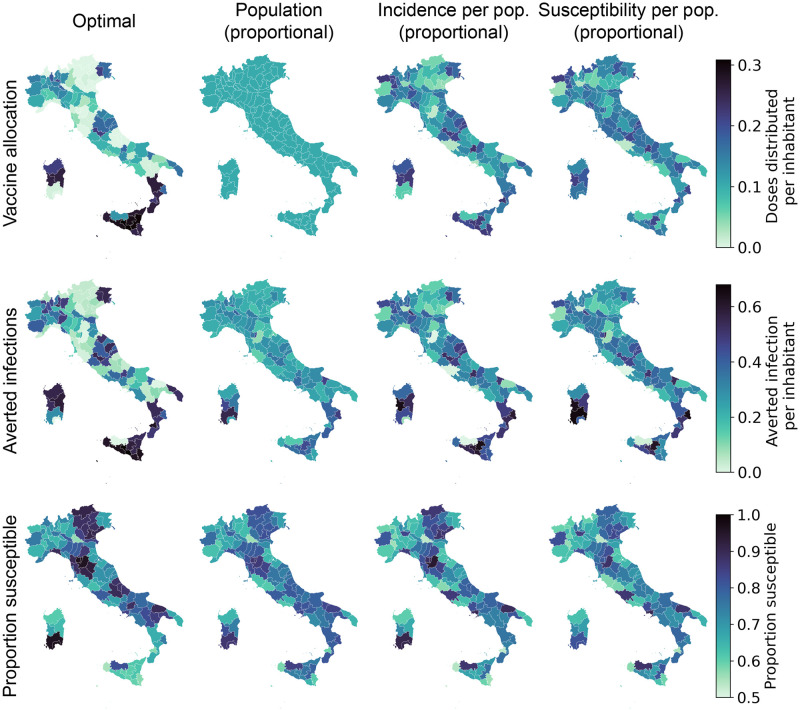
While campaigns of vaccination against SARS-CoV-2 are underway across the world, communities face the challenge of a fair and effective distribution of a limited supply of doses. Current vaccine allocation strategies are based on criteria such as age or risk. In the light of strong spatial heterogeneities in disease history and transmission, we explore spatial allocation strategies as a complement to existing approaches. Given the practical constraints and complex epidemiological dynamics, designing effective vaccination strategies at a country scale is an intricate task. We propose a novel optimal control framework to derive the best possible vaccine allocation for given disease transmission projections and constraints on vaccine supply and distribution logistics. As a proof-of-concept, we couple our framework with an existing spatially explicit compartmental COVID-19 model tailored to the Italian geographic and epidemiological context. We optimize the vaccine allocation on scenarios of unfolding disease transmission across the 107 provinces of Italy, from January to April 2021. For each scenario, the optimal solution significantly outperforms alternative strategies that prioritize provinces based on incidence, population distribution, or prevalence of susceptibles. Our results suggest that the complex interplay between the mobility network and the spatial heterogeneities implies highly non-trivial prioritization strategies for effective vaccination campaigns. Our work demonstrates the potential of optimal control for complex and heterogeneous epidemiological landscapes at country, and possibly global, scales.
虽然世界各地正在开展针对 SARS-CoV-2 的疫苗接种运动,但社区仍面临公平有效地分配有限剂量的挑战。当前的疫苗分配策略基于年龄或风险等标准。鉴于疾病史和传播存在强烈的空间异质性,我们探讨了空间分配策略作为现有方法的补充。鉴于实际限制和复杂的流行病学动态,在国家层面设计有效的疫苗接种策略是一项复杂的任务。我们提出了一种新的最优控制框架,根据疾病传播预测以及疫苗供应和分配物流的限制,为给定的疫苗分配方案提供最佳的疫苗分配。作为概念验证,我们将我们的框架与针对意大利地理和流行病学背景量身定制的现有的空间显式 COVID-19 模型耦合。我们针对意大利 2021 年 1 月至 4 月期间疾病传播的展开情况,在 107 个省份进行了疫苗分配的优化。对于每种情况,最优解都明显优于基于发病率、人口分布或易感染者流行率来优先考虑省份的替代策略。我们的结果表明,移动网络和空间异质性之间的复杂相互作用意味着对于有效的疫苗接种运动,需要采用高度非平凡的优先级策略。我们的工作表明,最优控制在国家和可能的全球范围内的复杂和异质的流行病学景观中具有潜力。