Biotechnical Faculty, University of Ljubljana, 1000 Ljubljana, Slovenia.
Department of Molecular and Biomedical Sciences, Jožef Stefan Institute, 1000 Ljubljana, Slovenia.
Int J Mol Sci. 2022 Jun 23;23(13):6972. doi: 10.3390/ijms23136972.
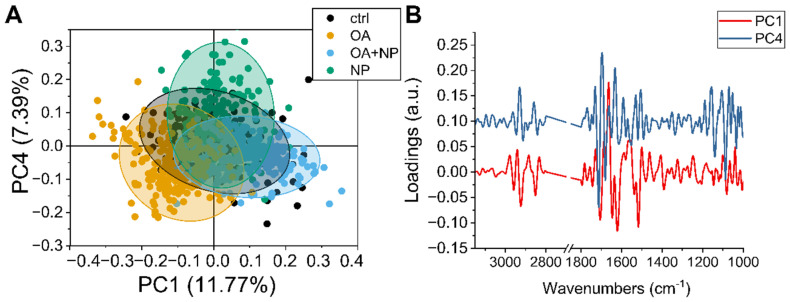
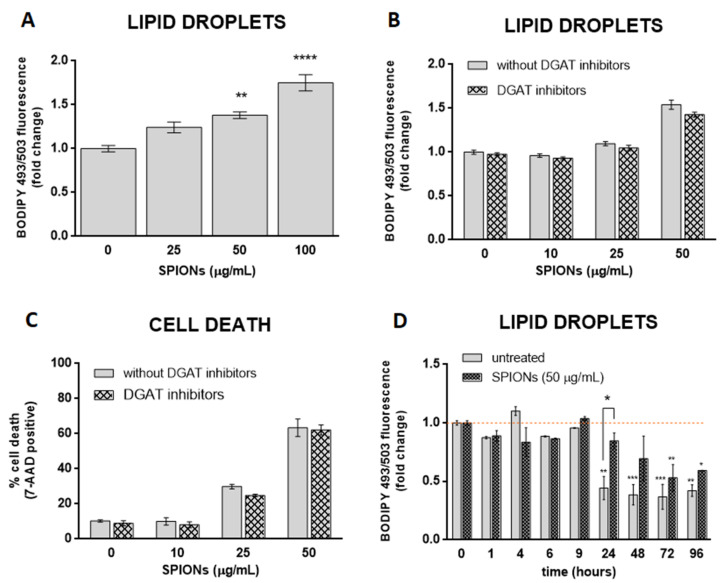
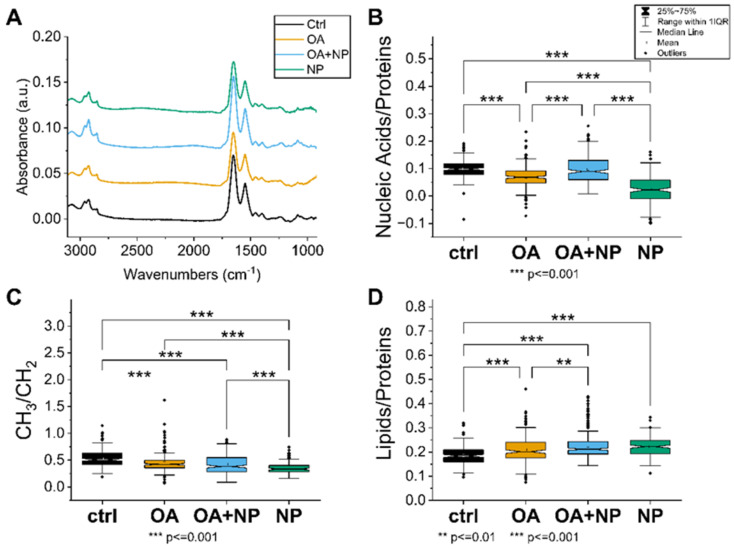
Superparamagnetic iron oxide nanoparticles (SPIONs) have great potential for use in medicine, but they may cause side effects due to oxidative stress. In our study, we investigated the effects of silica-coated SPIONs on endothelial cells and whether oleic acid (OA) can protect the cells from their harmful effects. We used viability assays, flow cytometry, infrared spectroscopy, fluorescence microscopy, and transmission electron microscopy. Our results show that silica-coated SPIONs are internalized by endothelial cells, where they increase the amount of reactive oxygen species (ROS) and cause cell death. Exposure to silica-coated SPIONs induced accumulation of lipid droplets (LD) that was not dependent on diacylglycerol acyltransferase (DGAT)-mediated LD biogenesis, suggesting that silica-coated SPIONs suppress LD degradation. Addition of exogenous OA promoted LD biogenesis and reduced SPION-dependent increases in oxidative stress and cell death. However, exogenous OA protected cells from SPION-induced cell damage even in the presence of DGAT inhibitors, implying that LDs are not required for the protective effect of exogenous OA. The molecular phenotype of the cells determined by Fourier transform infrared spectroscopy confirmed the destructive effect of silica-coated SPIONs and the ameliorative role of OA in the case of oxidative stress. Thus, exogenous OA protects endothelial cells from SPION-induced oxidative stress and cell death independent of its incorporation into triglycerides.
超顺磁性氧化铁纳米粒子(SPIONs)在医学中有很大的应用潜力,但由于氧化应激,它们可能会引起副作用。在我们的研究中,我们研究了硅涂层 SPIONs 对内皮细胞的影响,以及油酸(OA)是否可以保护细胞免受其有害影响。我们使用了细胞活力测定、流式细胞术、红外光谱、荧光显微镜和透射电子显微镜。我们的结果表明,硅涂层 SPIONs 被内皮细胞内化,在细胞内增加活性氧(ROS)的含量并导致细胞死亡。暴露于硅涂层 SPIONs 诱导脂滴(LD)的积累,这与二酰基甘油酰基转移酶(DGAT)介导的 LD 生物发生无关,表明硅涂层 SPIONs 抑制 LD 降解。添加外源性 OA 促进 LD 生物发生,并减少 SPION 依赖性氧化应激和细胞死亡的增加。然而,外源性 OA 即使在 DGAT 抑制剂存在的情况下也能保护细胞免受 SPION 诱导的细胞损伤,这表明 LD 对于外源性 OA 的保护作用不是必需的。傅里叶变换红外光谱法确定的细胞分子表型证实了硅涂层 SPIONs 的破坏作用和 OA 在氧化应激情况下的改善作用。因此,外源性 OA 可保护内皮细胞免受 SPION 诱导的氧化应激和细胞死亡,而与将其掺入三酸甘油脂无关。