Department of Medicinal Chemistry and the Institute for Structural Biology, Drug Discovery and Development, School of Pharmacy, Virginia Commonwealth University, Richmond, VA 23298, USA.
Department of Pharmaceutical Chemistry, King Abdulaziz University, Alsulaymanyah, Jeddah 21589, Saudi Arabia.
Int J Mol Sci. 2022 Jul 4;23(13):7448. doi: 10.3390/ijms23137448.
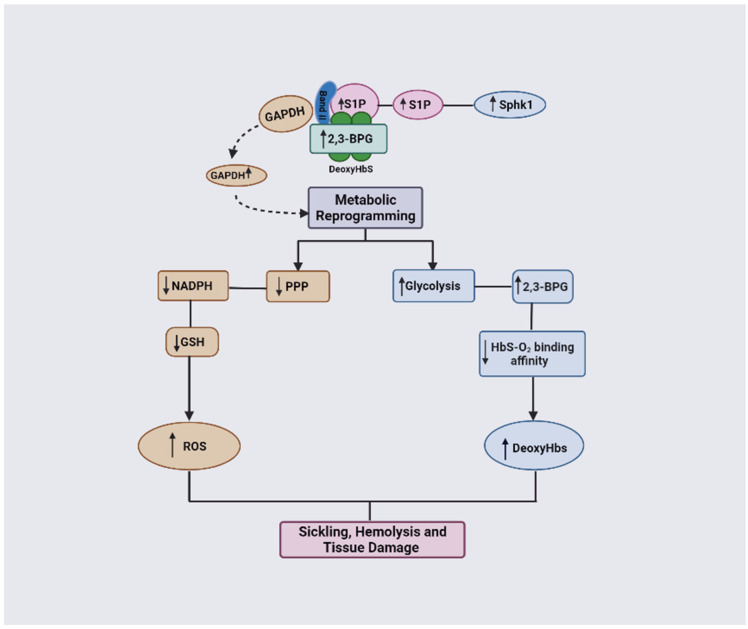
Sickle cell disease (SCD) is a genetic disorder that affects millions of individuals worldwide. Chronic anemia, hemolysis, and vasculopathy are associated with SCD, and their role has been well characterized. These symptoms stem from hemoglobin (Hb) polymerization, which is the primary event in the molecular pathogenesis of SCD and contributes to erythrocyte or red blood cell (RBC) sickling, stiffness, and vaso-occlusion. The disease is caused by a mutation at the sixth position of the β-globin gene, coding for sickle Hb (HbS) instead of normal adult Hb (HbA), which under hypoxic conditions polymerizes into rigid fibers to distort the shapes of the RBCs. Only a few therapies are available, with the universal effectiveness of recently approved therapies still being monitored. In this review, we first focus on how sickle RBCs have altered metabolism and then highlight how this understanding reveals potential targets involved in the pathogenesis of the disease, which can be leveraged to create novel therapeutics for SCD.
镰状细胞病(SCD)是一种影响全球数百万人的遗传性疾病。慢性贫血、溶血和血管病变与 SCD 相关,其作用已得到充分描述。这些症状源于血红蛋白(Hb)聚合,这是 SCD 分子发病机制中的主要事件,并导致红细胞或红血球(RBC)镰变、僵硬和血管阻塞。该疾病是由β-球蛋白基因第六位的突变引起的,该突变导致产生镰状血红蛋白(HbS)而不是正常成人血红蛋白(HbA),在缺氧条件下,HbS 聚合形成刚性纤维,从而改变 RBC 的形状。目前只有少数几种疗法可用,最近批准的疗法的普遍有效性仍在监测中。在这篇综述中,我们首先关注镰状 RBC 如何改变代谢,然后强调这种理解如何揭示疾病发病机制中涉及的潜在靶点,这些靶点可用于为 SCD 创造新的治疗方法。