Santra Hiran K, Banerjee Debdulal
Microbiology and Microbial Biotechnology Laboratory, Department of Botany and Forestry, Vidyasagar University, Midnapore, India.
Front Microbiol. 2022 Jun 23;13:920561. doi: 10.3389/fmicb.2022.920561. eCollection 2022.
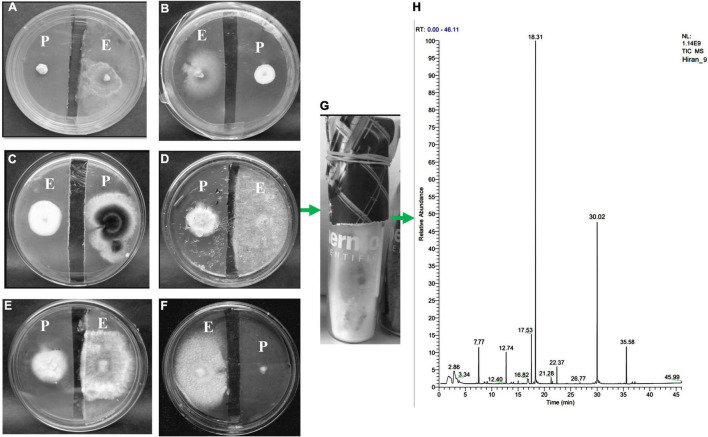
Endophytes are the mutualistic microorganisms that reside within the host plant and promote plant growth in adverse conditions. Plants and their endophytes are engaged in a symbiotic relationship that enables endophytes to access bioactive genes of the ethnomedicinal plants, and, as a result, endophytes are constantly addressed in the sector of pharmaceuticals and agriculture for their multidomain bio-utility. The gradual increase of antimicrobial resistance can be effectively countered by the endophytic metabolites. In these circumstances, in the present investigation, endophytic HelS1 was isolated from an ethnomedicinally valuable plant from East India's forests. The secondary volatile and non-volatile metabolites are extracted from HelS1 and are found to be effective broad-spectrum antimicrobials. A total of 26 secondary metabolites (9 volatiles and 17 non-volatiles) are extracted from the isolate, which exhibits effective antibacterial [against six Gram-positive and seven Gram-negative pathogens with a minimum inhibitory concentrations (MIC) value ranging from 12.5 to 400 μg ml] and antifungal (against seven fungal plant pathogens) activity. The secondary metabolite production was optimised by one variable at a time technique coupled with the response surface methodology. The results revealed that there was a 34% increase in antibacterial activity in parameters with 6.87 g L of fructose (as a carbon source), 3.79 g L of peptone (as a nitrogen source), pH 6.75, and an inoculation period of 191.5 h for fermentation. The volatile metabolite production was also found to be optimum when the medium was supplemented with yeast extract and urea (0.2 g L) along with dextrose (40 g L). Amongst extracted volatile metabolites, 1-H-indene 1 methanol acetate, tetroquinone, , -diphenyl-2-nitro-thio benzamide, 1, 2-diethyl--2-decalinol, naphthalene, and azulene are found to be the most effective. Our investigation opens up opportunities in the sector of sustainable agriculture as well as the discovery of novel antimicrobials against dreadful phyto and human pathogens.
内生菌是存在于宿主植物体内并在不利条件下促进植物生长的共生微生物。植物与其内生菌存在共生关系,这使得内生菌能够获取民族药用植物的生物活性基因,因此,内生菌因其多领域的生物效用在制药和农业领域一直受到关注。内生菌代谢产物可以有效对抗逐渐增加的抗菌耐药性。在这种情况下,在本研究中,从印度东部森林中一种具有民族药用价值的植物中分离出内生菌HelS1。从HelS1中提取了次生挥发性和非挥发性代谢产物,发现它们是有效的广谱抗菌剂。从该分离物中总共提取了26种次生代谢产物(9种挥发性和17种非挥发性),其对6种革兰氏阳性菌和7种革兰氏阴性病原菌表现出有效的抗菌活性[最低抑菌浓度(MIC)值范围为12.5至400μg/ml],对7种植物真菌病原菌表现出抗真菌活性。通过一次一个变量技术结合响应面法优化次生代谢产物的产生。结果表明,在含有6.87g/L果糖(作为碳源)、3.79g/L蛋白胨(作为氮源)、pH6.75以及发酵接种期为191.5小时的参数条件下,抗菌活性提高了34%。当培养基中添加酵母提取物和尿素(0.2g/L)以及葡萄糖(40g/L)时,挥发性代谢产物的产生也被发现是最佳的。在提取的挥发性代谢产物中,1-H-茚-1-甲醇乙酸酯、四醌、二苯基-2-硝基硫代苯甲酰胺、1,2-二乙基-2-十氢化萘醇、萘和薁被发现是最有效的。我们的研究为可持续农业领域以及发现针对可怕的植物和人类病原菌的新型抗菌剂开辟了机会。