Morris John A, Rahman Jahan A, Guo Xinyi, Sanjana Neville E
New York Genome Center, New York, NY 10013, USA.
Department of Biology, New York University, New York, NY 10003, USA.
iScience. 2021 Oct 30;24(11):103380. doi: 10.1016/j.isci.2021.103380. eCollection 2021 Nov 19.
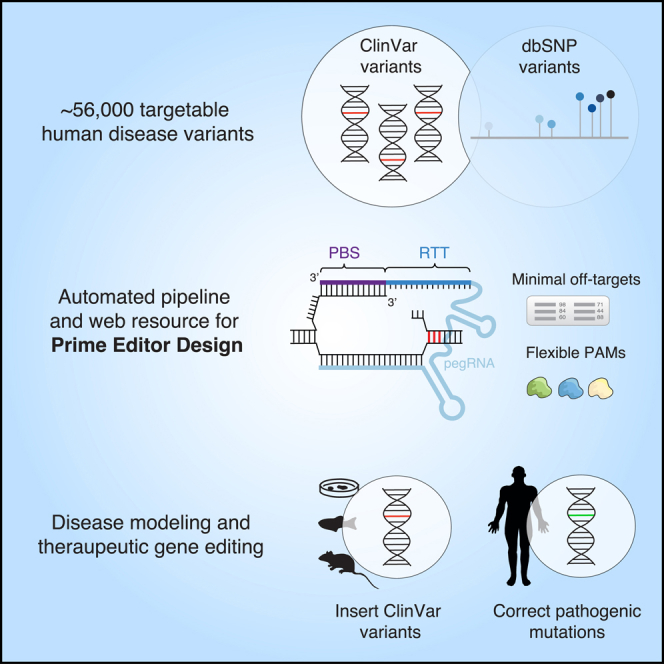
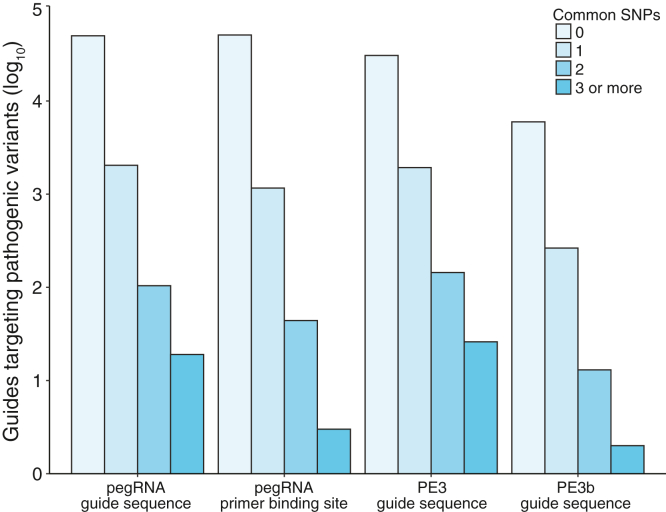
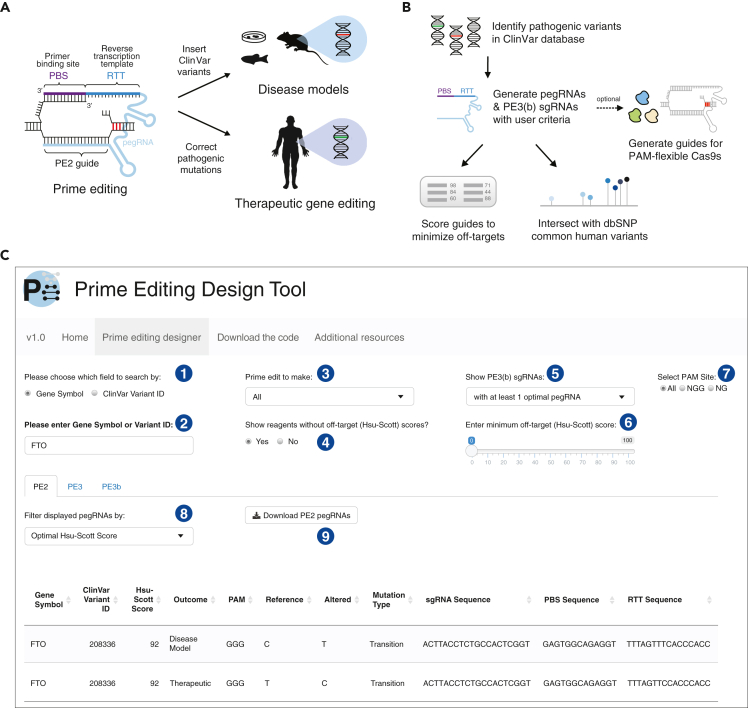
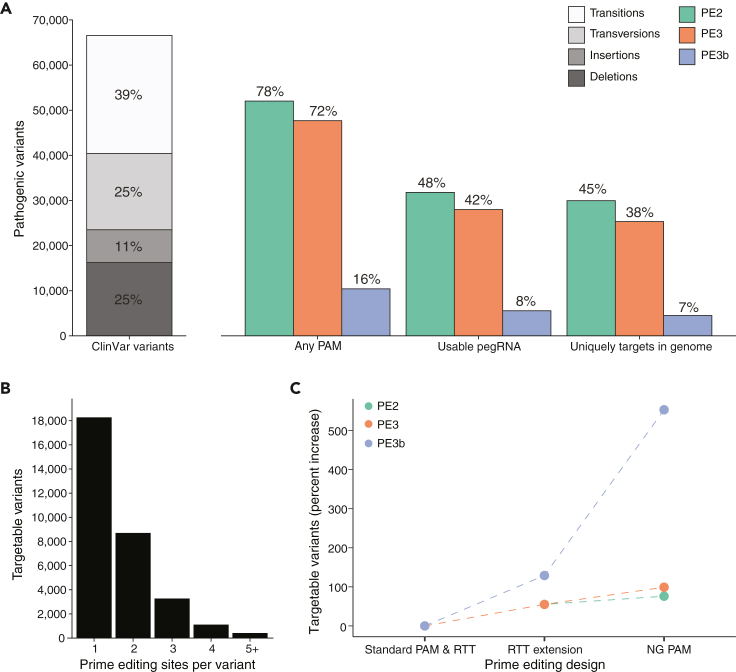
Prime editors (PEs) are clustered regularly interspaced short palindromic repeats (CRISPR)-based genome engineering tools that can introduce precise base-pair edits. We developed an automated pipeline to correct (therapeutic editing) or introduce (disease modeling) human pathogenic variants from ClinVar that optimizes the design of several RNA constructs required for prime editing and avoids predicted off-targets in the human genome. However, using optimal PE design criteria, we find that only a small fraction of these pathogenic variants can be targeted. Through the use of alternative Cas9 enzymes and extended templates, we increase the number of targetable pathogenic variants from 32,000 to 56,000 variants and make these pre-designed PE constructs accessible through a web-based portal (http://primeedit.nygenome.org). Given the tremendous potential for therapeutic gene editing, we also assessed the possibility of developing universal PE constructs, finding that common genetic variants impact only a small minority of designed PEs.
碱基编辑器(PEs)是基于规律成簇间隔短回文重复序列(CRISPR)的基因组工程工具,可引入精确的碱基对编辑。我们开发了一种自动化流程,用于校正(治疗性编辑)或引入(疾病建模)来自ClinVar的人类致病变体,该流程优化了碱基编辑所需的几种RNA构建体的设计,并避免了人类基因组中预测的脱靶效应。然而,使用最佳的PE设计标准时,我们发现这些致病变体中只有一小部分能够成为靶点。通过使用替代的Cas9酶和扩展模板,我们将可靶向的致病变体数量从32000个增加到56000个,并通过基于网络的门户(http://primeedit.nygenome.org)提供这些预先设计的PE构建体。鉴于治疗性基因编辑的巨大潜力,我们还评估了开发通用PE构建体的可能性,发现常见的基因变体仅影响少数已设计的PEs。