Digestive Disease Research Center, Ardabil University of Medical Sciences, Ardabil, Iran.
Research Center for Environmental Determinants of Health, Health Institute, Kermanshah University of Medical Sciences, Kermanshah, Iran.
BMC Endocr Disord. 2022 Jul 15;22(1):178. doi: 10.1186/s12902-022-01096-2.
The aim of the present study was to explore and determine the association between BMI and socio-economic factors in Iran.
Adults aged 35 to 70 (n = 20,460) were included from Ardabil Non-Communicable Disease (ArNCD) cohort study. BMI was calculated as kg/m. Principal Component Analysis (PCA) was used to determine the socio-economic quintiles. Multivariate linear regression was performed to analyze the association of BMI as dependent variable with explanatory variables, Additionally, decomposition analyzing conducted to identify factors that explained wealth-related inequality in obesity.
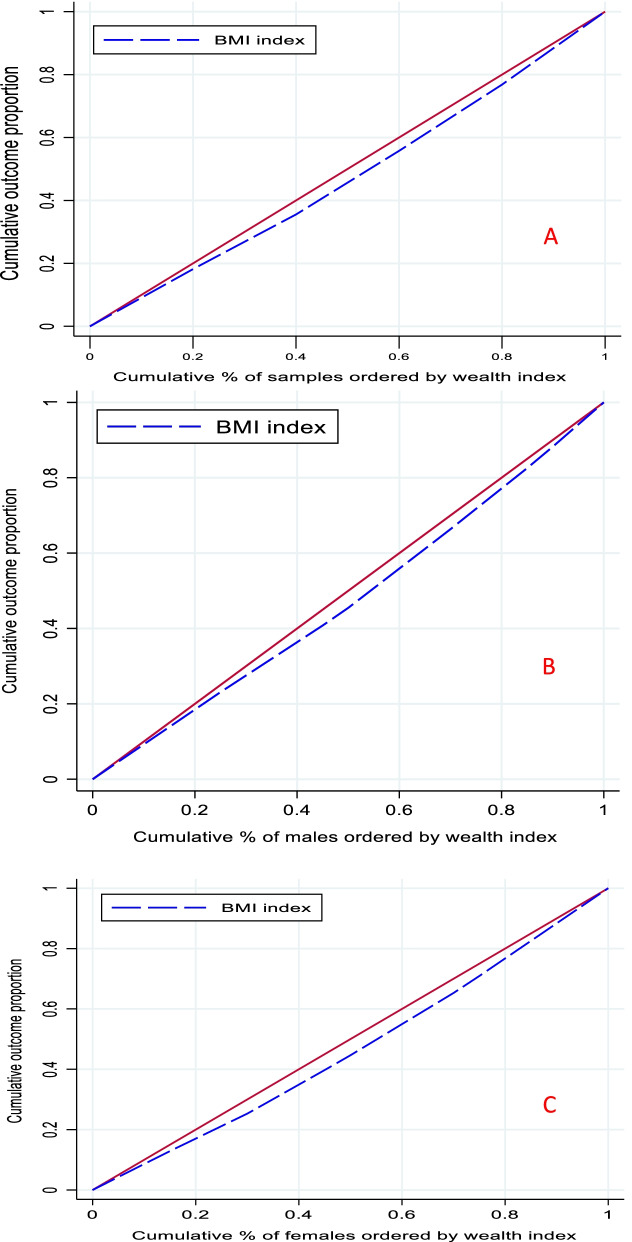
The prevalence of overweight and obese people was 83.7% (41.4% overweight and 42.5% obese) wherein the highest frequency of obese people belonged to the age group of 45 to 49 years old (19.9%) and to the illiterate people (33.1%). The results of multivariate linear regression model showed that age, being female, marriage, lower education level, having chronic disease, alcohol use, and higher socioeconomic level positively associated with obesity. The results of the decomposition model showed that the most important variables affecting socioeconomic inequality in higher BMI level were socioeconomic status (75.8%), being women (5.6%), education level (- 4.1%), and having chronic disease (2.4%).
BMI showed significant association with socio-economic status, where richest people had significantly higher BMI than poorest group. Considering the direct role of high BMI in non-communicable diseases, new policies are needed to be developed and implemented by means of diet intervention and increased physical activity to control the BMI in the population of Iran.
本研究旨在探讨和确定 BMI 与伊朗社会经济因素之间的关联。
纳入了来自阿尔达比勒非传染性疾病(ArNCD)队列研究的 35 至 70 岁成年人(n=20460)。BMI 计算为 kg/m。采用主成分分析(PCA)确定社会经济五分位数。采用多元线性回归分析 BMI 作为因变量与解释变量的关系。此外,进行分解分析以确定导致肥胖与财富相关不平等的因素。
超重和肥胖人群的患病率为 83.7%(41.4%超重和 42.5%肥胖),其中肥胖人群比例最高的年龄组为 45 至 49 岁(19.9%)和文盲人群(33.1%)。多元线性回归模型的结果表明,年龄、女性、婚姻、较低的教育水平、患有慢性病、饮酒以及较高的社会经济水平与肥胖呈正相关。分解模型的结果表明,影响较高 BMI 水平的社会经济不平等的最重要变量是社会经济地位(75.8%)、女性(5.6%)、教育水平(-4.1%)和慢性病(2.4%)。
BMI 与社会经济地位显著相关,最富裕的人群 BMI 明显高于最贫困的人群。考虑到高 BMI 对非传染性疾病的直接作用,需要制定和实施新政策,通过饮食干预和增加身体活动来控制伊朗人口的 BMI。