Anstey Kaarin J, Kootar Scherazad, Huque Md Hamidul, Eramudugolla Ranmalee, Peters Ruth
School of Psychology Matthews Building University of New South Wales Kensington New South Wales Australia.
Neuroscience Research Australia Sydney New South Wales Australia.
Alzheimers Dement (Amst). 2022 Jul 12;14(1):e12336. doi: 10.1002/dad2.12336. eCollection 2022.
We aimed to develop a comprehensive risk assessment tool for Alzheimer's disease (AD), vascular dementia (VaD), and any dementia, that will be applicable in high and low resource settings.
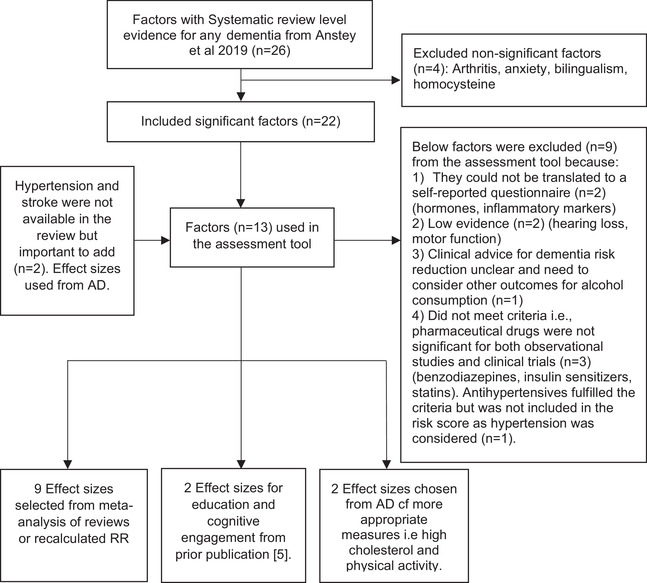
Risk factors which can easily be assessed in most settings, and their effect sizes, were identified from an umbrella review, or estimated using meta-analysis where new data were available.
Seventeen risk/protective factors met criteria for the algorithm to estimate risk for any dementia including age, sex, education, hypertension, midlife obesity, midlife high cholesterol, diabetes, insufficient physical activity, depression, traumatic brain injury, atrial fibrillation, smoking, social engagement, cognitive engagement, fish consumption (diet), stroke, and insomnia. A version for AD excluded atrial fibrillation and insomnia due to insufficient evidence and included pesticide exposure. There was insufficient evidence for a VaD risk score.
Validation of the tool on external datasets is planned. The assessment tool will assist with implementing risk reduction guidelines.
我们旨在开发一种适用于资源丰富和资源匮乏环境的、针对阿尔茨海默病(AD)、血管性痴呆(VaD)及任何类型痴呆的综合风险评估工具。
从一项综合性综述中确定了在大多数环境中易于评估的风险因素及其效应量,或在有新数据时通过荟萃分析进行估计。
17个风险/保护因素符合用于估计任何痴呆风险的算法标准,包括年龄、性别、教育程度、高血压、中年肥胖、中年高胆固醇、糖尿病、体力活动不足、抑郁、创伤性脑损伤、心房颤动、吸烟、社交参与、认知参与、鱼类消费(饮食)、中风和失眠。AD版本因证据不足排除了心房颤动和失眠,并纳入了农药暴露。目前尚无足够证据支持VaD风险评分。
计划在外部数据集上对该工具进行验证。该评估工具将有助于实施降低风险指南。