Kim Sangha, Yang Chaeyeon, Dong Suh-Yeon, Lee Seung-Hwan
Department of Information Technology Engineering, Sookmyung Women's University, Seoul, South Korea.
Clinical Emotion and Cognition Research Laboratory, Inje University, Goyang, South Korea.
Front Psychiatry. 2022 Jun 29;13:876036. doi: 10.3389/fpsyt.2022.876036. eCollection 2022.
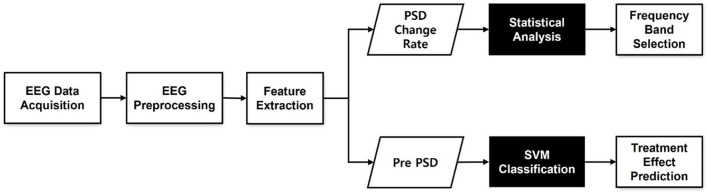
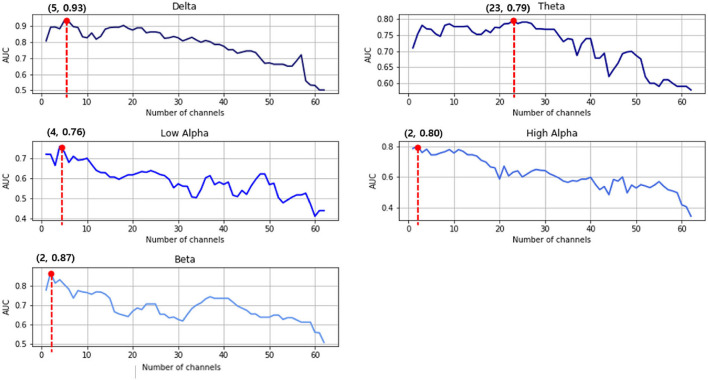
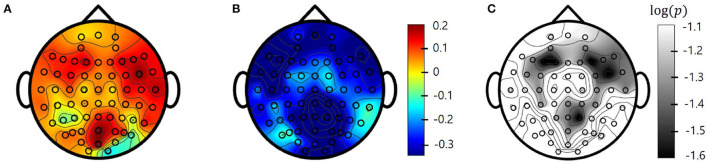
Transcranial direct current stimulation (tDCS) is an emerging therapeutic tool for treating posttraumatic stress disorder (PTSD). Prior studies have shown that tDCS responses are highly individualized, thus necessitating the individualized optimization of treatment configurations. To date, an effective tool for predicting tDCS treatment outcomes in patients with PTSD has not yet been proposed. Therefore, we aimed to build and validate a tool for predicting tDCS treatment outcomes in patients with PTSD. Forty-eight patients with PTSD received 20 min of 2 mA tDCS stimulation in position of the anode over the F3 and cathode over the F4 region. Non-responders were defined as those with less than 50% improvement after reviewing clinical symptoms based on the Clinician-Administered DSM-5 PTSD Scale (before and after stimulation). Resting-state electroencephalograms were recorded for 3 min before and after stimulation. We extracted power spectral densities (PSDs) for five frequency bands. A support vector machine (SVM) model was used to predict responders and non-responders using PSDs obtained before stimulation. We investigated statistical differences in PSDs before and after stimulation and found statistically significant differences in the F8 channel in the theta band ( = 0.01). The SVM model had an area under the ROC curve (AUC) of 0.93 for predicting responders and non-responders using PSDs. To our knowledge, this study provides the first empirical evidence that PSDs can be useful biomarkers for predicting the tDCS treatment response, and that a machine learning model can provide robust prediction performance. Machine learning models based on PSDs can be useful for informing treatment decisions in tDCS treatment for patients with PTSD.
经颅直流电刺激(tDCS)是一种用于治疗创伤后应激障碍(PTSD)的新兴治疗工具。先前的研究表明,tDCS反应具有高度个体化,因此需要对治疗配置进行个体化优化。迄今为止,尚未提出一种有效的工具来预测PTSD患者的tDCS治疗结果。因此,我们旨在构建并验证一种用于预测PTSD患者tDCS治疗结果的工具。48名PTSD患者在F3区域上方阳极和F4区域上方阴极位置接受了20分钟、2毫安的tDCS刺激。无反应者定义为根据临床医生管理的DSM-5创伤后应激障碍量表(刺激前后)评估临床症状后改善不足50%的患者。在刺激前后记录3分钟的静息态脑电图。我们提取了五个频段的功率谱密度(PSD)。使用支持向量机(SVM)模型,利用刺激前获得的PSD来预测反应者和无反应者。我们研究了刺激前后PSD的统计学差异,发现在θ频段的F8通道存在统计学显著差异( = 0.01)。使用PSD预测反应者和无反应者时,SVM模型的ROC曲线下面积(AUC)为0.93。据我们所知,本研究提供了首个实证证据,表明PSD可作为预测tDCS治疗反应的有用生物标志物,且机器学习模型可提供强大的预测性能。基于PSD的机器学习模型可有助于为PTSD患者的tDCS治疗提供治疗决策依据。