Department of Microbiology, Faculty of Veterinary Medicine, Zagazig University, Zagazig, Egypt.
Department of Microbiology, Veterinary Hospital, Faculty of Veterinary Medicine, University of Sadat City, Sadat City, Egypt.
Front Cell Infect Microbiol. 2022 Jul 1;12:807218. doi: 10.3389/fcimb.2022.807218. eCollection 2022.
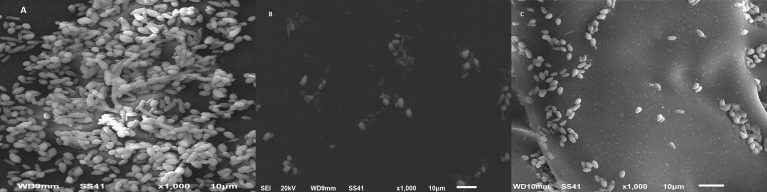
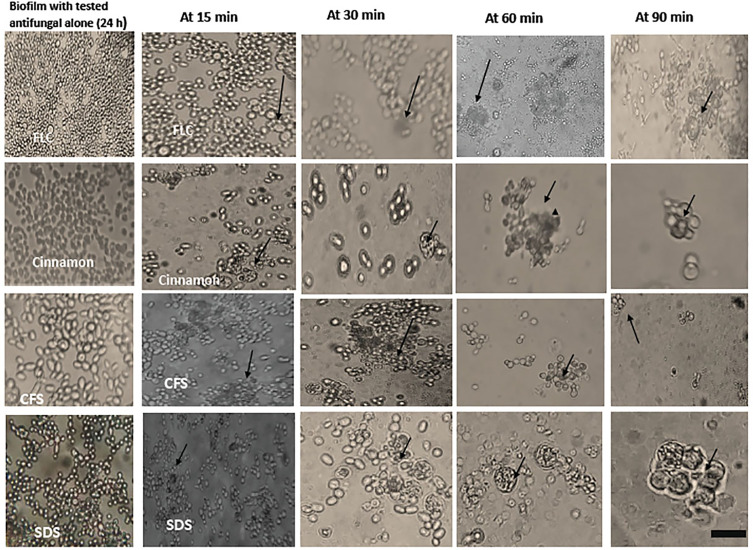
Little is known about the interactions among phagocytes and antifungal agents and the antifungal immunomodulatory activities on species biofilms. Here, inhibition of biofilms and the interactions among biofilms and phagocytes alone or in combination with essential oils, biological, and chemical agents, or fluconazole were investigated. Biofilm formation by a panel of 28 C clinical isolates from hospitalized patients, birds, and cattle was tested. The anti-biofilm activities of cinnamon and clove oils, sodium dodecyl sulfate (SDS), cetyltrimethylammonium bromide (CTAB), and cell-free supernatant (CFS) in comparison with fluconazole were investigated using crystal violet and XTT reduction assays, expression of hypha-specific and hyphal regulator genes, and scanning electron microscopy (SEM) analysis. Of the tested isolates, 15 of 28 (53.6%) were biofilm producers. Cinnamon followed by . -CFS, SDS, and CTAB was the most effective inhibitors of planktonic and biofilms. Fluconazole was an ineffective inhibitor of biofilms. Sessile minimal inhibitory concentration (SMIC) of cinnamon, SDS, CTAB, and CFS downregulated the hypha-specific and regulator genes, albeit to various extents, when compared with untreated biofilms ( < 0.001). SEM analysis revealed disruption and deformity of three-dimensional structures in cinnamon oil-treated biofilms. sessile cells within biofilm were less susceptible to phagocytosis than planktonic cells. The additive effects of phagocytes and the tested antifungals enabled phagocytes to engulf cells rapidly in cinnamon, -CFS, or SDS-treated biofilms. No differences in anti- or anti-biofilm eradication activities were detected among the tested isolates. Our findings reinforce the substantial anti-biofilm activity of cinnamon oil, SDS, and CFS and provide new avenues for the development of novel anti-biofilm immunotherapies or antifungals that could be used prior to or during the management of cases with biofilm-associated infections.
关于吞噬细胞与抗真菌剂之间的相互作用以及抗真菌免疫调节活性对物种生物膜的影响知之甚少。在这里,研究了生物膜的抑制作用以及生物膜与吞噬细胞之间的相互作用,这些作用单独或与精油、生物和化学制剂或氟康唑联合使用。测试了来自住院患者、鸟类和牛的 28 株临床分离株的生物膜形成。使用结晶紫和 XTT 还原测定法、菌丝特异性和菌丝调节剂基因的表达以及扫描电子显微镜 (SEM) 分析,比较了肉桂和丁香精油、十二烷基硫酸钠 (SDS)、十六烷基三甲基溴化铵 (CTAB) 和无细胞上清液 (CFS) 与氟康唑的抗生物膜活性。在测试的 28 株分离株中,28 株中的 15 株(53.6%)是生物膜生产者。肉桂随后是. -CFS、SDS 和 CTAB 是浮游生物和生物膜最有效的抑制剂。氟康唑对 生物膜的抑制作用无效。与未处理的生物膜相比( < 0.001),肉桂、SDS、CTAB 和 CFS 的静止最低抑菌浓度 (SMIC) 下调了菌丝特异性和调节剂基因,尽管程度不同。SEM 分析显示,肉桂油处理的生物膜中三维结构的破坏和变形。生物膜内的静止细胞比浮游细胞更不易被吞噬。吞噬细胞和测试的抗真菌剂的协同作用使吞噬细胞能够在肉桂、-CFS 或 SDS 处理的生物膜中迅速吞噬 细胞。在测试的分离株中未发现抗或抗生物膜消除活性的差异。我们的研究结果加强了肉桂油、SDS 和 CFS 的显著抗生物膜活性,并为开发新的抗生物膜免疫疗法或抗真菌剂提供了新途径,这些方法可用于生物膜相关感染的管理之前或期间。