Department of Engineering, University of Cambridge, Cambridge, UK.
The Nanoscience Centre, University of Cambridge, Cambridge, UK.
Sci Rep. 2022 Jul 19;12(1):12294. doi: 10.1038/s41598-022-16008-6.
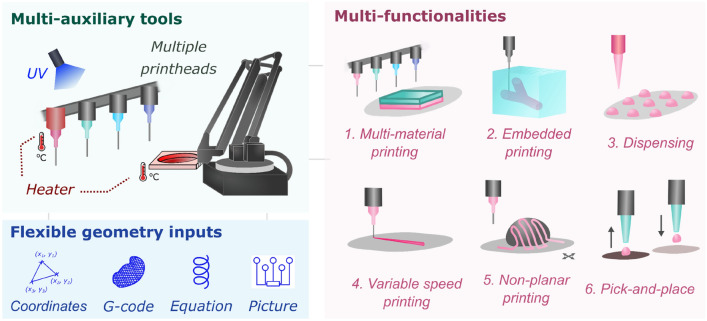
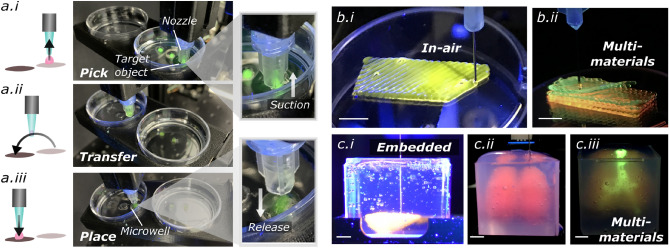
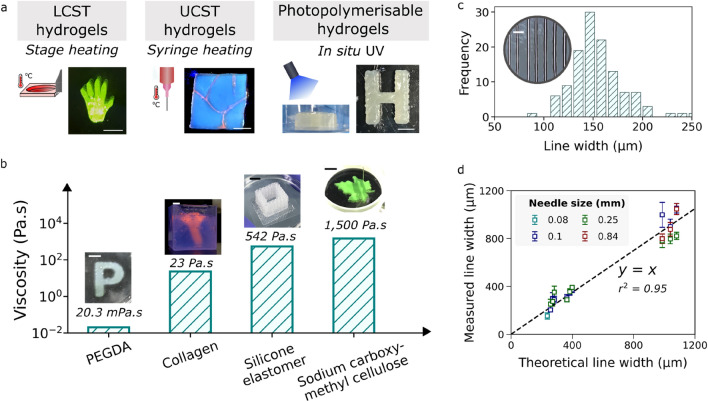
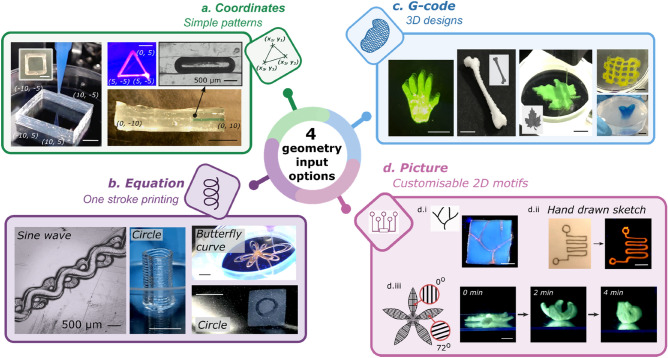
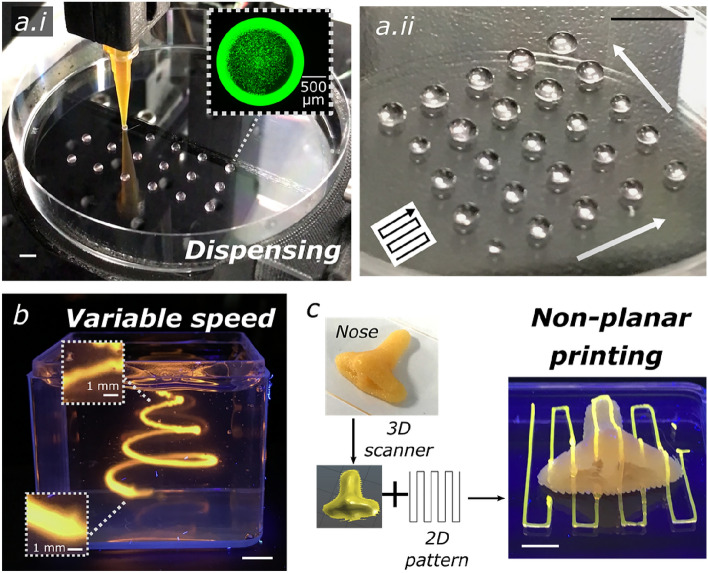
Three-dimensional (3D) printing has emerged as a powerful tool for material, food, and life science research and development, where the technology's democratization necessitates the advancement of open-source platforms. Herein, we developed a hackable, multi-functional, and modular extrusion 3D printer for soft materials, nicknamed Printer.HM. Multi-printhead modules are established based on a robotic arm for heterogeneous construct creation, where ink printability can be tuned by accessories such as heating and UV modules. Software associated with Printer.HM were designed to accept geometry inputs including computer-aided design models, coordinates, equations, and pictures, to create prints of distinct characteristics. Printer.HM could further perform versatile operations, such as liquid dispensing, non-planar printing, and pick-and-place of meso-objects. By 'mix-and-match' software and hardware settings, Printer.HM demonstrated printing of pH-responsive soft actuators, plant-based functional hydrogels, and organ macro-anatomical models. Integrating affordability and open design, Printer.HM is envisaged to democratize 3D printing for soft, biological, and sustainable material architectures.
三维(3D)打印已成为材料、食品和生命科学研发的有力工具,该技术的民主化需要开源平台的进步。在此,我们开发了一种可破解、多功能和模块化的挤出 3D 打印机,用于软材料,名为 Printer.HM。基于机械臂建立了多打印头模块,用于创建异质结构,通过加热和 UV 模块等附件可以调整墨水的可印刷性。与 Printer.HM 相关的软件被设计为接受几何图形输入,包括计算机辅助设计模型、坐标、方程和图片,以创建具有独特特征的打印件。Printer.HM 还可以执行多种操作,如液体分配、非平面打印和中观物体的拾取和放置。通过“混合搭配”软件和硬件设置,Printer.HM 展示了 pH 响应软执行器、基于植物的功能性水凝胶和器官宏观解剖模型的打印。集成了可负担性和开放式设计,Printer.HM 有望使软、生物和可持续材料结构的 3D 打印民主化。