Department of Biology, Indiana University, Bloomington, Indiana, USA.
mSphere. 2022 Aug 31;7(4):e0029722. doi: 10.1128/msphere.00297-22. Epub 2022 Jul 20.
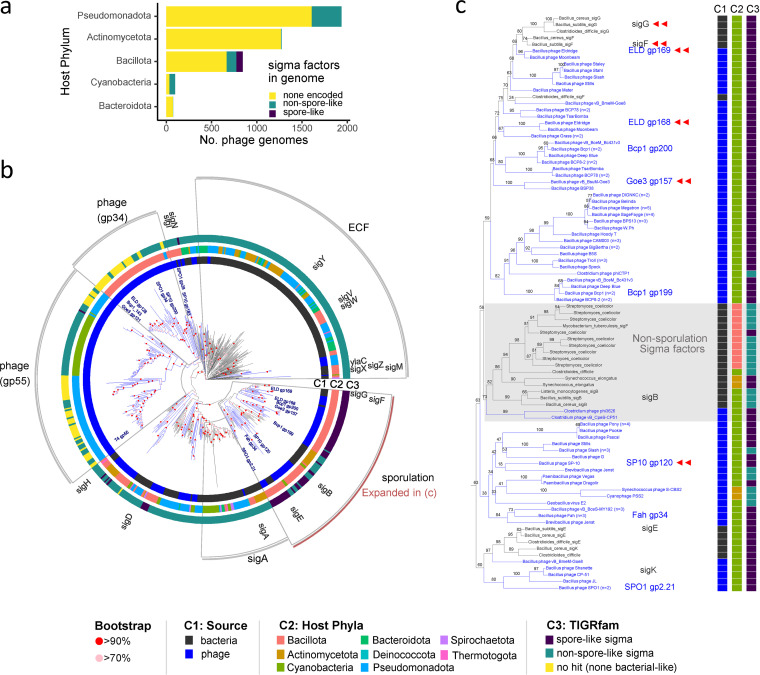
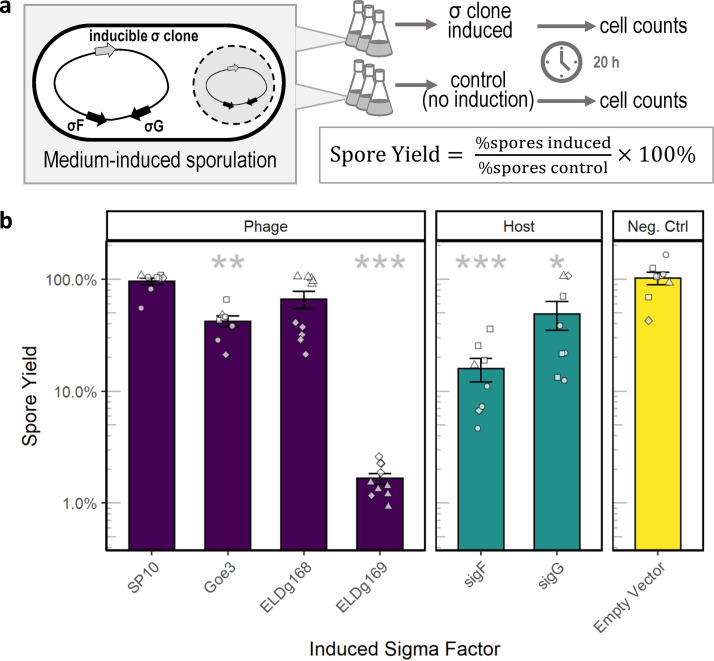
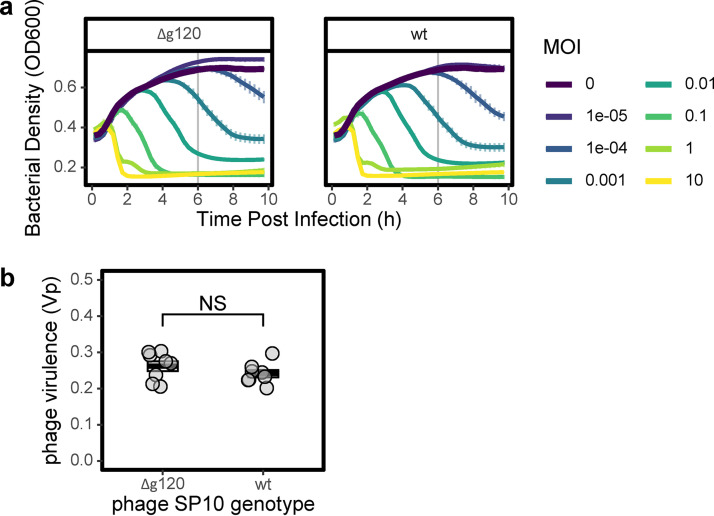
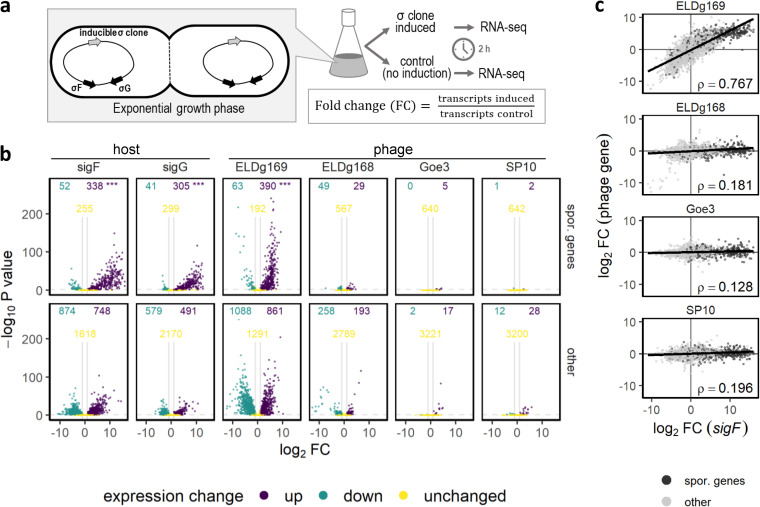
By entering a reversible state of reduced metabolic activity, dormant microorganisms are able to tolerate suboptimal conditions that would otherwise reduce their fitness. Dormancy may also benefit bacteria by serving as a refuge from parasitic infections. Here, we focus on dormancy in the , where endospore development is transcriptionally regulated by the expression of sigma factors. A disruption of this process could influence the survivorship or reproduction of phages that infect spore-forming hosts with implications for coevolutionary dynamics. We characterized the distribution of sigma factors in over 4,000 genomes of diverse phages capable of infecting hosts that span the bacterial domain. From this, we identified homologs of sporulation-specific sigma factors in phages that infect spore-forming hosts. Unlike sigma factors required for phage reproduction, we provide evidence that sporulation-like sigma factors are nonessential for lytic infection. However, when expressed in the spore-forming Bacillus subtilis, some of these phage-derived sigma factors can activate the bacterial sporulation gene network and lead to a reduction in spore yield. Our findings suggest that the acquisition of host-like transcriptional regulators may allow phages to manipulate a complex and ancient trait in one of the most abundant cell types on Earth. As obligate parasites, phages exert strong top-down pressure on host populations with eco-evolutionary implications for community dynamics and ecosystem functioning. The process of phage infection, however, is constrained by bottom-up processes that influence the energetic and nutritional status of susceptible hosts. Many phages have acquired auxiliary genes from bacteria, which can be used to exploit host metabolism with consequences for phage fitness. In this study, we demonstrate that phages infecting spore-forming bacteria carry homologs of sigma factors, which their hosts use to orchestrate gene expression during spore development. By tapping into regulatory gene networks, phages may manipulate the physiology and survival strategies of nongrowing bacteria in ways that influence host-parasite coevolution.
通过进入代谢活性降低的可逆状态,休眠微生物能够耐受否则会降低其适应性的次优条件。休眠也可以使细菌受益,因为它可以作为逃避寄生虫感染的避难所。在这里,我们专注于 中的休眠,其中芽孢发育的转录调控由 sigma 因子的表达来完成。这一过程的中断可能会影响感染形成芽孢的宿主的噬菌体的存活或繁殖,从而影响共进化动力学。我们在能够感染跨越细菌域的宿主的 4000 多种噬菌体的超过 4000 个基因组中表征了 sigma 因子的分布。由此,我们在感染形成芽孢的宿主的噬菌体中鉴定出了芽孢特异性 sigma 因子的同源物。与噬菌体繁殖所需的 sigma 因子不同,我们提供的证据表明,类似芽孢的 sigma 因子对于裂解感染并非必不可少。然而,当在形成芽孢的枯草芽孢杆菌中表达时,这些噬菌体衍生的 sigma 因子中的一些可以激活细菌的芽孢形成基因网络,并导致芽孢产量减少。我们的研究结果表明,宿主样转录调节因子的获得可能使噬菌体能够操纵地球上最丰富的细胞类型之一的复杂而古老的特征。作为专性寄生虫,噬菌体对宿主种群施加强烈的自上而下的压力,对群落动态和生态系统功能具有生态进化意义。然而,噬菌体感染的过程受到影响易感宿主能量和营养状况的自下而上的过程的限制。许多噬菌体已经从细菌中获得了辅助基因,这些基因可用于利用宿主代谢,从而影响噬菌体的适应性。在这项研究中,我们证明了感染形成芽孢的细菌的噬菌体携带 sigma 因子的同源物,它们的宿主在芽孢发育过程中利用这些同源物来协调基因表达。通过利用调节基因网络,噬菌体可能以影响宿主-寄生虫共进化的方式操纵非生长细菌的生理学和生存策略。