Thorarinsdottir Kristjana, Holmes Emily A, Hardarson Johann, Stephenssen Elin S, Jonasdottir Marianna H, Kanstrup Marie, Singh Laura, Hauksdottir Arna, Halldorsdottir Thorhildur, Gudmundsdottir Berglind, Thordardottir Edda, Valdimarsdottir Unnur, Bjornsson Andri
Department of Psychology, University of Iceland, Reykjavík, Iceland.
Department of Psychology, Uppsala University, Uppsala, Sweden.
JMIR Form Res. 2022 Jul 20;6(7):e37382. doi: 10.2196/37382.
Novel interventions should be developed for people who have undergone psychological trauma. In a previous case study, we found that the number of intrusive memories of trauma could be reduced with a novel intervention. The intervention included a brief memory reminder, a visuospatial task and mental rotation, and targeted trauma memory hotspots one at a time in separate sessions.
This case series (N=3) extended the first case study with 3 new cases to determine whether a similar pattern of beneficial results is observed. We explored whether the brief intervention would result in reduced numbers of intrusive memories and whether it would impact symptoms of posttraumatic stress, depression and anxiety, and general functioning. Acceptability of the intervention was also explored.
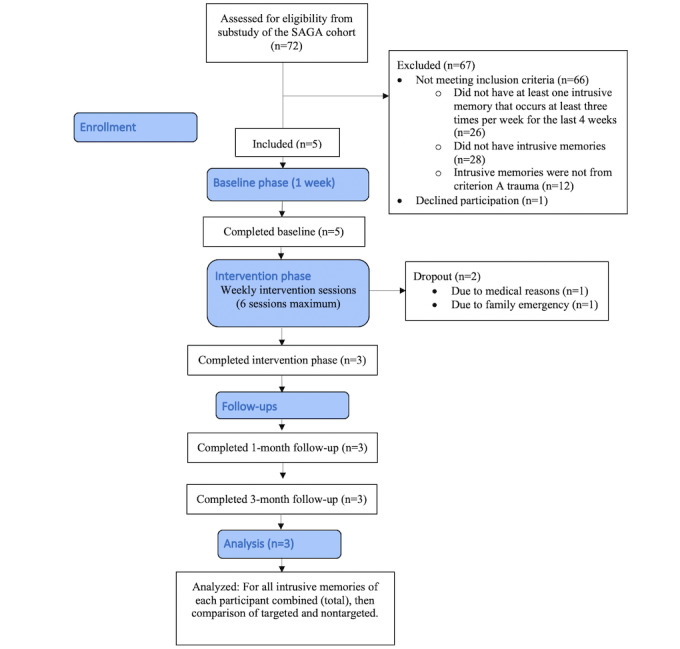
A total of 3 women completed the study: 2 with posttraumatic stress disorder and other comorbidities and 1 with subthreshold posttraumatic stress disorder. The primary outcome was the change in the number of intrusive memories from the baseline phase to the intervention phase and at the 1-month follow-up, with an assessment of the intrusion frequency at 3 months. Participants monitored the number of intrusive memories in a daily diary for 1 week at baseline, for maximum of 6 weeks during the intervention phase and for 1 week at the 1-month and 3-month follow-ups. The intervention was delivered in person or digitally, with guidance from a clinical psychologist. A repeated AB design was used (A was a preintervention baseline phase and B intervention phase). Intrusions were targeted individually, creating repetitions of an AB design.
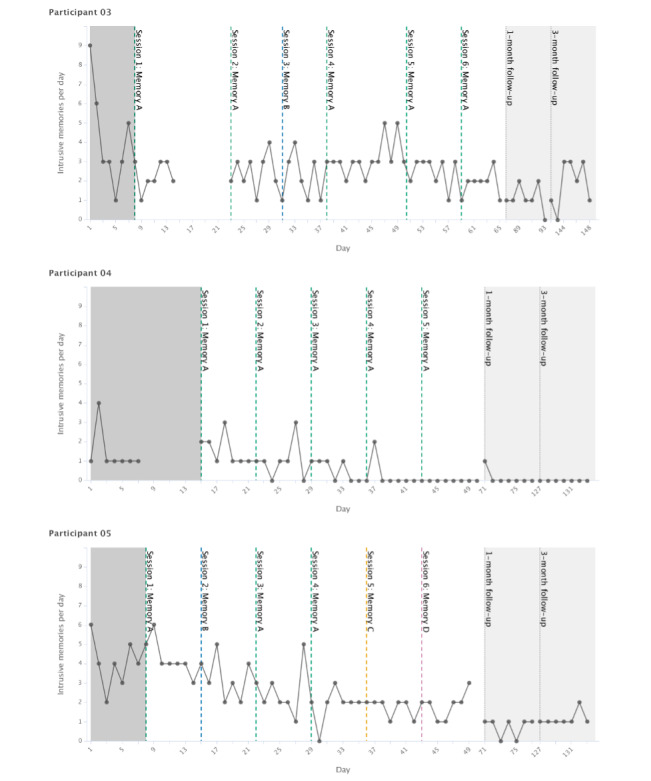
The total number of intrusive memories was reduced from the baseline to the intervention phase for all participants. The total number for participant 3 (P3) reduced from 38.8 per week during the baseline phase to 18.0 per week in the intervention phase. It was 13 at the 3-month follow-up. The total number for P4 reduced from 10.8 per week at baseline to 4.7 per week in the intervention phase. It was 0 at the 3-month follow-up. The total number for P5 was reduced from 33.7 at baseline to 20.7 per week in the intervention phase. It was 8 at the 3-month follow-up. All participants reported reduction in posttraumatic stress symptoms in the postintervention phase. Depression and anxiety symptoms reduced in 2 of the 3 participants in the postintervention phase. Acceptability was favorable.
We observed good compliance with the intervention and intrusive memory diary in all 3 cases. The number of intrusive memories was reduced for all participants during the intervention phase and at the 1-month follow-up, with some improvement in other symptoms and functioning. Further research should explore the remote delivery of the intervention and whether nonspecialists can deliver the intervention effectively.
应为经历过心理创伤的人群开发新的干预措施。在之前的一项案例研究中,我们发现一种新的干预措施可以减少创伤侵入性记忆的数量。该干预措施包括一次简短的记忆提醒、一项视觉空间任务和心理旋转,并在单独的疗程中一次针对一个创伤记忆热点。
本案例系列(N = 3)通过3个新案例扩展了第一个案例研究,以确定是否能观察到类似的有益结果模式。我们探讨了这种简短干预是否会减少侵入性记忆的数量,以及它是否会影响创伤后应激障碍、抑郁和焦虑症状以及总体功能。还探讨了该干预措施的可接受性。
共有3名女性完成了该研究:2名患有创伤后应激障碍及其他合并症,1名患有阈下创伤后应激障碍。主要结局是从基线期到干预期以及1个月随访时侵入性记忆数量的变化,并在3个月时评估侵入频率。参与者在基线期用每日日记记录侵入性记忆的数量,为期1周,在干预期最多记录6周,在1个月和3个月随访时各记录1周。该干预措施由临床心理学家指导,通过面对面或数字方式进行。采用重复AB设计(A为干预前基线期,B为干预期)。针对每个个体的侵入性记忆进行干预,形成AB设计的重复。
所有参与者从基线期到干预期侵入性记忆的总数均有所减少。参与者3(P3)的总数从基线期的每周38.8次减少到干预期的每周18.0次。在3个月随访时为13次。P4的总数从基线期的每周10.8次减少到干预期的每周4.7次。在3个月随访时为0次。P5的总数从基线期的33.7次减少到干预期的每周20.7次。在3个月随访时为8次。所有参与者在干预后阶段均报告创伤后应激症状有所减轻。3名参与者中有2名在干预后阶段抑郁和焦虑症状减轻。可接受性良好。
我们观察到所有3个案例对干预措施和侵入性记忆日记的依从性良好。在干预期和1个月随访时,所有参与者的侵入性记忆数量均有所减少,其他症状和功能也有一定改善。进一步的研究应探索该干预措施的远程实施方式,以及非专业人员是否能有效地实施该干预措施。