Jongen H J, Steeneveld G J, Beringer J, Christen A, Chrysoulakis N, Fortuniak K, Hong J, Hong J W, Jacobs C M J, Järvi L, Meier F, Pawlak W, Roth M, Theeuwes N E, Velasco E, Vogt R, Teuling A J
Hydrology and Quantitative Water Management Wageningen University Wageningen The Netherlands.
Meteorology and Air Quality Wageningen University Wageningen The Netherlands.
Geophys Res Lett. 2022 Feb 16;49(3):e2021GL096069. doi: 10.1029/2021GL096069. Epub 2022 Feb 8.
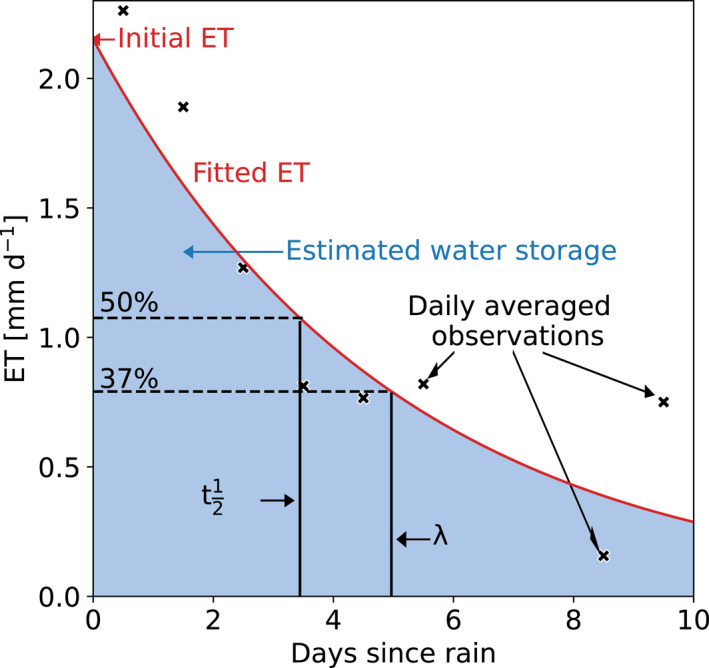
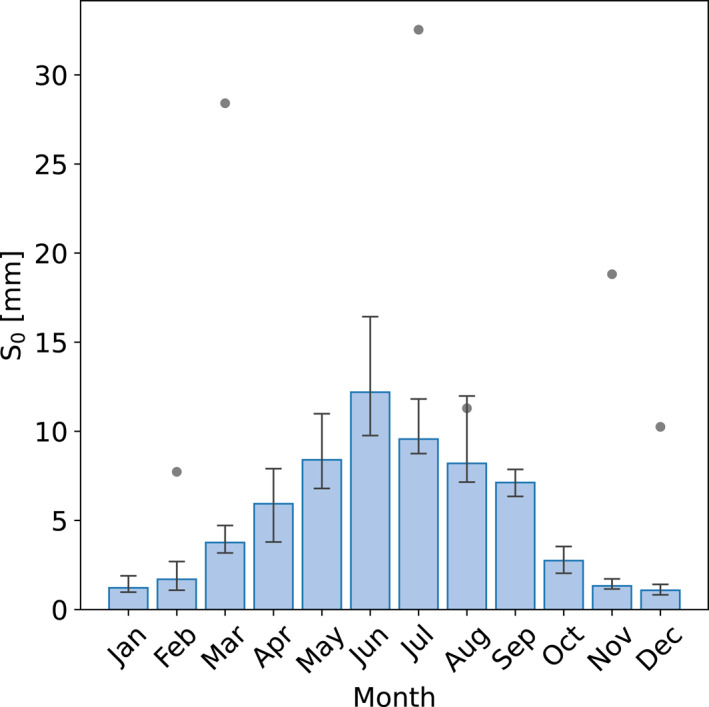
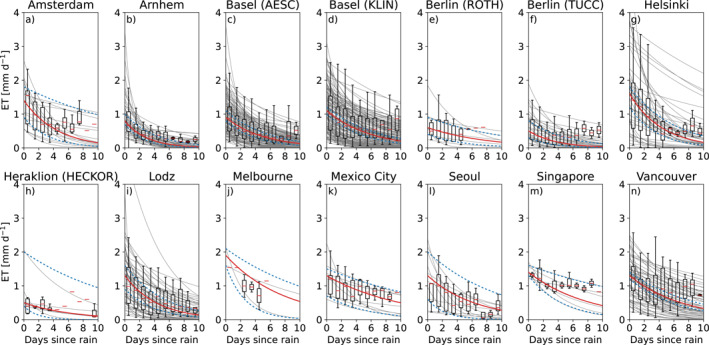
Water storage plays an important role in mitigating heat and flooding in urban areas. Assessment of the water storage capacity of cities remains challenging due to the inherent heterogeneity of the urban surface. Traditionally, effective storage has been estimated from runoff. Here, we present a novel approach to estimate effective water storage capacity from recession rates of observed evaporation during precipitation-free periods. We test this approach for cities at neighborhood scale with eddy-covariance based latent heat flux observations from 14 contrasting sites with different local climate zones, vegetation cover and characteristics, and climates. Based on analysis of 583 drydowns, we find storage capacities to vary between 1.3 and 28.4 mm, corresponding to -folding timescales of 1.8-20.1 days. This makes the urban storage capacity at least five times smaller than all the observed values for natural ecosystems, reflecting an evaporation regime characterized by extreme water limitation.
储水在缓解城市地区的高温和洪水方面发挥着重要作用。由于城市表面固有的异质性,评估城市的储水能力仍然具有挑战性。传统上,有效储水量是根据径流量估算的。在此,我们提出一种新方法,根据无降水期间观测到的蒸发衰退率来估算有效储水能力。我们利用来自14个具有不同局部气候区、植被覆盖和特征以及气候的对比站点基于涡度相关的潜热通量观测数据,在邻里尺度上对城市进行了该方法的测试。基于对583次干涸过程的分析,我们发现储水能力在1.3至28.4毫米之间变化,对应的半衰期为1.8至20.1天。这使得城市储水能力至少比自然生态系统的所有观测值小五倍,反映出一种以极端水分限制为特征的蒸发状态。