The Fifth Affiliated Hospital of Kunming Medical University, Diannan Central Hospital of Honghe Prefecture (Gejiu People's Hospital), Gejiu, Yunnan, China.
PLoS One. 2022 Jul 21;17(7):e0270345. doi: 10.1371/journal.pone.0270345. eCollection 2022.
The situation of the COVID-19 outbreak in the border areas of China and Vietnam is complex, and its progress may affect the willingness of urban and rural residents to receive the vaccine.
This study aims to understand the influence of the COVID-19 epidemic situation on the willingness of urban and rural residents in China-Vietnam border areas to get vaccinated and the factors that affect the vaccinations.
A cross-sectional survey was conducted in Hani-Yi Autonomous Prefecture of Honghe, a border area between China and Vietnam, using online and paper questionnaires from April 1 to June 4, 2021. A total of 8849 valid questionnaires were surveyed to compare the differences in the willingness of urban and rural residents to receive the COVID-19 vaccine. Single factor analysis and multivariate logistic regression analysis were used to explore the influence of the epidemic situation on the willingness to be vaccinated.
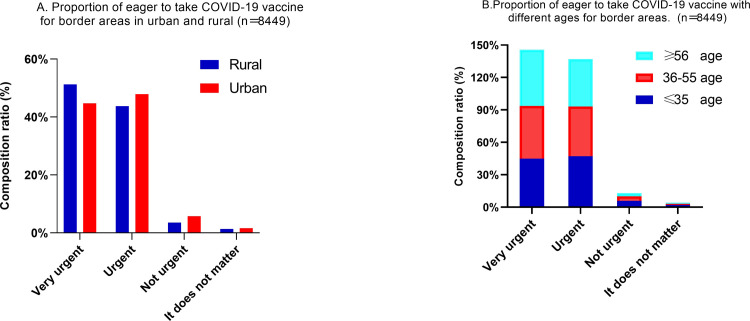
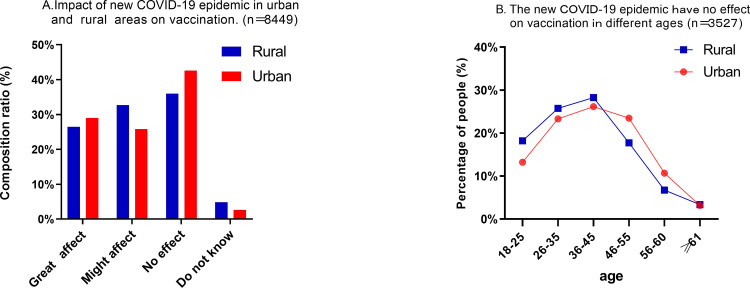
In the border areas between China and Vietnam in Yunnan Province, both urban and rural residents had a high willingness (> 90%) to receive the COVID-19 vaccination, with a higher level of willingness in urban than in rural areas and a higher willingness among residents aged ≥ 56 years. Rural residents mainly concerned about the vaccination were different from urban residents (p< 0.05). About 54.8% of urban respondents and 59.2% of rural respondents indicated that their willingness to get COVID-19 vaccine would be affected by new COVID-19 cases. Respondents who were divorced, had an occupation other than farming, had contraindications to vaccination, were concerned about the safety of vaccines and worried about virus mutation, thought that the epidemic situation would not affect their willingness to get vaccinated (p< 0.05).
The prevention and control of epidemics in border areas is of considerable importance. It is necessary to conduct targeted health education and vaccine knowledge popularization among urban and rural residents to increase the vaccination rate and consolidate the epidemic prevention and control at the border.
中越边境地区的 COVID-19 疫情形势复杂,其发展态势可能会影响城乡居民接种疫苗的意愿。
了解中越边境地区城乡居民对 COVID-19 疫苗接种意愿的影响因素。
2021 年 4 月 1 日至 6 月 4 日,采用线上线下结合的问卷调查方式,对中越边境云南省红河哈尼族彝族自治州进行横断面调查,共调查有效问卷 8849 份,比较城乡居民接种意愿的差异。采用单因素分析和多因素 logistic 回归分析探讨疫情对疫苗接种意愿的影响。
云南省中越边境地区城乡居民接种 COVID-19 疫苗意愿均较高(>90%),城市居民意愿高于农村居民,≥56 岁居民意愿较高。农村居民关注的接种问题与城市居民不同(p<0.05)。约 54.8%的城市居民和 59.2%的农村居民表示,他们接种 COVID-19 疫苗的意愿会受到新增确诊病例的影响。离异、非务农、有接种禁忌、担心疫苗安全性、担心病毒变异、认为疫情不会影响接种意愿的受访者(p<0.05)。
边境地区的疫情防控工作至关重要。有必要针对城乡居民开展有针对性的健康教育和疫苗知识普及,提高接种率,巩固边境疫情防控。