Department of Public Health, Faculty of Medicine, Semmelweis University, Üllői út 26, Budapest, H-1085, Hungary.
Vascular Cognitive Impairment and Neurodegeneration Program, Oklahoma Center for Geroscience and Healthy Brain Aging, Department of Biochemistry and Molecular Biology, University of Oklahoma Health Sciences Center, Oklahoma City, OK, USA.
Geroscience. 2022 Oct;44(5):2361-2369. doi: 10.1007/s11357-022-00622-3. Epub 2022 Jul 22.
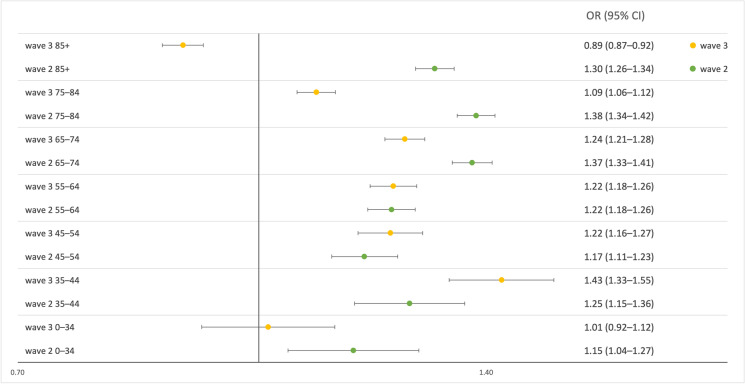
It is well accepted that COVID-19-related mortality shows a strong age dependency. However, temporal changes in the age distribution of excess relative mortality between waves of the pandemic are less frequently investigated. We aimed to assess excess absolute mortality and the age-distribution of all-cause mortality during the second and third waves of the COVID-19 pandemic in Hungary compared to the same periods of non-pandemic years. Rate ratios for excess all-cause mortality with 95% confidence intervals and the number of excess deaths for the second (week 41 of 2020 through week 4 of 2021) and third waves (weeks 7-21 of 2021) of the COVID pandemic for the whole of Hungary compared to the same periods of the pre-pandemic years were estimated for 10-year age strata using Poisson regression. Altogether, 9771 (95% CI: 9554-9988) excess deaths were recorded during the second wave of the pandemic, while it was lower, 8143 (95% CI: 7953-8333) during the third wave. During the second wave, relative mortality peaked for ages 65-74 and 75-84 (RR 1.37, 95%CI 1.33-1.41, RR 1.38, 95%CI 1.34-1.42). Conversely, during the third wave, relative mortality peaked for ages 35-44 (RR 1.43, 95%CI 1.33-1.55), while those ≥65 had substantially lower relative risks compared to the second wave. The reduced relative mortality among the elderly during the third wave is likely a consequence of the rapidly increasing vaccination coverage of the elderly coinciding with the third wave. The hugely increased relative mortality of those 35-44 could point to non-biological causes, such as less stringent adherence to non-pharmaceutical measures in this population.
人们普遍认为,与 COVID-19 相关的死亡率与年龄密切相关。然而,对于大流行期间各波次超额相对死亡率的年龄分布变化,研究较少。本研究旨在评估匈牙利在 COVID-19 大流行的第二和第三波期间的绝对超额死亡率和全因死亡率的年龄分布,并与非大流行年份同期进行比较。使用泊松回归,针对整个匈牙利,为每 10 岁年龄组估计了第二波(2020 年第 41 周至 2021 年第 4 周)和第三波(2021 年第 7-21 周)COVID 大流行期间与同期相比的超额全因死亡率的发生率比(95%置信区间)和超额死亡人数。总共记录了第二波大流行期间 9771 例(95%CI:9554-9988)超额死亡,而第三波期间为 8143 例(95%CI:7953-8333)。在第二波期间,65-74 岁和 75-84 岁的相对死亡率最高(RR 1.37,95%CI 1.33-1.41,RR 1.38,95%CI 1.34-1.42)。相反,在第三波期间,35-44 岁的相对死亡率最高(RR 1.43,95%CI 1.33-1.55),而与第二波相比,65 岁以上人群的相对风险显著降低。在第三波期间,老年人的相对死亡率降低,可能是由于老年人疫苗接种率的快速上升,恰逢第三波。35-44 岁人群的相对死亡率大幅增加可能指向非生物学原因,例如该人群对非药物措施的依从性较低。