Barragan-Jason Gladys, de Mazancourt Claire, Parmesan Camille, Singer Michael C, Loreau Michel
Theoretical and Experimental Ecology Station CNRS Moulis France.
Biological and Marine Sciences University of Plymouth Plymouth UK.
Conserv Lett. 2022 Jan-Feb;15(1):e12852. doi: 10.1111/conl.12852. Epub 2021 Nov 21.
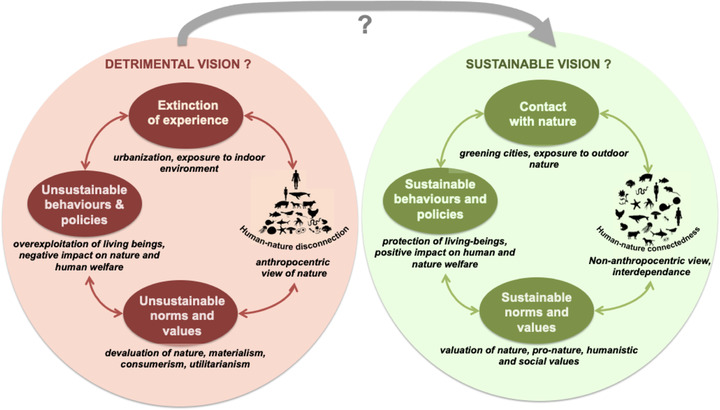
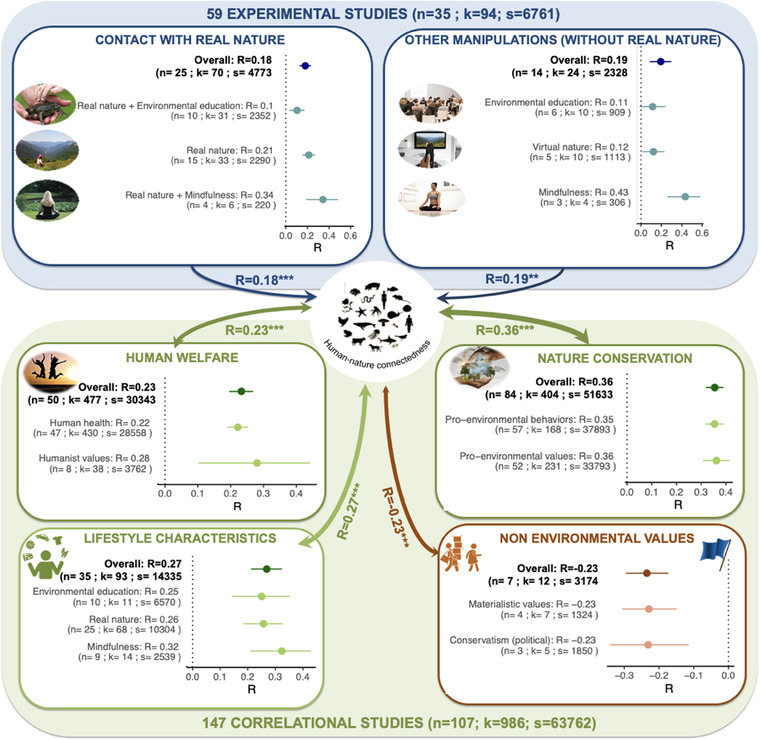
Internationally agreed sustainability goals are being missed. Here, we conduct global meta-analyses to assess how the extent to which humans see themselves as part of nature-known as (HNC)-can be used as a leverage point to reach sustainability. A meta-analysis of 147 correlational studies shows that individuals with high HNC had more pronature behaviours and were significantly healthier than those with low HNC. A meta-analysis of 59 experimental studies shows significant increases in HNC after manipulations involving contact with nature and mindfulness practices. Surprisingly, this same meta-analysis finds no significant effect of environmental education on HNC. Thus, HNC is positively linked to mind-sets that value sustainability and behaviours that enhance it. Further, we argue that HNC can be enhanced by targeted practices, and we identify those most likely to succeed. Our results suggest that enhancing HNC, via promotion of targeted practices, can improve sustainability and should be integrated into conservation policy.
国际商定的可持续发展目标正在落空。在此,我们进行全球荟萃分析,以评估人类将自身视为自然一部分的程度(即“人类与自然的联系”,简称HNC)如何能够作为实现可持续发展的一个杠杆点。对147项相关性研究的荟萃分析表明,HNC高的个体具有更多亲自然行为,且比HNC低的个体明显更健康。对59项实验研究的荟萃分析表明,在涉及与自然接触和正念练习的干预后,HNC有显著增加。令人惊讶的是,同一荟萃分析发现环境教育对HNC没有显著影响。因此,HNC与重视可持续发展的思维模式以及增强可持续发展的行为呈正相关。此外,我们认为可以通过有针对性的做法来增强HNC,并且我们确定了那些最有可能成功的做法。我们的结果表明,通过推广有针对性的做法来增强HNC,可以改善可持续发展,并且应该纳入保护政策。