Department of Psychological and Brain Sciences, Johns Hopkins University, Baltimore, 21218, MD, USA.
Nat Commun. 2022 Jul 22;13(1):4235. doi: 10.1038/s41467-022-31965-2.
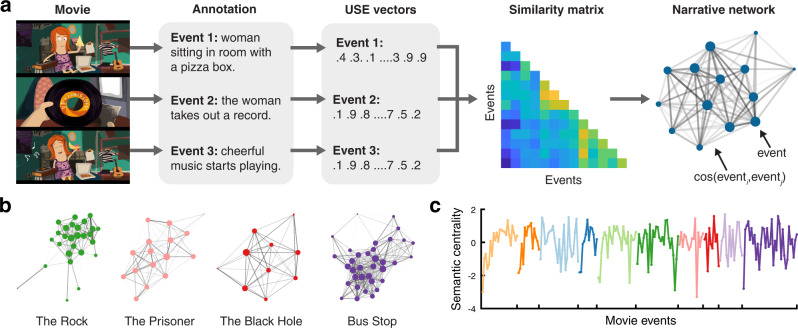
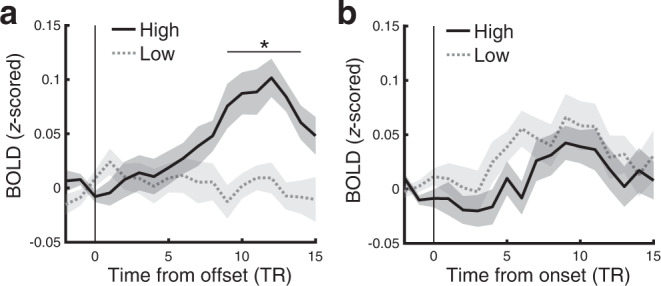
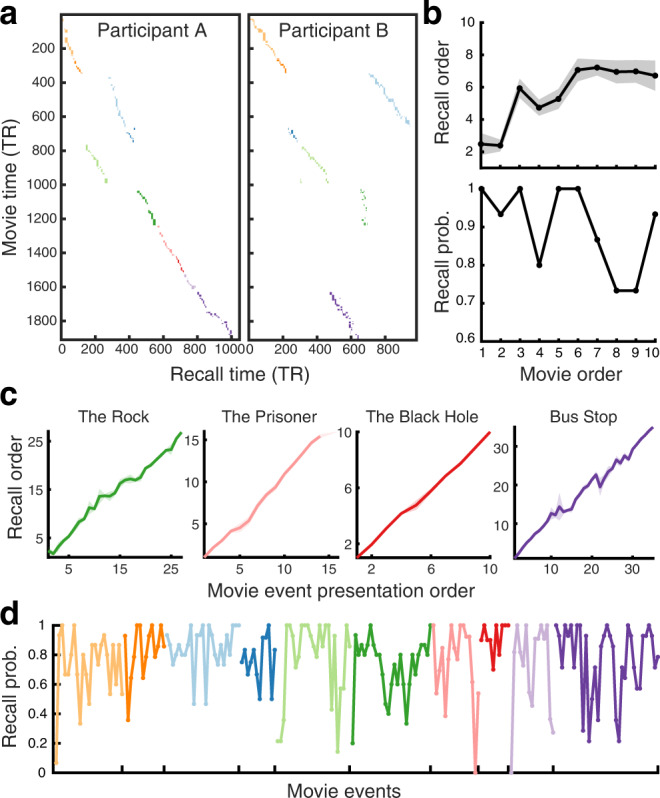
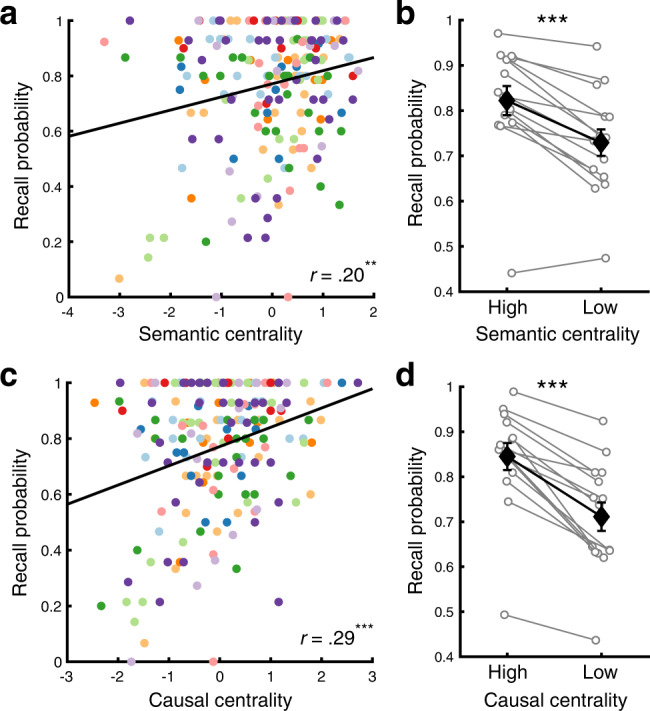
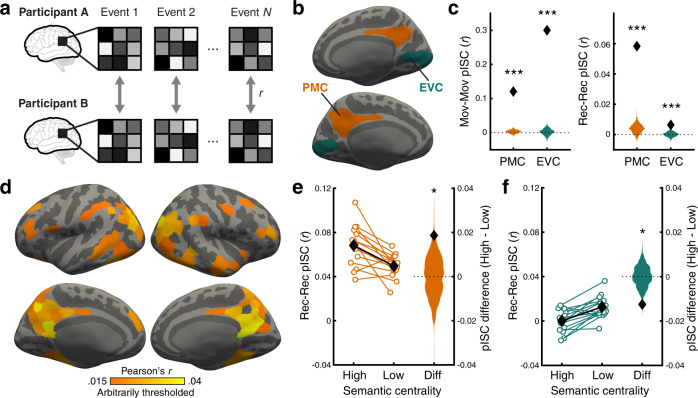
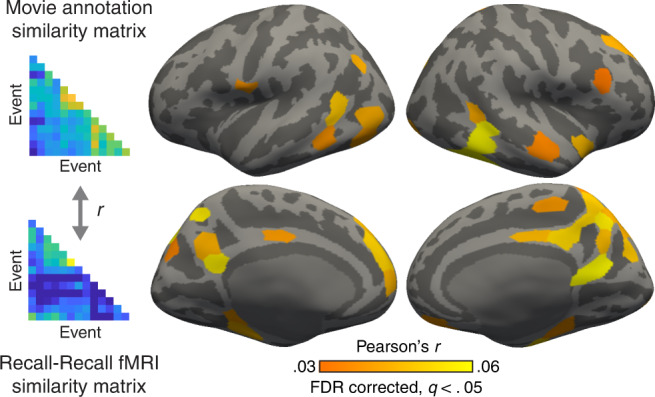
When we remember events, we often do not only recall individual events, but also the connections between them. However, extant research has focused on how humans segment and remember discrete events from continuous input, with far less attention given to how the structure of connections between events impacts memory. Here we conduct a functional magnetic resonance imaging study in which participants watch and recall a series of realistic audiovisual narratives. By transforming narratives into networks of events, we demonstrate that more central events-those with stronger semantic or causal connections to other events-are better remembered. During encoding, central events evoke larger hippocampal event boundary responses associated with memory formation. During recall, high centrality is associated with stronger activation in cortical areas involved in episodic recollection, and more similar neural representations across individuals. Together, these results suggest that when humans encode and retrieve complex real-world experiences, the reliability and accessibility of memory representations is shaped by their location within a network of events.
当我们回忆事件时,我们不仅会回忆起单个事件,还会回忆起它们之间的联系。然而,现有研究主要关注人类如何从连续的输入中分割和记忆离散的事件,而很少关注事件之间连接的结构如何影响记忆。在这里,我们进行了一项功能磁共振成像研究,参与者观看并回忆一系列现实的视听叙事。通过将叙事转化为事件网络,我们证明了更中心的事件——那些与其他事件有更强语义或因果联系的事件——更容易被记住。在编码过程中,中心事件会引起更大的海马体事件边界反应,与记忆形成有关。在回忆过程中,高中心性与参与情节回忆的皮质区域的更强激活以及个体之间更相似的神经表示相关。总之,这些结果表明,当人类对复杂的真实世界体验进行编码和检索时,记忆表示的可靠性和可访问性是由它们在事件网络中的位置决定的。