Patrick Christopher J, Anderson Kurt E, Brown Brown L, Hawkins Charles P, Metcalfe Anya, Saffarinia Parsa, Siqueira Tadeu, Swan Christopher M, Tonkin Jonathan D, Yuan Lester L
Department of Biological Sciences, Virginia Institute of Marine Science, College of William and Mary, 1370 Greate Rd., Gloucester Point, VA 23062.
Department of Evolution, Ecology, and Organismal Biology, 900 University Ave., University of California, Riverside, CA, 92521, USA.
WIREs Water. 2021 Aug 16;8(6):1-21. doi: 10.1002/wat2.1557.
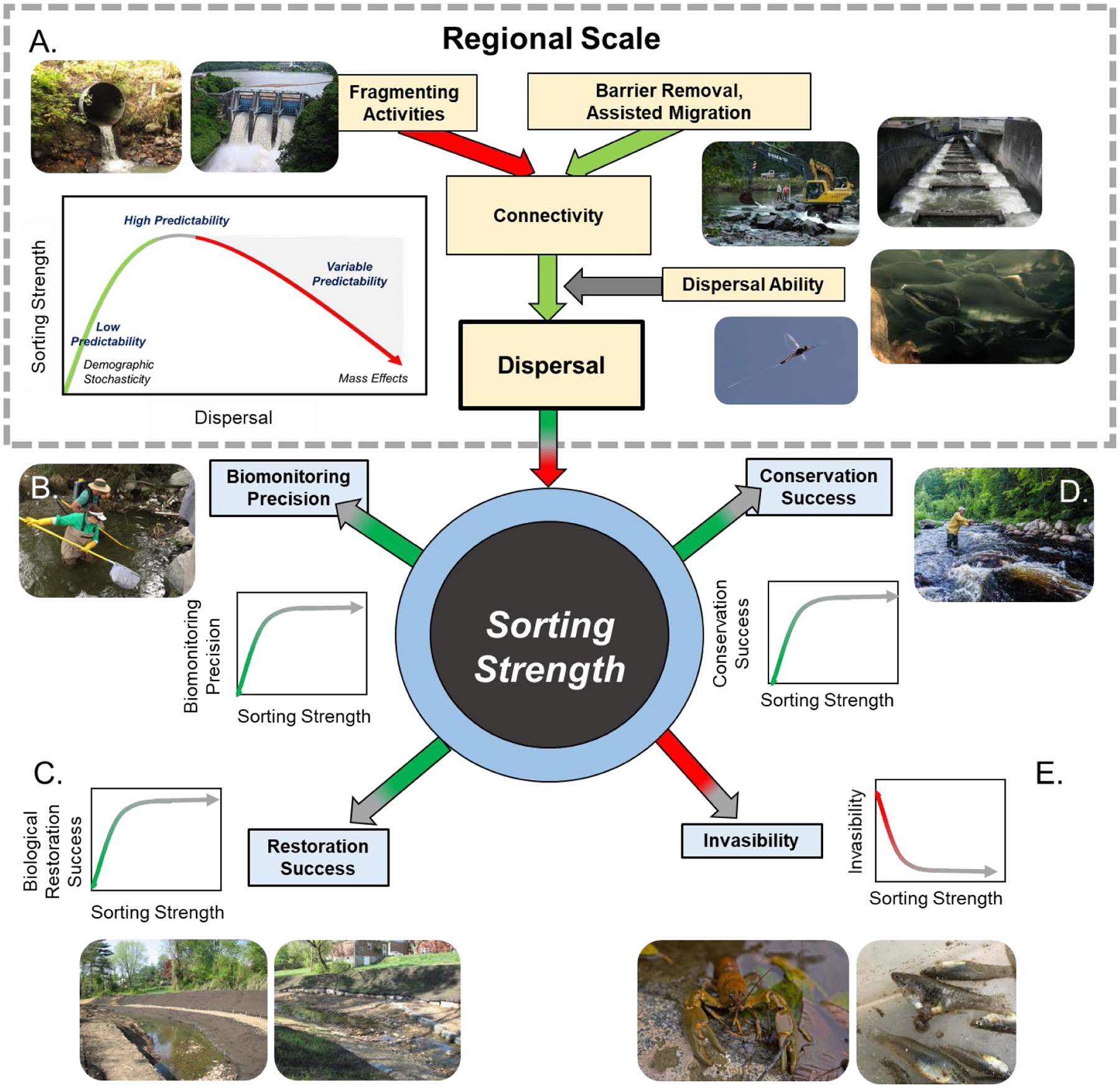
River managers strive to use the best available science to sustain biodiversity and ecosystem function. To achieve this goal requires consideration of processes at different scales. Metacommunity theory describes how multiple species from different communities potentially interact with local-scale environmental drivers to influence population dynamics and community structure. However, this body of knowledge has only rarely been used to inform management practices for river ecosystems. In this paper, we present a conceptual model outlining how the metacommunity processes of local niche sorting and dispersal can influence the outcomes of management interventions and provide a series of specific recommendations for applying these ideas as well as research needs. In all cases, we identify situations where traditional approaches to riverine management could be enhanced by incorporating an understanding of metacommunity dynamics. A common theme is developing guidelines for assessing the metacommunity context of a site or region, evaluating how that context may affect the desired outcome, and incorporating that understanding into the planning process and methods used. To maximize the effectiveness of management activities, scientists and resource managers should update the toolbox of approaches to riverine management to reflect theoretical advances in metacommunity ecology.
河流管理者努力运用现有的最佳科学知识来维持生物多样性和生态系统功能。要实现这一目标,需要考虑不同尺度的过程。集合群落理论描述了来自不同群落的多个物种如何与局部尺度的环境驱动因素相互作用,从而影响种群动态和群落结构。然而,这一知识体系很少被用于为河流生态系统的管理实践提供信息。在本文中,我们提出了一个概念模型,概述了局部生态位分选和扩散的集合群落过程如何影响管理干预的结果,并提供了一系列应用这些理念的具体建议以及研究需求。在所有情况下,我们都确定了通过纳入对集合群落动态的理解可以加强传统河流管理方法的情形。一个共同的主题是制定评估场地或区域集合群落背景的指导方针,评估该背景如何影响预期结果,并将这种理解纳入规划过程和所使用的方法中。为了最大限度地提高管理活动的有效性,科学家和资源管理者应该更新河流管理方法的工具箱,以反映集合群落生态学的理论进展。