Farm Animal Genetic Resources Exploration and Innovation Key Laboratory of Sichuan Province, Sichuan Agricultural University, Chengdu, China.
College of Forestry, Sichuan Agricultural University, Chengdu, China.
Front Immunol. 2022 Jul 7;13:925256. doi: 10.3389/fimmu.2022.925256. eCollection 2022.
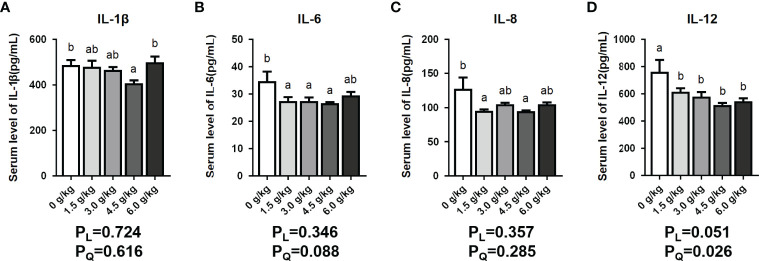
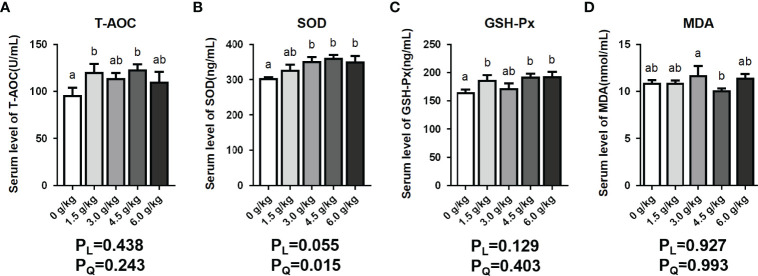
The growing period is a critical period for growth and development in laying hens. During this period, chicks grow rapidly, but are accompanied by unstable digestive function, incomplete organ development, and high mortality. Small peptide, a feed additive, which has been proved to promote intestinal development and immunity in poultry. In order to elucidate the effects of small peptides on growth performance, immunity, antioxidant capacity, and intestinal health of growing laying hens, a total of 900 Tianfu green shell laying hens (1-day-old) were randomly divided into 5 treatments with 6 replicates of 30 birds each in this 18-week trial. Dietary treatments included a corn-soybean meal-based diet supplemented with 0 g/kg, 1.5 g/kg, 3.0 g/kg, 4.5 g/kg and 6.0 g/kg small peptide, respectively. The results showed that the supplementation of small peptides significantly increased growth rate (<0.05) in laying hens, as well as elevated the serum immunoglobulins (<0.05) and antioxidant indices (<0.05), however, it decreased inflammation parameters (<0.05). The supplementation of small peptides enhanced the intestinal function by promoting gut development (<0.05) and improving gut integrity (<0.05), barrier function (<0.05) and the diversity of gut microbiota (<0.05) in the growing hens. The best performance was recorded among the hens fed 4.5 g/kg level of small peptide. Taken together, these results showed that small peptide supplementation could improve the economic value of growing hens by promoting growth rate, disease resistance, and the optimal amount of addition for Tianfu green shell laying hens was 4.5 g/kg.
生长期是蛋鸡生长发育的关键时期。在此期间,雏鸡生长迅速,但伴随不稳定的消化功能、器官发育不完全和高死亡率。小肽作为一种饲料添加剂,已被证明能促进家禽的肠道发育和免疫力。为了阐明小肽对生长期蛋鸡生长性能、免疫力、抗氧化能力和肠道健康的影响,本试验在为期 18 周的试验中,将 900 只天府绿壳蛋鸡(1 日龄)随机分为 5 个处理组,每组 6 个重复,每个重复 30 只鸡。日粮处理包括玉米-豆粕基础日粮,分别补充 0 g/kg、1.5 g/kg、3.0 g/kg、4.5 g/kg 和 6.0 g/kg 的小肽。结果表明,小肽的添加显著提高了蛋鸡的生长速度(<0.05),提高了血清免疫球蛋白(<0.05)和抗氧化指标(<0.05),但降低了炎症参数(<0.05)。小肽的添加通过促进肠道发育(<0.05)和改善肠道完整性(<0.05)、屏障功能(<0.05)和肠道微生物多样性(<0.05)来增强肠道功能。在饲喂 4.5 g/kg 小肽水平的母鸡中,表现出最佳性能。总之,这些结果表明,小肽的添加可以通过提高生长速度、抗病能力来提高生长期蛋鸡的经济价值,天府绿壳蛋鸡的最佳添加量为 4.5 g/kg。