Sanchez-Mirasierra Irene, Ghimire Saurav, Hernandez-Diaz Sergio, Soukup Sandra-Fausia
Universite Bordeaux, CNRS, IMN, UMR 5293, F-33000 Bordeaux, France.
Front Cell Dev Biol. 2022 Jul 6;10:921314. doi: 10.3389/fcell.2022.921314. eCollection 2022.
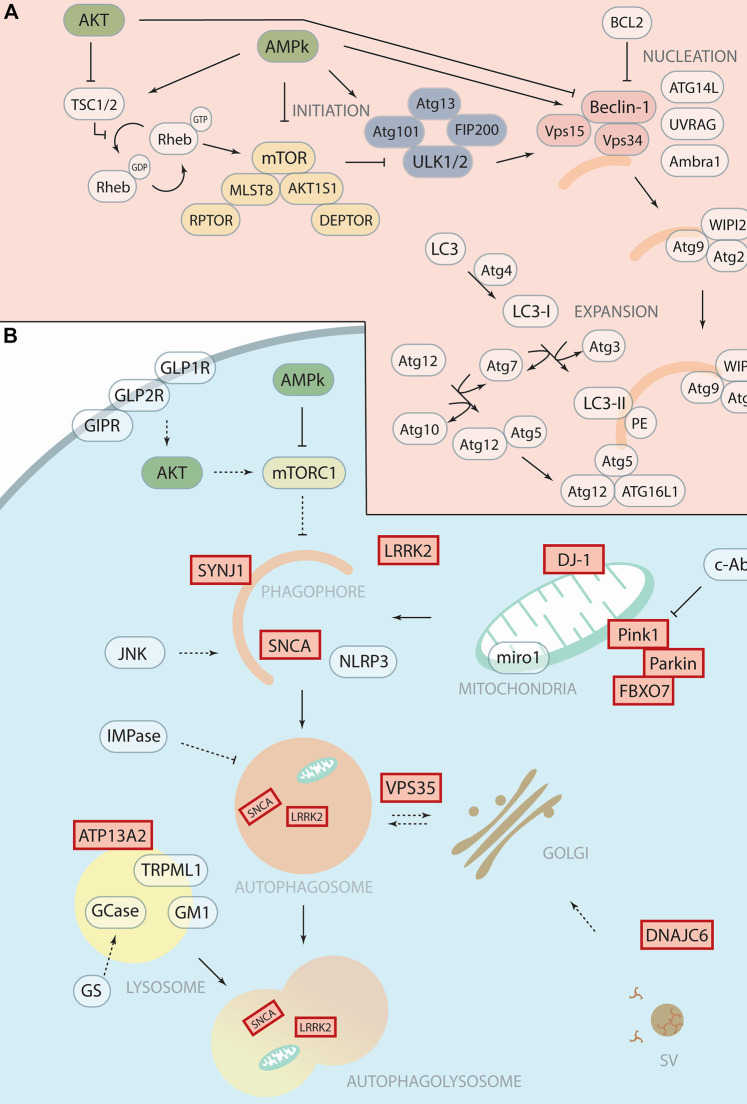
Macroautophagy, an evolutionary conserved catabolic process in the eukaryotic cell, regulates cellular homeostasis and plays a decisive role in self-engulfing proteins, protein aggregates, dysfunctional or damaged organelles, and invading pathogens. Growing evidence from and models shows that autophagy dysfunction plays decisive role in the pathogenesis of various neurodegenerative diseases, including Parkinson's disease (PD). PD is an incurable and second most common neurodegenerative disease characterised by neurological and motor dysfunction accompanied of non-motor symptoms that can also reduce the life quality of patients. Despite the investment in research, the aetiology of the disease is still unknown and the therapies available are aimed mostly at ameliorating motor symptoms. Hence, therapeutics regulating the autophagy pathway might play an important role controlling the disease progression, reducing neuronal loss and even ameliorating non-motor symptoms. In this review, we highlight potential therapeutic opportunities involved in different targeting options like an initiation of autophagy, Leucine-rich repeat kinase 2 (LRRK2) inhibition, mitophagy, lysosomes, lipid metabolism, immune system, gene expression, biomarkers, and also non-pharmacological interventions. Thus, strategies to identify therapeutics targeting the pathways modulating autophagy might hold a future for therapy development against PD.
巨自噬是真核细胞中一种进化保守的分解代谢过程,它调节细胞内稳态,并在自噬蛋白质、蛋白质聚集体、功能失调或受损的细胞器以及入侵病原体方面发挥决定性作用。来自动物和细胞模型的越来越多的证据表明,自噬功能障碍在包括帕金森病(PD)在内的各种神经退行性疾病的发病机制中起决定性作用。PD是一种无法治愈的第二常见神经退行性疾病,其特征是神经和运动功能障碍,并伴有非运动症状,这些症状也会降低患者的生活质量。尽管在研究方面投入巨大,但该疾病的病因仍然未知,现有的治疗方法主要旨在改善运动症状。因此,调节自噬途径的疗法可能在控制疾病进展、减少神经元损失甚至改善非运动症状方面发挥重要作用。在这篇综述中,我们重点介绍了不同靶向选择所涉及的潜在治疗机会,如自噬的启动、富含亮氨酸重复激酶2(LRRK2)的抑制、线粒体自噬、溶酶体、脂质代谢、免疫系统、基因表达、生物标志物,以及非药物干预。因此,识别靶向调节自噬途径的治疗方法的策略可能为PD的治疗发展带来希望。