Nanobio Analytical Chemistry, Biomolecular Chemistry, Department of Biomolecular Engineering, Graduate School of Engineering, Nagoya University, Furo-cho, Chikusa-ku, Nagoya 464-8603, Japan.
Institute of Nano-Life-Systems, Institutes of Innovation for Future Society, Nagoya University, Furo-cho, Chikusa-ku, Nagoya 464-8603, Japan.
ACS Appl Mater Interfaces. 2022 Aug 3;14(30):34365-34376. doi: 10.1021/acsami.2c06503. Epub 2022 Jul 24.
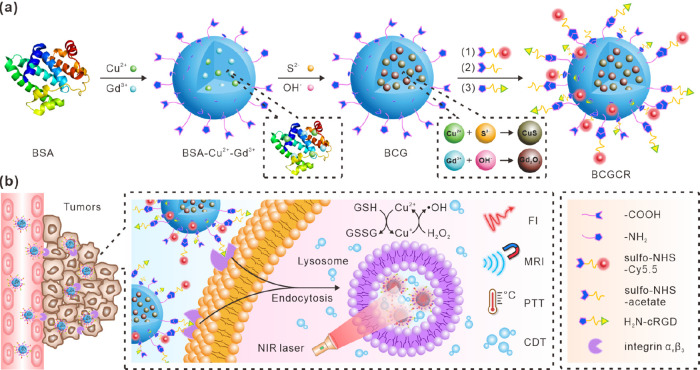
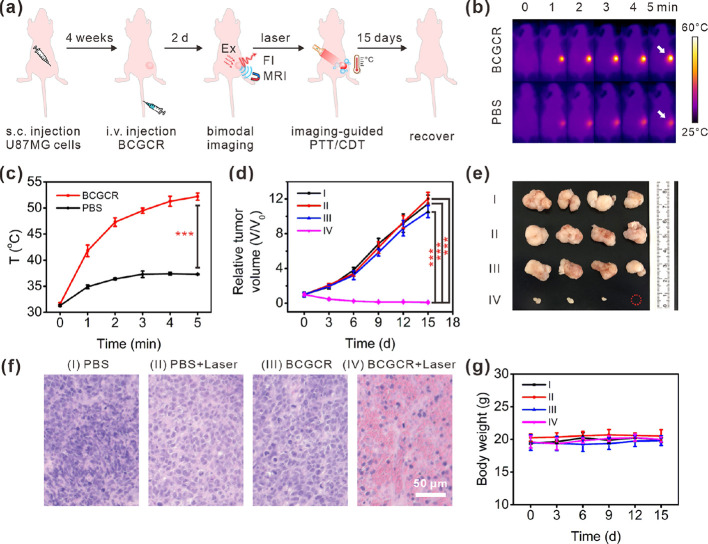
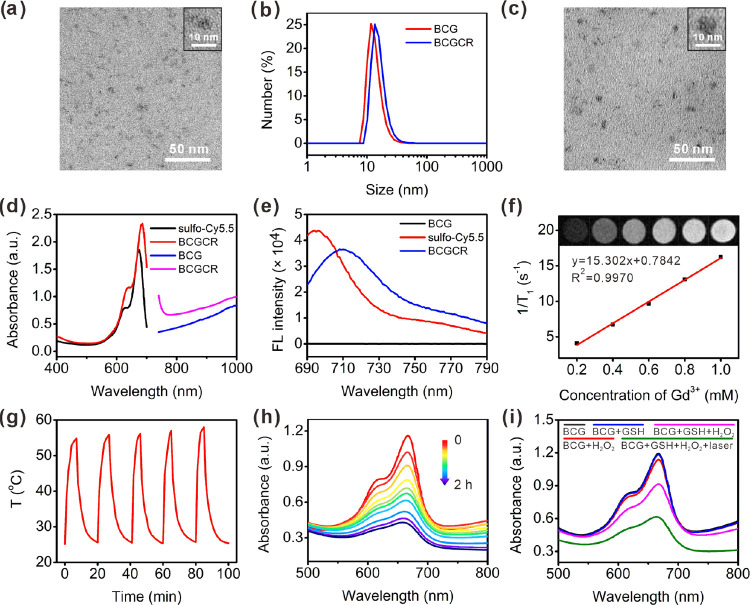
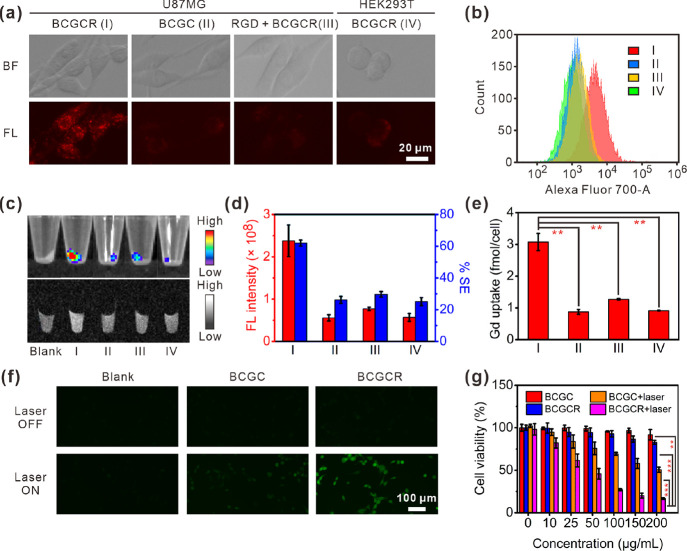
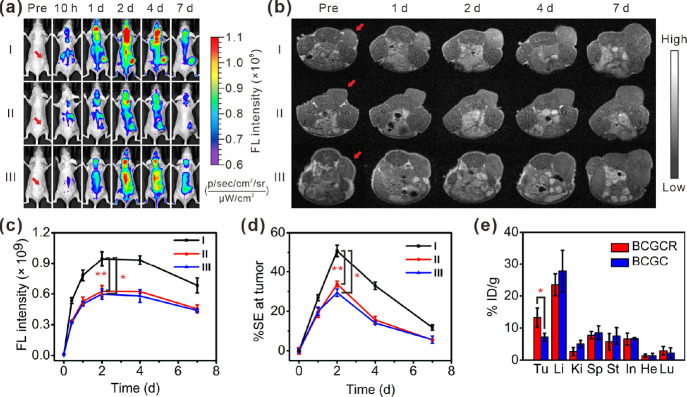
Chemodynamic therapy (CDT), which consumes endogenous hydrogen peroxide (HO) to generate reactive oxygen species (ROS) and causes oxidative damage to tumor cells, shows tremendous promise for advanced cancer treatment. However, the rate of ROS generation based on the Fenton reaction is prone to being restricted by inadequate HO and unattainable acidity in the hypoxic tumor microenvironment. We herein report a multifunctional nanoprobe (BCGCR) integrating bimodal imaging and photothermal-enhanced CDT of the targeted tumor, which is produced by covalent conjugation of bovine serum albumin-stabilized CuS/GdO nanoparticles (NPs) with the Cy5.5 fluorophore and the tumor-targeting ligand RGD. BCGCR exhibits intense near-infrared (NIR) fluorescence and acceptable relaxivity (∼15.3 mM s) for both sensitive fluorescence imaging and high-spatial-resolution magnetic resonance imaging of tumors in living mice. Moreover, owing to the strong NIR absorbance from the internal CuS NPs, BCGCR can generate localized heat and displays a high photothermal conversion efficiency (30.3%) under 980 nm laser irradiation, which enables photothermal therapy and further intensifies ROS generation arising from the Cu-induced Fenton-like reaction for enhanced CDT. This synergetic effect shows such an excellent therapeutic efficacy that it can ablate xenografted tumors . We believe that this strategy will be beneficial to exploring other advanced nanomaterials for the clinical application of multimodal imaging-guided synergetic cancer therapies.
化学动力学疗法(CDT)利用内源性过氧化氢(HO)生成活性氧(ROS),导致肿瘤细胞发生氧化损伤,在癌症的先进治疗中展现出巨大的应用潜力。然而,基于芬顿反应的 ROS 生成率容易受到缺氧肿瘤微环境中 HO 不足和酸度不可达的限制。本文报道了一种多功能纳米探针(BCGCR),它通过将牛血清白蛋白稳定的 CuS/GdO 纳米颗粒(NPs)与 Cy5.5 荧光团和肿瘤靶向配体 RGD 共价偶联而集成了靶向肿瘤的双模态成像和光热增强 CDT。BCGCR 表现出强烈的近红外(NIR)荧光和可接受的弛豫率(∼15.3 mM s),可用于活鼠体内肿瘤的灵敏荧光成像和高空间分辨率磁共振成像。此外,由于内部 CuS NPs 的强 NIR 吸收,BCGCR 在 980nm 激光照射下可产生局部热量,并显示出高的光热转换效率(30.3%),从而实现光热治疗,并进一步增强由 Cu 诱导的类芬顿反应产生的 ROS 生成,以增强 CDT。这种协同效应表现出如此优异的治疗效果,以至于可以消融异种移植瘤。我们相信,这种策略将有助于探索其他先进的纳米材料,用于多模态成像引导的协同癌症治疗的临床应用。